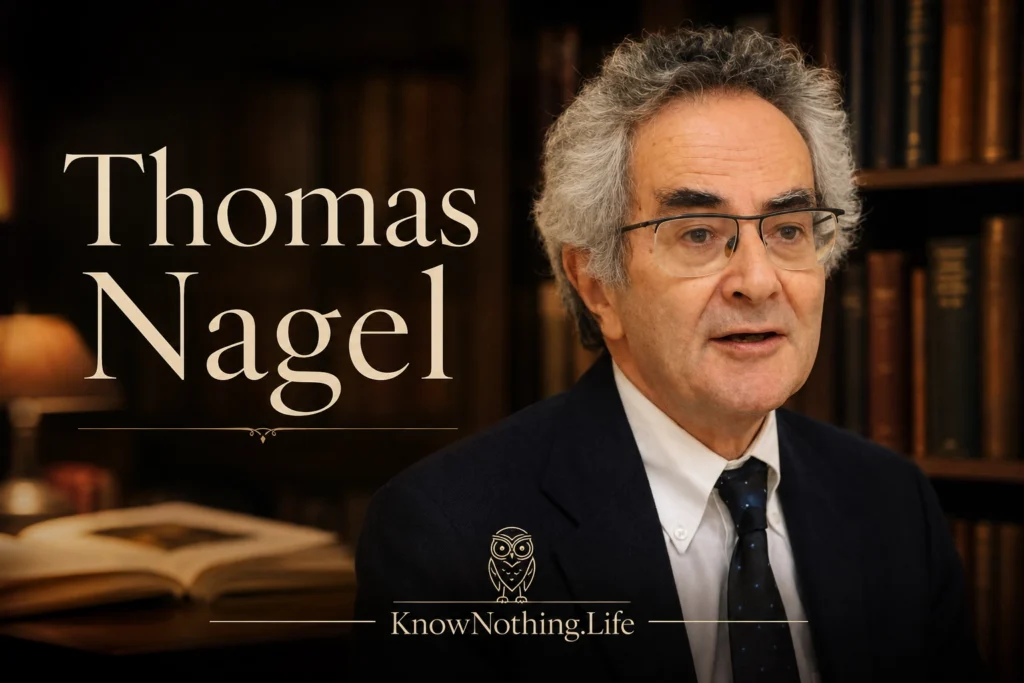
Thomas Nagel was born on July 4, 1937, in Belgrade, Yugoslavia, now Serbia, to a family that soon emigrated to the United States. He became a naturalized American citizen as a child and was raised in and around New York. His life began in the shadow of European crisis, but his intellectual formation unfolded in the postwar American academy, where analytic philosophy, moral theory, political liberalism, and the philosophy of mind were undergoing major transformation.
Nagel studied philosophy at Cornell University, earning his B.A. in 1958, then went to Oxford on a Fulbright Scholarship, where he completed a B.Phil. in 1960. At Oxford, he encountered the powerful influence of ordinary language philosophy and philosophers such as J. L. Austin and Paul Grice. He then completed his Ph.D. at Harvard in 1963, working in an environment shaped by moral and political philosophy, especially the work of John Rawls. From the beginning, Nagel’s thought combined analytic precision with large human questions: consciousness, death, morality, justice, subjectivity, objectivity, and the meaning of life.
Early Career and Philosophical Range
Nagel began his academic career at the University of California, Berkeley, then moved to Princeton University in 1966. In 1980, he joined New York University, where he became one of the central figures in one of the world’s strongest philosophy departments. His career has never been confined to one narrow specialty. He has written influentially on ethics, political philosophy, legal theory, metaphysics, epistemology, philosophy of mind, and the human condition. This range is one reason Nagel became so important: he saw that many philosophical problems arise from the same deep conflict between the personal point of view and the impersonal view of the world.
His first book, The Possibility of Altruism, published in 1970, developed a rational account of morality and practical reason. Nagel argued that moral reasons are not merely expressions of private preference. Human beings can recognize reasons that apply beyond the immediate standpoint of the self. This early concern with the tension between personal desire and impersonal reason continued throughout his career. Whether writing about ethics, consciousness, politics, or death, Nagel returned again and again to the same problem: how can creatures like us, rooted in subjective experience, understand ourselves as part of an objective world?
Mortal Questions and the Human Condition
In 1979, Nagel published Mortal Questions, a collection of essays that became one of the most widely read works in contemporary philosophy. The book includes essays on death, sexual perversion, war, moral luck, absurdity, and consciousness. Nagel’s style in these essays is clear, unsettling, and often quietly devastating. He does not hide philosophical difficulty behind technical language. He begins from ordinary human concerns and shows that they contain puzzles deeper than they first appear.
In the essay “The Absurd,” Nagel defines absurdity as a “conspicuous discrepancy between pretension or aspiration and reality.” His treatment of absurdity differs from darker existentialist accounts because he does not end in despair. Human beings are absurd because they can take their lives seriously while also stepping back and seeing that seriousness from a detached perspective. The result is not necessarily tragedy. For Nagel, irony and humor may be more appropriate than despair. This capacity to move between seriousness and detachment became one of his signature philosophical themes.
What Is It Like to Be a Bat?
Nagel’s most famous essay, “What Is It Like to Be a Bat?,” first published in 1974 and later included in Mortal Questions, changed modern philosophy of mind. The essay argues that consciousness has an essentially subjective character. Nagel’s central claim is that “an organism has conscious mental states if and only if there is something that it is like to be that organism.” This formulation became one of the most important sentences in twentieth-century philosophy because it gave a precise expression to the problem of subjective experience.
The bat example is powerful because bats are mammals, but their sensory life is deeply unlike ours. They navigate largely through echolocation, experiencing the world through reflected high-frequency sound in ways humans cannot directly imagine. Nagel’s point is not that we lack enough scientific data about bats. We can learn their neurophysiology, behavior, and sensory mechanisms in extraordinary detail. The problem is that objective knowledge still may not reveal what the bat’s experience is like from the bat’s own point of view. Consciousness, therefore, resists reduction to purely objective physical description.
The Challenge to Reductionism
Nagel’s argument against reductionism does not deny science. He is not claiming that the brain is irrelevant or that consciousness floats free of nature. His point is more exact: physical science describes the world from an objective standpoint, but conscious experience includes a subjective standpoint that cannot be eliminated without losing the very phenomenon to be explained. If a theory explains behavior, brain processes, and functional organization but leaves out what experience feels like, then it has not fully explained consciousness.
This argument influenced later debates about qualia, physicalism, cognitive science, and the “hard problem” of consciousness. Philosophers such as David Chalmers built on questions Nagel helped sharpen, while critics such as Daniel Dennett resisted the idea that subjectivity creates an explanatory gap. Whether one agrees with Nagel or not, his essay made it difficult to treat consciousness as just another functional process. It forced philosophy to confront the fact that mind is not only something we observe from outside. It is also the medium through which the world appears at all.
The View from Nowhere
In 1986, Nagel published The View from Nowhere, one of his major systematic works. The book explores the conflict between subjective and objective standpoints across philosophy. Human beings can step outside their immediate perspective and try to see the world impersonally, as if from no particular place. This “view from nowhere” is one of the achievements of reason, science, and ethics. It allows us to correct bias, recognize others as real, and understand ourselves as parts of a larger order.
Yet Nagel argues that objectivity can also become misleading when it tries to erase the subjective standpoint entirely. We are not only objects in the world; we are subjects for whom the world appears. The challenge is not to abandon objectivity, but to integrate it with the first-person perspective. This is why Nagel’s philosophy resists simple materialism, simple relativism, and simple skepticism. He wants a wider realism, one that admits that subjective experience, value, reason, and personal life are also parts of reality.
Ethics, Politics, and Justice
Nagel’s work in ethics and political philosophy is as significant as his work on consciousness. In essays on moral luck, war, equality, and public policy, he asks how moral judgment is possible when human beings are embedded in circumstances they do not fully control. The problem of moral luck is especially troubling: people are judged for outcomes shaped by chance, temperament, history, and accident. Nagel does not resolve the tension easily. He shows why it is built into moral life.
His 1991 book Equality and Partiality develops the conflict between the personal and impersonal standpoints in political theory. A credible moral and political order must recognize both the claims of individuals pursuing their own lives and the impersonal demand to treat persons with equal concern. Nagel’s political philosophy is liberal, but not naïve. He knows that justice must work with human partiality, not pretend people have no special attachments. His moral thought is powerful because it neither worships impartiality nor excuses selfishness.
The Last Word and Reason
In The Last Word, published in 1997, Nagel defended reason against subjectivist, relativist, and reductionist attacks. He argued that logic, mathematics, and moral reasoning cannot be fully explained away as local psychological habits, cultural products, or evolutionary conveniences. To argue against reason, one must use reason. This gives rational thought a kind of inescapable authority. We can question many things, but the activity of questioning already commits us to standards of consistency, evidence, and validity.
This defense of reason connects Nagel’s ethics, epistemology, and philosophy of mind. The human mind is not merely a bundle of impulses or adaptive mechanisms. It can make claims that aim beyond its own local standpoint. It can ask what is true, what is right, and what follows from what. Nagel’s realism about reason is one of the most important features of his work. He believes the world contains not only physical facts, but also rational structures that thinking beings can recognize.
Mind and Cosmos and Later Controversy
In 2012, Nagel published Mind and Cosmos, one of his most controversial books. Its subtitle, Why the Materialist Neo-Darwinian Conception of Nature Is Almost Certainly False, announced the provocation clearly. Nagel, an atheist and not a defender of intelligent design, argued that standard materialist accounts of life, consciousness, reason, and value are incomplete. He suggested that mind may not be an accidental late product of matter, but something that requires a broader understanding of nature.
The book received intense criticism from many scientists and philosophers, who argued that Nagel underestimated evolutionary explanation or gave too much ground to teleological speculation. Yet the controversy also revealed the continuity of his career. From “What Is It Like to Be a Bat?” onward, Nagel had argued that subjectivity, reason, and value are not easily absorbed into a purely objective physical picture. Mind and Cosmos extended that challenge into metaphysics and philosophy of science, asking whether reality itself must be understood more broadly than materialism allows.
Legacy and Lasting Importance
Thomas Nagel remains one of the most influential living philosophers in the English-speaking world. His major works include The Possibility of Altruism, Mortal Questions, The View from Nowhere, Equality and Partiality, The Last Word, Other Minds, Secular Philosophy and the Religious Temperament, and Mind and Cosmos. Across these works, he has shown rare range: from bats to death, from justice to absurdity, from reason to cosmic order.
Nagel’s lasting importance lies in his refusal to let philosophy become either shallow scientism or private impressionism. He insists that the subjective point of view is real, but he also insists that objectivity and reason are indispensable. Human beings are strange creatures: biological organisms, conscious subjects, moral agents, political beings, and rational inquirers capable of trying to see beyond themselves. Nagel’s philosophy matters because it keeps all of those facts in view. He teaches that the deepest questions are not solved by choosing between the inside and the outside. They begin when we realize that we are both.