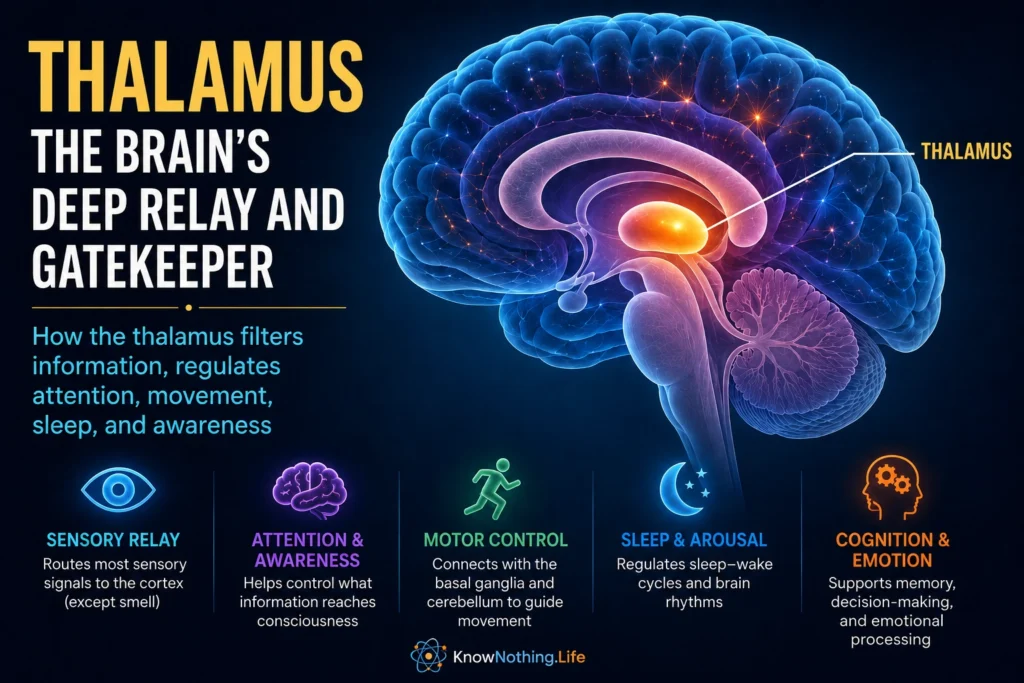
The thalamus is a paired, egg-shaped structure located deep within the brain, near the center of the diencephalon, above the midbrain and beside the third ventricle. It is often described as the brain’s relay station because most sensory information, except smell, passes through thalamic nuclei before reaching the cerebral cortex. But this familiar description is only the beginning. The thalamus also helps regulate motor signals, attention, alertness, sleep, wakefulness, consciousness, emotion, memory, and communication between cortical regions. The thalamus is a mostly gray-matter structure with essential roles in relaying sensory and motor signals and regulating consciousness and alertness.
The thalamus is not one simple unit with one function. It is made of many nuclei, each with different connections and roles. Some nuclei relay visual, auditory, or touch information. Others participate in motor control, memory, emotional processing, language, attention, and executive function. This makes the thalamus one of the brain’s great organizers. It sits between the body, brainstem, basal ganglia, limbic system, cerebellum, and cortex, helping coordinate what information gets through, how it is timed, and how different brain systems work together.
Anatomy and Major Thalamic Nuclei
The thalamus is divided into several nuclear groups, commonly described as anterior, medial, lateral, ventral, intralaminar, midline, and reticular regions. The lateral geniculate nucleus relays visual information from the retina to the visual cortex. The medial geniculate nucleus relays auditory information toward the auditory cortex. The ventral posterior nuclei relay touch, pain, temperature, and body-position information to the somatosensory cortex. The ventral anterior and ventral lateral nuclei are involved in motor circuits connected with the basal ganglia, cerebellum, and motor cortex. The anterior and mediodorsal nuclei participate in memory, emotion, and higher cognition through connections with limbic and prefrontal regions.
The thalamic reticular nucleus is especially important because it forms a thin shell around much of the thalamus and helps regulate thalamic activity. Unlike many thalamic nuclei that project to the cortex, the reticular nucleus is largely inhibitory and helps control the flow of signals through thalamocortical circuits. This makes it important for attention, sensory filtering, and sleep-related rhythms. The thalamus is therefore not just a collection of relays. It is a regulated system of gates, filters, loops, and timing mechanisms that help the cortex receive and coordinate information in useful patterns.
The Thalamus as a Sensory Gateway
The most familiar role of the thalamus is sensory relay. Visual signals pass through the lateral geniculate nucleus before reaching the occipital lobe. Auditory signals pass through the medial geniculate nucleus before reaching the temporal lobe. Somatosensory signals from the body pass through ventral posterior nuclei before reaching the parietal lobe. This organization shows that the cortex does not receive most sensory information directly. The thalamus helps shape the arrival of sensory experience before it becomes conscious perception.
This relay function is not passive. The thalamus does not simply pass messages along like a wire. It helps regulate timing, strength, synchrony, and relevance. For example, the same sound may be ignored while someone is focused, noticed when it becomes important, or wake someone from sleep if it signals danger. Sensory information is therefore not merely delivered to the cortex; it is filtered and modulated. This is one reason the thalamus is so important for attention. It helps determine which signals become prominent enough for the cortex to process deeply.
More Than a Relay Station
For much of neuroscience history, the thalamus was treated mainly as a relay structure. That view has changed. Neuroscientist S. Murray Sherman argued in his influential paper “The Thalamus Is More Than Just a Relay” that thalamic circuits include both first-order relays, which carry information from subcortical sources to cortex, and higher-order relays, which help transmit information from one cortical area to another. In this view, much of the thalamus participates in cortico-thalamo-cortical communication, making it an active contributor to cortical processing rather than a simple sensory switchboard.
This idea changes how we understand the thalamus. If the thalamus helps cortical areas communicate with each other, then it is involved not only in receiving information, but also in coordinating thought, perception, and action. The cortex and thalamus form loops. The cortex sends signals to the thalamus, the thalamus sends signals back to the cortex, and this reciprocal exchange helps regulate what the brain is doing. The thalamus is therefore better understood as a hub of dynamic communication. It helps the brain decide not only what comes in, but how information circulates.
Motor Control and Action Selection
The thalamus is also central to movement. It receives input from the basal ganglia and cerebellum and sends information to motor and premotor areas of the cerebral cortex. These circuits help regulate voluntary movement, posture, coordination, motor planning, and the selection of actions. The ventral anterior and ventral lateral thalamic nuclei are especially important in these motor loops. They help integrate signals from systems that influence whether a movement should begin, how it should be shaped, and how smoothly it should unfold.
This motor role explains why thalamic dysfunction can contribute to movement disorders. When thalamic circuits are disrupted, a person may experience tremor, abnormal posture, involuntary movement, weakness, or impaired coordination depending on the location and cause of damage. The thalamus is also relevant in neurosurgical treatments for certain movement disorders, including deep brain stimulation approaches that target thalamic or thalamus-related circuits. The thalamus helps connect intention with motor execution by linking the cortex, basal ganglia, and cerebellum into functional loops.
Sleep, Wakefulness, and Thalamocortical Rhythms
The thalamus plays a major role in sleep and wakefulness. During sleep, thalamocortical circuits change the way sensory information is handled and help generate rhythmic brain activity. During wakefulness, thalamic relay neurons are more available for transmitting information to the cortex. During certain sleep states, thalamic and cortical networks shift into rhythmic patterns that reduce responsiveness to the outside world. Mircea Steriade’s work on thalamocortical systems showed how rhythms in thalamic and cortical neurons are associated with states of vigilance, slow-wave sleep, wakefulness, and REM sleep.
This role is one reason sleep is not simply the brain “turning off.” Sleep involves organized changes in neural activity. The thalamus helps regulate the boundary between outside sensory input and internal brain rhythms. It contributes to sleep spindles, slow oscillations, and the gating of sensory signals during sleep. This helps explain why people can sleep through many ordinary sounds but wake to personally meaningful or threatening ones. The thalamus participates in controlling how open or closed the brain is to the outside world.
Attention, Cognition, and the Prefrontal Cortex
The thalamus is increasingly recognized as important for cognition. The mediodorsal thalamus has strong reciprocal connections with the prefrontal cortex, a region involved in working memory, decision-making, planning, and cognitive control. A review by Stéphanie Parnaudeau and colleagues describes the mediodorsal thalamus as an essential partner of the prefrontal cortex and emphasizes its role in cognition based on anatomical, behavioral, and electrophysiological research.
This does not mean the thalamus thinks by itself. Instead, it helps regulate cortical networks that support thought. A person solving a problem, shifting attention, holding a goal in mind, or making a decision is relying on communication among multiple brain regions. The thalamus helps coordinate those circuits. In this sense, cognition is not purely cortical. Deep brain systems help determine which cortical patterns are stabilized, amplified, or suppressed. The thalamus acts like a dynamic coordinator, helping thought remain organized in the face of competing signals.
Consciousness and Clinical Importance
The thalamus has long been associated with consciousness because of its role in arousal, sensory access, and thalamocortical integration. Damage to certain thalamic regions can impair alertness, awareness, attention, memory, and perception. Modern research on disorders of consciousness has paid special attention to thalamic and thalamocortical circuits. The mesocircuit hypothesis, for example, proposes that widespread brain injury can disrupt arousal and awareness partly through effects on frontostriatal and central thalamic systems.
Clinically, thalamic injury can produce many different symptoms because the thalamus participates in so many circuits. A stroke in one thalamic region may cause sensory loss or chronic pain. Another may affect memory, language, attention, movement, or alertness. Some patients develop thalamic pain syndrome, in which injury to sensory thalamic pathways produces severe, persistent pain. Others may experience neglect, confusion, sleep disturbance, tremor, or impaired consciousness. The thalamus is small compared with the cortex, but injury to it can have wide effects because it sits at the intersection of so many brain systems.
Why the Thalamus Matters
The thalamus matters because it shows that perception, thought, movement, and consciousness depend on deep coordination. The brain is not just a cortex receiving information from the outside world. It is a looped system in which subcortical structures help regulate what reaches awareness, what gets ignored, what becomes action, and what patterns of activity define sleep or wakefulness. The thalamus helps the brain organize experience before experience becomes fully conscious.
The thalamus also challenges the simple division between “higher” and “lower” brain. It is beneath the cortex, but it is not beneath intelligence in importance. It helps relay sensation, regulate attention, shape movement, support cognition, organize sleep rhythms, and contribute to awareness. To understand the thalamus is to understand one of the brain’s most important deep structures: a gatekeeper, relay, regulator, and coordinator that helps turn scattered neural signals into a usable world.