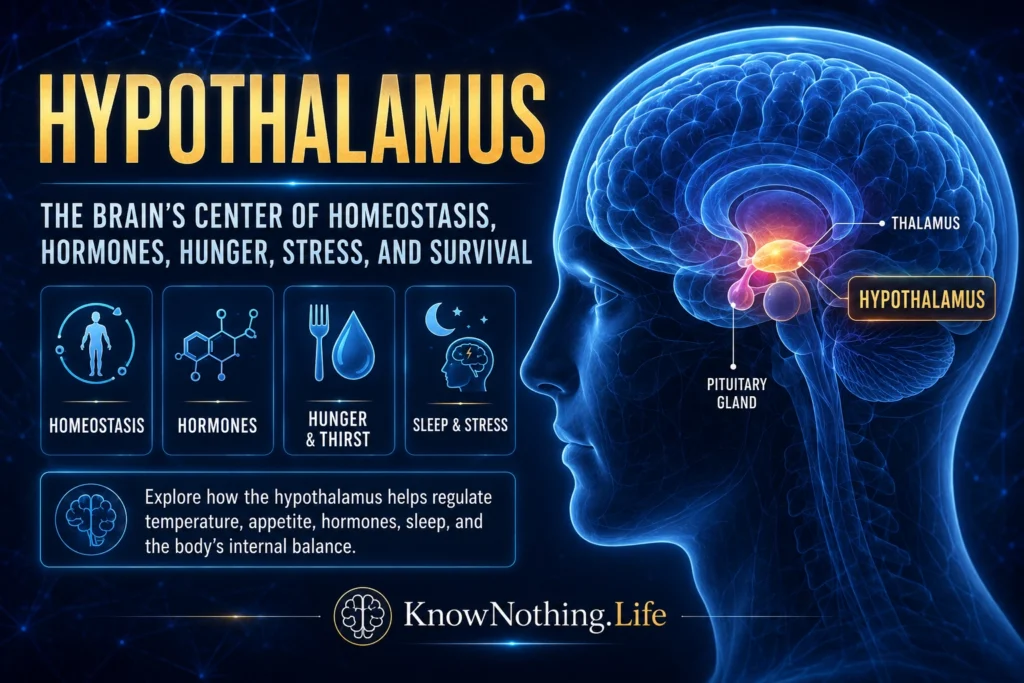
The hypothalamus is a small but essential structure located deep within the brain, below the thalamus and above the pituitary gland. Its name literally means “under the thalamus,” but its importance is far greater than its size suggests. The hypothalamus helps regulate the body’s internal balance, also known as homeostasis. It influences hunger, thirst, body temperature, sleep-wake rhythms, stress responses, sexual behavior, emotional expression, autonomic activity, and hormone release. The hypothalamus is a brain region that coordinates the endocrine system and also participates in temperature regulation, autonomic control, and appetite control.
The hypothalamus is one of the clearest examples of how deeply the brain and body are connected. It does not merely process information in an abstract way. It constantly monitors internal conditions and helps the body respond. When someone becomes too hot, the hypothalamus helps trigger cooling responses. When blood water levels change, it contributes to thirst and fluid balance. When energy stores decline, it helps promote hunger. When stress appears, it activates hormonal and autonomic pathways that prepare the body for action. In this sense, the hypothalamus is not just a brain structure; it is a biological command center for survival regulation.
Anatomy and Major Regions
The hypothalamus is part of the diencephalon and sits around the lower walls and floor of the third ventricle. It contains many nuclei, each with specialized roles. Important hypothalamic regions include the lateral hypothalamus, ventromedial nucleus, arcuate nucleus, paraventricular nucleus, supraoptic nucleus, anterior hypothalamus, posterior hypothalamus, mammillary bodies, and suprachiasmatic nucleus. These regions are involved in appetite, hormone release, autonomic regulation, memory-related circuits, temperature control, circadian rhythms, and reproductive function.
One of the hypothalamus’s most important anatomical relationships is with the pituitary gland. The hypothalamus communicates with the anterior pituitary through releasing and inhibiting hormones carried by the hypophyseal portal system, and it communicates with the posterior pituitary through direct neural projections. Through these pathways, the hypothalamus helps regulate the thyroid gland, adrenal glands, reproductive organs, growth, lactation, water balance, and stress hormones. StatPearls notes that hypothalamic releasing and inhibiting hormones act on the pituitary gland to direct functions involving the thyroid, adrenal glands, reproductive organs, growth, fluid balance, and milk production.
Homeostasis and Internal Balance
Homeostasis is the process by which the body maintains stable internal conditions despite changing external circumstances. The hypothalamus is central to this process because it receives information from the body and brain, compares that information with biological needs, and helps initiate corrective responses. Body temperature is a classic example. If the body becomes too warm, hypothalamic circuits can help produce sweating, blood vessel dilation, and behavioral drives to seek cooler environments. If the body becomes too cold, the hypothalamus can help trigger shivering, blood vessel constriction, and heat-seeking behavior.
This regulatory role shows why the hypothalamus is not simply a “hormone center.” It is an integrative structure that coordinates the endocrine system, autonomic nervous system, and motivated behavior. A person’s body does not maintain balance only through unconscious reflexes. It also creates drives: hunger pushes the person toward food, thirst toward water, fatigue toward sleep, and discomfort toward environmental change. Hypothalamic function therefore links physiology to behavior. It turns internal needs into actions that help the organism survive.
Hunger, Thirst, and Energy Regulation
The hypothalamus plays a major role in appetite and energy balance. The arcuate nucleus is especially important because it receives hormonal and nutrient-related signals from the body, including signals related to leptin, insulin, ghrelin, and glucose. Some hypothalamic neurons promote hunger, while others promote satiety. The lateral hypothalamus has historically been associated with feeding behavior, while the ventromedial hypothalamus has been linked with satiety, although modern neuroscience sees appetite control as a more complex network involving many regions and hormones.
One of the most important discoveries in appetite science was the identification of leptin, a hormone produced by fat cells that helps signal energy stores to the brain. Jeffrey Friedman and colleagues’ work on the obese gene helped transform the study of body-weight regulation by showing that adipose tissue communicates with the brain through molecular signals. A later review by Friedman explains that when fat mass increases, leptin levels rise and suppress appetite until weight is lost, helping maintain homeostatic control of adipose tissue mass. The hypothalamus is a major target of leptin signaling, which shows how body fat, hormones, and brain circuits interact in the regulation of hunger and metabolism.
Hormones and the Pituitary Connection
The hypothalamus controls much of the endocrine system through its relationship with the pituitary gland. This hypothalamic-pituitary connection allows the brain to influence hormone release throughout the body. The hypothalamus produces releasing and inhibiting hormones that regulate anterior pituitary hormones such as thyroid-stimulating hormone, adrenocorticotropic hormone, growth hormone, prolactin, luteinizing hormone, and follicle-stimulating hormone. It also produces oxytocin and vasopressin, which are transported to and released from the posterior pituitary.
This system allows the hypothalamus to connect psychological states, bodily needs, and hormonal responses. Stress, for example, can activate the hypothalamic-pituitary-adrenal axis. The hypothalamus releases corticotropin-releasing hormone, which stimulates the pituitary to release adrenocorticotropic hormone, which then stimulates the adrenal glands to release cortisol. This pathway helps the body mobilize energy and adapt to challenge. The same general principle applies across many domains: the hypothalamus receives information about the body and environment, then helps coordinate endocrine responses that affect metabolism, reproduction, growth, fluid balance, and stress adaptation.
Sleep, Circadian Rhythm, and the Suprachiasmatic Nucleus
The hypothalamus is essential for sleep-wake regulation and circadian timing. The suprachiasmatic nucleus, often abbreviated SCN, is a small hypothalamic region located above the optic chiasm. It is widely described as the brain’s master circadian clock because it helps coordinate daily rhythms in sleep, hormone release, body temperature, feeding, alertness, and physiology. A review by Michael Hastings and colleagues describes the SCN as the principal circadian clock that directs daily cycles of behavior and physiology.
The SCN receives light-related information from the retina, allowing the body’s internal rhythm to synchronize with the external day-night cycle. This is why light exposure can shift sleep timing, and why irregular light-dark schedules can disrupt circadian rhythms. The hypothalamus also contains wake-promoting and sleep-promoting systems, including orexin-producing neurons in the lateral hypothalamus that help stabilize wakefulness. Damage or dysfunction in these systems can contribute to sleep problems, including narcolepsy when orexin signaling is severely impaired. Sleep is therefore not simply a passive state. It is regulated by hypothalamic circuits that coordinate timing, arousal, hormones, and bodily rhythms.
Stress, Emotion, and Survival Behavior
The hypothalamus is deeply involved in stress and survival behavior. When the brain detects danger, the hypothalamus helps coordinate autonomic and hormonal responses that prepare the body to act. It influences heart rate, blood pressure, sweating, pupil dilation, digestion, energy mobilization, and cortisol release. These changes are often discussed through the “fight-or-flight” response, but hypothalamic regulation is broader than emergency reaction. It also participates in long-term adaptation to repeated stress, reproductive behavior, caregiving, aggression, thermoregulation, and defensive responses.
The hypothalamus works closely with the amygdala, hippocampus, prefrontal cortex, brainstem, and endocrine system. The amygdala may help identify emotional significance or threat, the hippocampus may provide context, the prefrontal cortex may regulate interpretation and behavior, and the hypothalamus helps translate emotional meaning into bodily response. This is why emotions are felt physically. Fear, anger, desire, and stress are not merely thoughts; they involve changes in heartbeat, breathing, temperature, hormones, posture, and readiness for action. The hypothalamus is one of the structures that turns emotional signals into bodily states.
Clinical Importance of the Hypothalamus
Because the hypothalamus regulates so many vital functions, hypothalamic dysfunction can produce a wide range of symptoms. Problems may include abnormal body temperature regulation, appetite changes, obesity or weight loss, excessive thirst, dehydration, sleep disturbances, hormone deficiencies, infertility, delayed or early puberty, fatigue, abnormal stress responses, and autonomic instability. StatPearls notes that hypothalamic dysfunction can affect endocrine and autonomic pathways and influence thermoregulation, circadian rhythm, sleep, thirst, and appetite.
Clinical disorders involving the hypothalamus can result from tumors, traumatic brain injury, inflammation, genetic conditions, vascular injury, surgery, radiation, infections, or developmental disorders. Because it lies near the pituitary gland and optic pathways, hypothalamic disease may overlap with endocrine problems and visual symptoms. The clinical importance of the hypothalamus comes from its role as a deep regulator. When it fails, the problem is often not limited to one symptom. Many body systems can become dysregulated because the hypothalamus helps coordinate the internal environment as a whole.
Why the Hypothalamus Matters
The hypothalamus matters because it shows that the brain is not only built for thought, perception, and memory. It is built for survival. Every moment, the body must regulate temperature, fluids, energy, sleep, hormones, stress, reproduction, and autonomic function. The hypothalamus helps manage these demands quietly, often beneath conscious awareness. People usually notice it only through the drives it helps create: hunger, thirst, sleepiness, sexual motivation, stress, comfort-seeking, and the urge to escape danger.
The hypothalamus also reveals that the mind is embodied. Mood, motivation, attention, and behavior are shaped by internal bodily state. A tired, hungry, overheated, dehydrated, or stressed person does not experience the world in the same way as a rested, nourished, comfortable person. The hypothalamus helps explain why. It connects internal physiology to feeling and action. To understand the hypothalamus is to understand one of the brain’s most important survival hubs: a small deep structure that helps keep the body alive, balanced, responsive, and ready to meet the world.