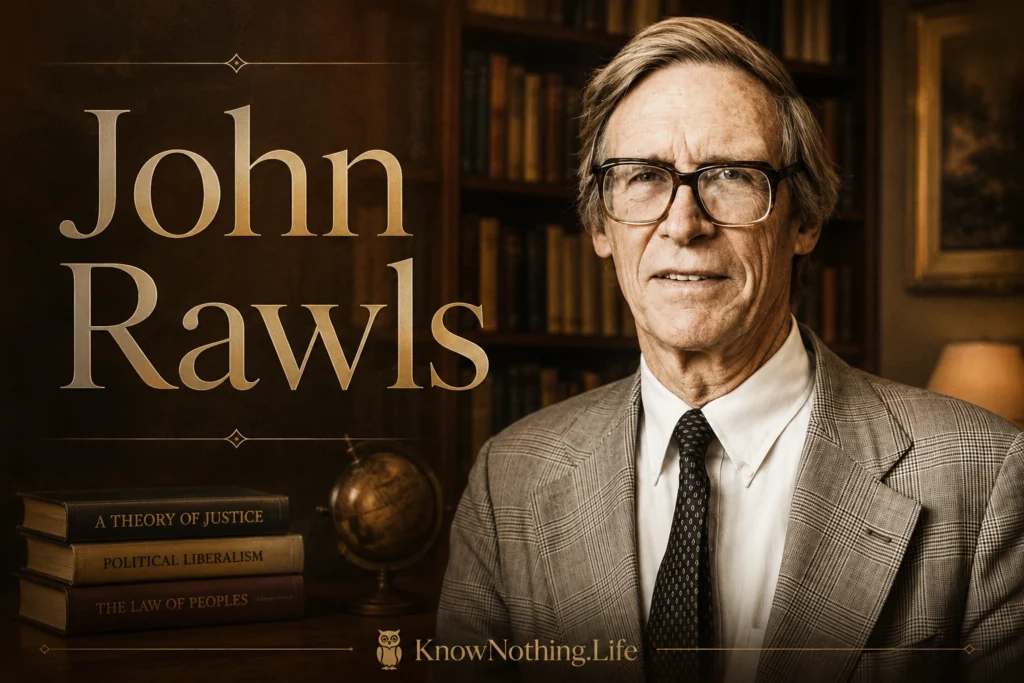
John Bordley Rawls was born on February 21, 1921, in Baltimore, Maryland, into a prosperous family shaped by law, civic life, and public responsibility. His father was a lawyer, and Rawls grew up in a world where institutions, duty, and social position were visible facts of life. Yet his childhood also included painful encounters with chance and vulnerability. Two of his brothers died from illnesses they had contracted from him, experiences that later biographers have connected to his lifelong concern with moral luck, contingency, and the unfairness of advantages and burdens people do not choose.
Rawls studied at Princeton University, where he first became interested in religion and philosophy. He completed his undergraduate degree in 1943, then entered the U.S. Army during the Second World War. He served in the Pacific, including New Guinea and the Philippines, and witnessed the realities of war, destruction, and political violence. After the war, he returned to Princeton for graduate study in philosophy, earning his Ph.D. in 1950. These years gave Rawls a lasting sense that moral philosophy could not remain abstract if it ignored the institutions that shape life chances.
War, Faith, and Moral seriousness
Rawls’s wartime experience changed him deeply. He had once considered becoming an Episcopal priest, but the war and the Holocaust helped undermine his earlier religious beliefs. His later political philosophy was secular, but it retained something of a moral and almost spiritual seriousness. He wanted to know how free and equal persons could live together under fair institutions despite disagreement, inequality, ambition, and historical injustice. His work did not begin from cynicism about human nature, but neither did it rely on sentimental optimism.
This combination of moral hope and institutional realism became central to his thought. Rawls was not interested in private virtue alone. He believed that the basic structure of society—its laws, markets, schools, political rights, property rules, and opportunities—profoundly shapes what people can become. A society may praise freedom while arranging its institutions so that some citizens are born into lasting disadvantage. Rawls wanted political philosophy to ask whether those arrangements could be justified to everyone subject to them.
Academic Career and the Revival of Political Philosophy
Rawls taught at Cornell University and the Massachusetts Institute of Technology before joining Harvard University in 1962. At Harvard, he became one of the most influential philosophers of the twentieth century, eventually serving as James Bryant Conant University Professor. His teaching style was quiet and careful, without the theatrical brilliance associated with some famous philosophers. But his intellectual influence was enormous. Students, colleagues, critics, and political theorists found in Rawls a new model of rigorous moral argument.
By the mid-twentieth century, many philosophers in the English-speaking world had become suspicious of large-scale normative political theory. Rawls helped reverse that trend. He showed that political philosophy could again ask ambitious questions about justice, rights, equality, liberty, and social cooperation without abandoning analytic clarity. His 1971 masterpiece, A Theory of Justice, did not merely contribute to a debate. It restarted one. After Rawls, no serious theory of justice could avoid responding to his framework.
A Theory of Justice
A Theory of Justice is Rawls’s greatest work and one of the most important books in modern political philosophy. Its opening sentence became famous: “Justice is the first virtue of social institutions, as truth is of systems of thought.” With that sentence, Rawls announced that institutions are not justified merely because they are efficient, stable, traditional, or profitable. They must be just. A society may be productive and orderly, but if its basic structure is unfair, something fundamental has gone wrong.
Rawls called his view “justice as fairness.” He wanted to identify principles that free and equal persons would choose to govern the basic structure of society under fair conditions. His method drew from the social contract tradition of Locke, Rousseau, and Kant, but transformed it into a thought experiment. Instead of asking what people actually agreed to in history, Rawls asked what they would choose if bargaining conditions were morally fair. The result was a new way to think about legitimacy: institutions should be acceptable from the standpoint of citizens who do not know whether they will be rich or poor, powerful or vulnerable, lucky or unlucky.
The Original Position and the Veil of Ignorance
Rawls’s most famous idea is the original position, a hypothetical situation in which rational persons choose principles of justice from behind a “veil of ignorance.” Behind this veil, no one knows their class, race, gender, religion, talents, family background, social position, or conception of the good. They do know general facts about human society, economics, psychology, and scarcity, but they do not know where they personally will land. The purpose is to prevent morally arbitrary facts from shaping the rules of society.
Rawls wrote that “the principles of justice are chosen behind a veil of ignorance.” This device forces impartiality. If people do not know whether they will be born wealthy or poor, gifted or disabled, part of a majority or minority, they have strong reason to choose principles that protect basic liberties and guard against severe disadvantage. The veil of ignorance does not ask people to stop caring about themselves. It asks them to design institutions without rigging the rules in favor of their own unchosen advantages.
The Two Principles of Justice
From the original position, Rawls argued, rational persons would choose two principles of justice. The first guarantees equal basic liberties for all citizens, including freedoms of conscience, speech, association, political participation, and personal liberty. These liberties cannot be sacrificed merely to increase wealth or convenience. Rawls’s liberalism begins with the moral importance of persons as free and equal citizens.
The second principle governs social and economic inequalities. Rawls did not argue that every inequality is unjust. He argued that inequalities must satisfy fair equality of opportunity and the difference principle. Fair equality of opportunity requires more than formal permission to compete; citizens with similar talents and motivation should have genuinely fair chances regardless of social class. The difference principle allows inequalities only if they benefit the least advantaged members of society. Rawls’s point was not envy or leveling for its own sake. It was that the rewards of social cooperation should be arranged so that even those with the least power have reason to accept the system.
Political Liberalism and Reasonable Pluralism
Rawls later revised and deepened his theory in Political Liberalism, published in 1993. He recognized that modern democratic societies contain many reasonable but conflicting religious, moral, and philosophical doctrines. Citizens will not all agree about salvation, virtue, happiness, metaphysics, or the ultimate meaning of life. The question, then, is how a stable and just society can exist among people who disagree deeply but reasonably.
His answer was political liberalism. Rawls argued that principles of justice should be political, not dependent on one comprehensive religious or philosophical worldview. A just society can be supported by an “overlapping consensus,” in which citizens endorse the same political principles for different deeper reasons. A Christian, a secular Kantian, a liberal utilitarian, and a humanist may disagree about ultimate truth but still support equal liberties, fair opportunity, and constitutional democracy. Rawls wanted liberal society to rest not on shallow neutrality, but on public reasons citizens can share.
The Law of Peoples and Later Work
Rawls’s later work extended his thinking beyond domestic justice. In The Law of Peoples, published in 1999, he asked how liberal and decent peoples should relate internationally. The book addressed human rights, war, toleration, nonliberal societies, and duties of assistance. Some critics argued that Rawls’s global theory was not egalitarian enough, especially compared with his domestic theory. Others saw it as a careful attempt to adapt liberal principles to a world of plural peoples rather than a single global state.
His final major statement, Justice as Fairness: A Restatement, published in 2001, clarified and revised the central ideas of A Theory of Justice. Rawls also published important essays and lectures on moral philosophy, political philosophy, and the history of philosophy, including lectures on Kant, Hume, Leibniz, and Hegel. Across these works, he remained committed to the same core question: what principles should regulate a fair system of cooperation among free and equal persons over time?
Criticism and Influence
Rawls’s influence was so large that many major political philosophers defined themselves through agreement, revision, or opposition to him. Robert Nozick challenged Rawls from a libertarian direction in Anarchy, State, and Utopia, arguing for stronger property rights and a minimal state. Communitarian critics such as Michael Sandel questioned whether Rawls’s picture of the person was too abstract and detached from community. Feminist, Marxist, capability, global justice, and critical race theorists pressed Rawls on family structure, power, disability, empire, race, and the limits of ideal theory.
Yet the scale of criticism shows the scale of achievement. Rawls gave political philosophy a common vocabulary: the original position, the veil of ignorance, primary goods, basic structure, fair equality of opportunity, the difference principle, public reason, and overlapping consensus. Even critics who reject his conclusions often work inside a landscape he helped create. He made justice once again the central problem of political philosophy.
Death and Lasting Legacy
John Rawls died on November 24, 2002, at the age of eighty-one. By then, he was widely regarded as one of the most important moral and political philosophers of the modern era. His personal manner was famously modest, but his philosophical ambition was vast. He wanted to show that liberal democracy could be more than a compromise among competing interests. It could be a fair system of cooperation grounded in respect for persons.
Rawls’s lasting importance lies in his insistence that social institutions must be justifiable to those who live under them, especially those least favored by fortune. He did not promise a perfect society, but he gave modern thought one of its strongest methods for asking whether a society is fair. In a world still marked by inequality, polarization, inherited privilege, and disagreement over values, Rawls remains essential because he asks a question no serious society can escape: would we choose these rules if we did not know who we would be?