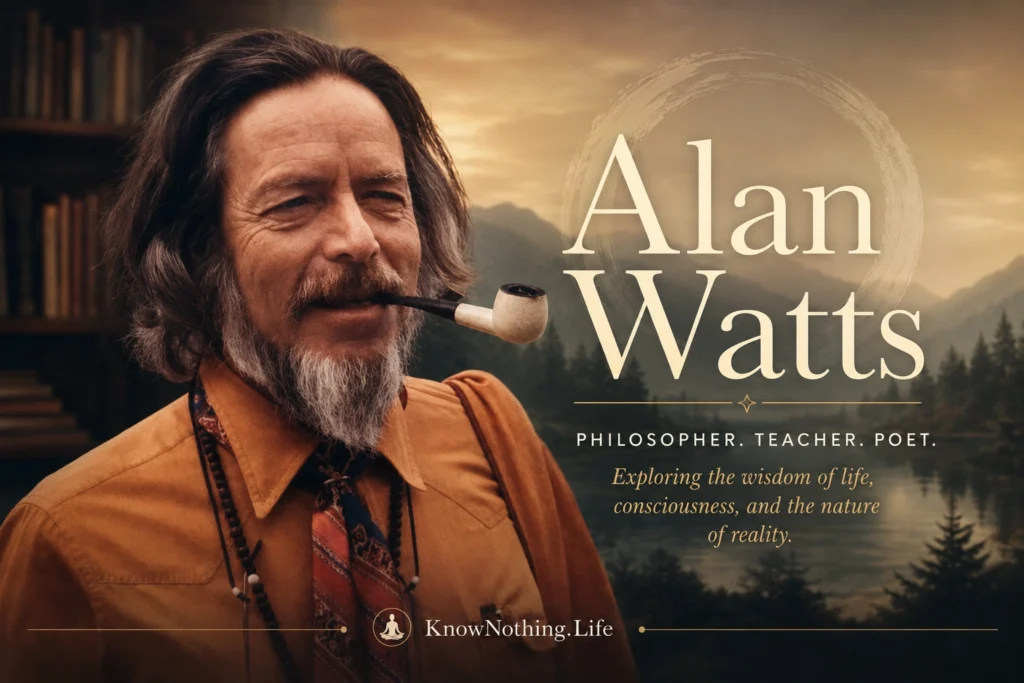
Alan Watts was a British-born writer, speaker, theologian, and interpreter of Asian philosophy who introduced millions of Western readers and listeners to Zen Buddhism, Taoism, Hindu thought, and comparative mysticism. With his resonant voice, playful humor, and gift for metaphor, he translated difficult philosophical ideas into vivid discussions of identity, anxiety, nature, consciousness, and everyday experience. He did not present himself as a conventional religious authority. Instead, he called himself a “philosophical entertainer,” a description that reflected his belief that serious ideas could be explored through delight, paradox, storytelling, and intellectual play.
Watts’s major works include The Spirit of Zen, The Meaning of Happiness, The Wisdom of Insecurity, The Way of Zen, Nature, Man, and Woman, Psychotherapy East and West, The Joyous Cosmology, Beyond Theology, The Book, and Tao: The Watercourse Way. Across these books, he challenged the Western image of the individual as an isolated ego confronting an alien universe. Human beings, he argued, are expressions of nature rather than strangers placed within it. His enduring appeal comes from the way he joined ancient traditions with modern psychology, ecology, science, and the problem of how to live in an uncertain world.
Early Life and the Discovery of Asian Thought
Alan Wilson Watts was born on January 6, 1915, in Chislehurst, England, and grew up in the county of Kent. His father worked in business, while his mother taught at a school attended by children of missionaries returning from Asia. Objects and artworks brought back from China and Japan awakened his fascination with Asian aesthetics. As a boy, Watts was drawn to landscape painting, Buddhist imagery, and the suggestion that nature could be experienced as a living process rather than as raw material awaiting human control.
Watts attended King’s School in Canterbury but did not follow the expected route into an English university. Instead, he educated himself through extensive reading and involvement with the Buddhist Lodge of London. He became an editor of the lodge’s journal, The Middle Way, and encountered influential interpreters of Buddhism, including Christmas Humphreys and D. T. Suzuki. At sixteen, he produced An Outline of Zen Buddhism, and his first substantial book, The Spirit of Zen, appeared during the 1930s. These early writings already displayed the quality that would define his career: an ability to make foreign philosophical traditions feel immediate without presenting them as museum pieces.
America, Theology, and the Priesthood
Watts moved to the United States in 1938 and initially pursued Zen training in New York. His intellectual interests, however, were never confined to one tradition. He believed that Christian mysticism could be reconsidered through ideas encountered in Buddhism, Hinduism, and perennial philosophy. He enrolled at Seabury-Western Theological Seminary in Illinois, studied Christian scripture and theology, and earned a master’s degree. He was ordained as an Episcopal priest during the 1940s and served as chaplain at Northwestern University.
His years in the church produced Behold the Spirit, The Supreme Identity, and other works attempting to recover the mystical dimension of Christianity. Yet his theology remained too unconventional for a permanent clerical career. He increasingly rejected doctrines that separated God from creation, spirit from body, and humanity from nature. In 1950, he left the ministry and began writing The Wisdom of Insecurity: A Message for an Age of Anxiety. Leaving the priesthood did not end his interest in religion; it freed him to examine religious experience without defending a single institution or creed.
San Francisco, Radio, and the Zen Boom
In 1951, Watts relocated to San Francisco and joined the American Academy of Asian Studies at the invitation of Frederic Spiegelberg. He taught comparative philosophy and psychology and later served as dean. His classes attracted students interested in Buddhism, Hinduism, mysticism, art, and the emerging dialogue between Eastern religion and Western psychotherapy. The academy became an important meeting place for scholars, artists, writers, and members of the developing San Francisco cultural scene.
Watts’s influence expanded dramatically when he began broadcasting on Berkeley’s KPFA radio station in 1953. Programs such as “The Great Books of Asia” and “Way Beyond the West” allowed his distinctive voice to reach listeners beyond universities. His lectures combined scholarship with jokes, images, spontaneous digressions, and carefully timed rhetorical surprises. Television appearances and the series Eastern Wisdom and Modern Life further increased his audience. By the end of the 1950s, he had become one of the most recognizable interpreters of Zen during America’s expanding “Zen Boom.”
The Wisdom of Insecurity and the Present Moment
Published in 1951, The Wisdom of Insecurity addressed the anxiety produced by the attempt to make life psychologically secure. Watts argued that human beings use memories, predictions, religious certainties, possessions, and social identities to defend themselves against change. Yet the pursuit of permanent security increases fear because life is inherently fluid. The more tightly people attempt to preserve a fixed self or guaranteed future, the more threatened they feel by the movement of actual experience. The problem is not uncertainty alone, but the demand that an uncertain world become permanent.
Watts summarized this philosophy in one of his best-known statements: “The only way to make sense out of change is to plunge into it, move with it, and join the dance.” Acceptance did not mean passivity or abandoning practical planning. It meant recognizing that memories and plans exist only as activities occurring in the present. People lose contact with life when they treat the future as the destination and the present merely as transportation. The book remains relevant because it describes a culture of constant anticipation in which happiness is always expected after one more achievement, purchase, or improvement.
The Way of Zen
Watts achieved national recognition with The Way of Zen, published in 1957. The book traced Zen through Indian Buddhism, Chinese Taoism, Ch’an, and Japanese culture while explaining concepts such as nonattachment, spontaneity, meditation, and awakening. He portrayed Zen not as a system of beliefs but as a transformation in perception. The awakened person does not escape ordinary existence; rather, the division between sacred and ordinary life begins to dissolve. Eating, walking, working, and listening can become expressions of awareness when they are no longer treated merely as means to future rewards.
Watts distinguished Zen from both rigid asceticism and the casual romanticism that surrounded it within sections of the Beat movement. His essay Beat Zen, Square Zen, and Zen questioned attempts to turn spiritual freedom into a fashionable identity. At the same time, his interpretations were deliberately accessible and synthetic rather than narrowly academic. He placed Zen in conversation with Western psychology, art, and philosophy, helping readers see it as an approach to consciousness rather than an exotic set of rituals. That accessibility brought criticism from specialists, but it also explains why his work reached audiences that formal scholarship rarely touched.
Identity, Nature, and The Book
In The Book: On the Taboo Against Knowing Who You Are, published in 1966, Watts attacked the sensation of being a separate ego sealed within the body. Language encourages people to imagine that they arrived from somewhere outside nature and now confront a world of objects. Watts reversed this image: an organism is something the environment is doing, just as a wave is something the ocean is doing. Identity includes relationships, atmosphere, food, language, history, and the larger ecological field that makes individual life possible.
His remark that “Trying to define yourself is like trying to bite your own teeth” captures the paradox of self-knowledge. The observer who searches for the self is already part of what is being observed. Watts did not argue that names and personal identities are useless; they are necessary social conventions. The mistake is confusing the convention with the complete living person. His ideas anticipated ecological and systems-oriented views in which organisms and environments form interdependent processes. They also challenged spiritual seekers who tried to conquer or eliminate the ego through another project of self-improvement.
Counterculture, Psychedelics, and Later Works
During the 1960s, Watts lectured throughout North America and appeared at emerging centers of humanistic psychology, including the Esalen Institute. He engaged with writers, psychologists, artists, and countercultural figures while refusing to become the official teacher of a movement. He discussed psychedelic experience but warned against confusing temporary visions with lasting understanding, famously advising that “once you get the message, hang up the phone.” His deeper interest was not intoxication itself but the possibility of loosening habitual assumptions about identity and reality.
His later books expanded into sexuality, psychotherapy, mythology, material culture, ecology, and Taoism. Nature, Man, and Woman criticized the cultural separation of spirit from bodily and natural life. Psychotherapy East and West compared liberation traditions with modern psychological treatment, while Beyond Theology reconsidered Christianity after his departure from the church. Cloud-Hidden, Whereabouts Unknown gathered reflective mountain essays, and Tao: The Watercourse Way, completed after his death with Al Chung-liang Huang, explored action that follows rather than fights the patterns of nature.
Final Years and Lasting Influence
Watts spent much of his final period between a ferryboat in Sausalito and a cabin in the Druid Heights community on Mount Tamalpais. He continued writing and touring despite declining health and died in his sleep on November 16, 1973. His autobiography, In My Own Way, appeared shortly before his death and presented his life as a series of intellectual experiments rather than a straight path toward spiritual authority. Recordings made by Watts and his son Mark preserved the voice that had been central to his appeal.
His influence now extends through philosophy, meditation culture, psychology, music, film, and digital media. Short excerpts from his lectures circulate widely, though their brevity can strip away the humor and qualifications that gave his arguments depth. Watts’s enduring achievement was not the creation of a new religion. It was his ability to unsettle familiar assumptions: that the self is isolated, that nature is external, that life must justify itself through achievement, or that wisdom must be solemn. He invited readers to recognize existence not as a problem awaiting final solution but as a changing activity in which they are already participating.