The philosophy of Parmenides marks a turning point in the history of Western thought, introducing a radical and deeply challenging vision of reality. In stark contrast to thinkers like Heraclitus, who emphasized change and flux, Parmenides argued that change itself is an illusion. For him, true reality—what he called “Being”—is unchanging, eternal, and indivisible.
Born in the Greek colony of Elea (modern Velia), Parmenides lived in the early 5th century BCE. His work, preserved in fragments of a philosophical poem, presents a systematic argument for the nature of reality that continues to influence metaphysics. By challenging the reliability of sensory experience and emphasizing the role of reason, Parmenides laid the groundwork for philosophical inquiry into existence itself.
Life and Historical Context
Little is known with certainty about Parmenides’ life, but historical accounts suggest that he was a respected figure in his community, possibly involved in political and legal affairs. He is often associated with the Eleatic school, a group of philosophers who emphasized the unity and permanence of Being.
Parmenides lived during a period of intense philosophical exploration, when early Greek thinkers were attempting to understand the nature of the cosmos through reason. Pre-Socratic philosophers such as Thales and Anaximenes sought to identify the fundamental substance underlying reality. Parmenides, however, shifted the focus from substance to existence itself, asking what it means for something to be.
This shift represents a profound development in philosophical thought. Rather than explaining the world in terms of physical elements, Parmenides introduced a conceptual analysis of Being, emphasizing logic and necessity over observation and speculation.
The Poem: On Nature
Parmenides’ philosophy is preserved in fragments of a poem commonly referred to as On Nature. In this work, he presents his ideas through a narrative in which a traveler is guided by a divine figure, often interpreted as a goddess, who reveals the nature of reality.
The poem is divided into two main parts: the “Way of Truth” and the “Way of Opinion.” The Way of Truth presents Parmenides’ argument for the nature of Being, while the Way of Opinion describes the deceptive world of appearances, shaped by human perception.
This poetic structure reflects the dual nature of his philosophy. On one hand, it offers a rigorous logical argument; on the other, it acknowledges the persistence of illusion in human experience. The use of poetry underscores the depth and complexity of his ideas, inviting readers to engage with them on multiple levels.
The Nature of Being
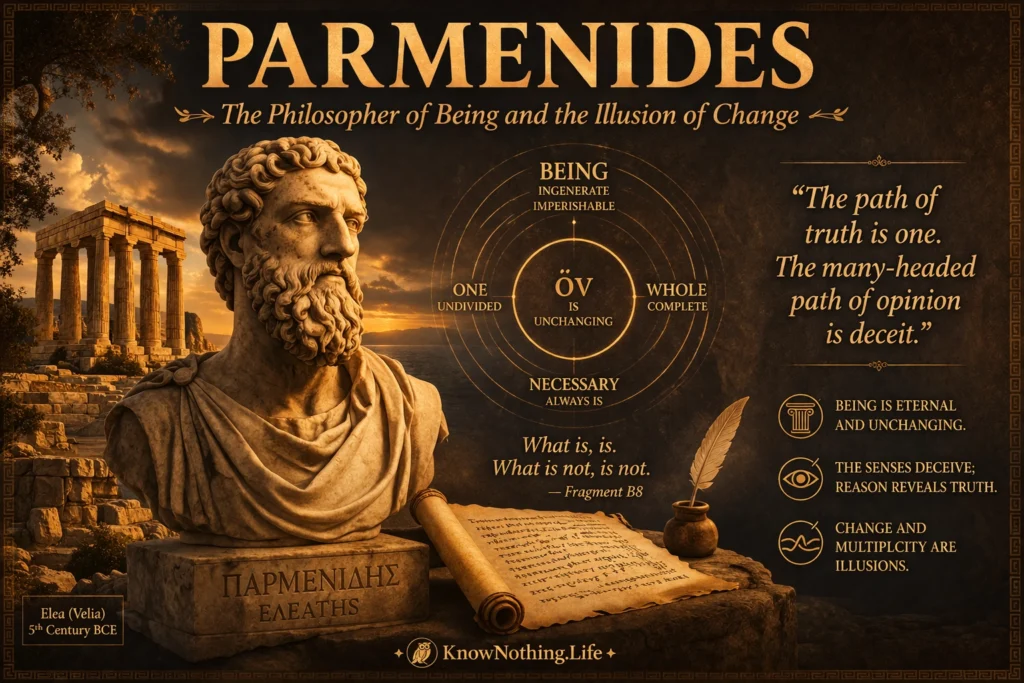
At the heart of Parmenides’ philosophy is the concept of Being, which he defines as what truly exists. According to Parmenides, Being is ungenerated, indestructible, whole, and unchanging. It cannot come into existence, nor can it cease to exist, because this would require it to arise from or return to non-being—something he considers impossible.
Parmenides argues that “what is, is,” and “what is not, is not.” This seemingly simple statement carries profound implications. It means that non-being cannot be thought or spoken of, as it does not exist. Therefore, any claim about change, which involves something becoming what it is not, must be false.
This reasoning leads to a radical conclusion: change, motion, and plurality are illusions. The world of sensory experience, which appears to be dynamic and diverse, does not reflect true reality. Instead, reality is a single, unchanging whole that can only be understood through reason.
Reason vs. Perception
One of Parmenides’ most significant contributions is his distinction between reason and perception. He argues that the senses are unreliable, presenting a world of change and multiplicity that contradicts the logical necessity of Being. True knowledge, therefore, must be derived from reason rather than sensory experience.
This emphasis on rational inquiry represents a major shift in philosophical methodology. While earlier thinkers relied on observation to understand the world, Parmenides prioritizes logical consistency and necessity. His approach challenges the assumption that what we perceive corresponds to what is real.
The tension between reason and perception introduced by Parmenides has had a lasting impact on philosophy. It raises fundamental questions about the nature of knowledge and the relationship between appearance and reality—questions that continue to be explored in various forms.
Quotes and Key Ideas
Although Parmenides’ work survives only in fragments, several statements capture the essence of his philosophy:
- “What is, is; what is not, is not.”
- “Being is ungenerated and imperishable.”
- “It is the same thing that can be thought and that can be.”
- “The path of truth is one.”
These statements reflect his commitment to logical clarity and his rejection of change and non-being. They emphasize the unity and permanence of reality, as well as the importance of reason in understanding it. Parmenides’ key ideas—Being as unchanging, the impossibility of non-being, and the unreliability of the senses—form the foundation of his philosophical system. They continue to influence debates in metaphysics and epistemology.
Influence and the Eleatic School
Parmenides’ ideas had a profound influence on subsequent philosophers, particularly within the Eleatic school. His student Zeno of Elea is known for his paradoxes, which defend Parmenides’ claims by demonstrating the contradictions inherent in the concept of motion.
Beyond the Eleatics, Parmenides’ philosophy influenced major figures such as Plato, who grappled with the tension between the world of forms and the world of appearances. Aristotle also engaged with Parmenides’ ideas, seeking to reconcile the permanence of Being with the reality of change.
In modern philosophy, Parmenides’ emphasis on logic and the nature of existence continues to resonate. His work is often seen as the beginning of metaphysics, establishing a framework for thinking about reality that remains relevant today.
The Challenge of Change
Parmenides’ denial of change presents a challenge that has shaped philosophical inquiry for centuries. If change is an illusion, how can we account for the dynamic world we experience? This question has led to various attempts to reconcile the apparent contradiction between reason and perception.
Some philosophers have sought to preserve elements of Parmenides’ thought while allowing for change, proposing that change occurs within a stable underlying structure. Others have rejected his conclusions, arguing that his reasoning overlooks important aspects of reality. Regardless of these responses, the challenge posed by Parmenides remains significant. It forces us to reconsider our assumptions about the nature of existence and the reliability of our perceptions.
Conclusion
Parmenides stands as one of the most radical and influential thinkers in the history of philosophy. His insistence on the primacy of Being and his rejection of change challenge deeply held beliefs about the nature of reality. By emphasizing the role of reason, he established a new approach to philosophical inquiry that continues to shape intellectual traditions.
His philosophy invites us to question the world as we perceive it, encouraging a deeper exploration of what it means to exist. While his conclusions may seem counterintuitive, they reveal the power of logical reasoning to uncover hidden truths.
In the ongoing dialogue between change and permanence, appearance and reality, Parmenides’ voice remains essential. His work reminds us that understanding the world requires not only observation, but also critical reflection and philosophical insight.