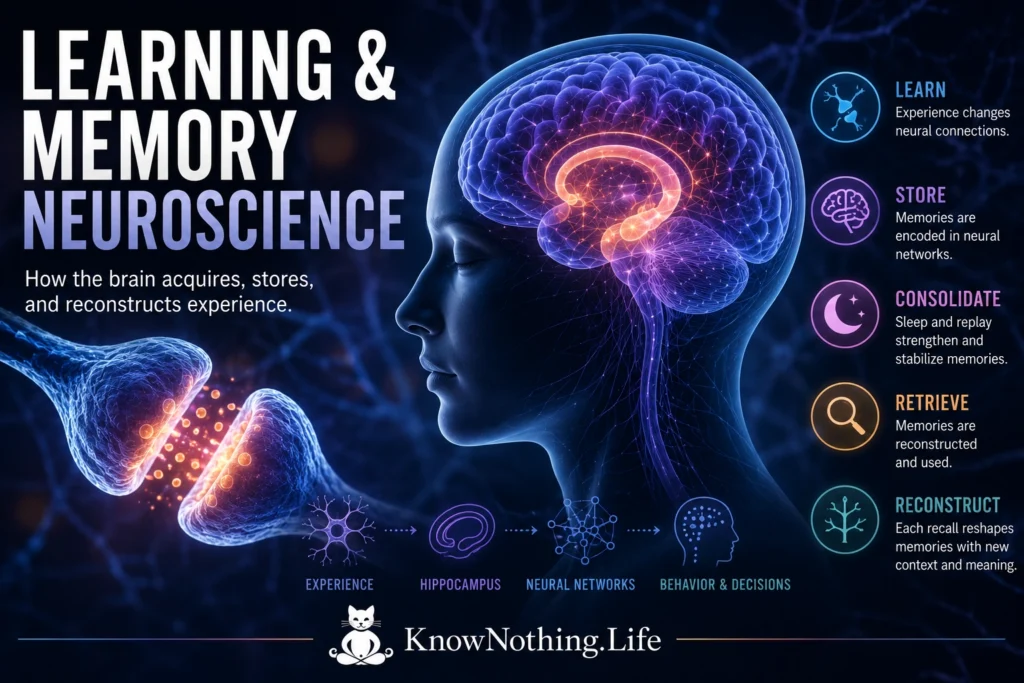
Learning is the process through which experience changes behavior, knowledge, expectations, or neural function. Memory is the persistence of those changes over time. Although the terms are closely connected, they describe different stages of adaptation. Learning may occur during exposure to new information, practice, conditioning, or observation, while memory allows the results of that learning to influence later thought and action. Neuroscientists commonly divide memory processing into encoding, consolidation, storage, and retrieval, but these stages overlap. The way information is attended to during encoding affects what can later be consolidated, and every act of retrieval can alter the memory being recalled.
Memory is not one unified capacity stored in one location. Working memory temporarily maintains information needed for an immediate task. Episodic memory represents personally experienced events, while semantic memory contains knowledge about facts and concepts. Procedural memory supports skills and habits, and emotional learning allows cues to acquire motivational or threatening significance. Damage to one neural system can severely impair one form of memory while leaving others relatively intact. This separation became especially clear through studies of amnesia and habit learning, which showed that the brain contains multiple interacting memory systems rather than a single storage center.
Working Memory and Prefrontal Control
Working memory allows the brain to hold information in an active, usable form for several seconds. It is involved when a person remembers the beginning of a sentence, follows a sequence of instructions, compares alternatives, performs mental arithmetic, or keeps a goal in mind while ignoring distractions. Working memory is limited in capacity and depends heavily on attention. Information that is not refreshed, reorganized, or connected to existing knowledge can disappear quickly, especially when competing material enters awareness.
Early neurophysiological evidence linked working memory to sustained activity in the prefrontal cortex. In 1971, Joaquín Fuster and Garrett Alexander recorded neurons in monkeys performing a delayed-response task. Some prefrontal neurons remained active during the delay between the presentation of a cue and the required response, even though the cue was no longer visible. Later experiments by Earl Miller and colleagues found prefrontal neurons that carried information about remembered visual objects during similar delays. Contemporary research suggests that working memory depends not only on persistent firing but also on dynamic interactions among prefrontal, parietal, sensory, and thalamic networks.
The Hippocampus and Declarative Memory
The hippocampus and surrounding medial temporal structures are essential for forming many new episodic and factual memories. This role was demonstrated dramatically by patient H.M., later identified as Henry Molaison. After portions of both medial temporal lobes were surgically removed to treat severe epilepsy, Molaison developed profound anterograde amnesia. He could converse normally and retain information briefly, but he struggled to form lasting memories of new events and facts. William Scoville and Brenda Milner’s 1957 report showed that extensive bilateral hippocampal damage produced a persistent impairment in recent memory while leaving several intellectual and perceptual abilities relatively preserved.
The hippocampus does not function merely as a passive recording device. It organizes relationships among people, places, objects, actions, and temporal contexts. John O’Keefe and Jonathan Dostrovsky’s 1971 study discovered hippocampal neurons that became active when freely moving rats occupied particular locations. These “place cells” suggested that the hippocampus creates internal representations of spatial environments. Later research connected hippocampal activity to navigation, contextual memory, event sequences, and the flexible recombination of past experiences. The hippocampus appears especially important when a memory must preserve relationships among several elements rather than simply strengthen one isolated response.
Synaptic Plasticity and the Cellular Basis of Learning
Learning requires neural circuits to change as a consequence of activity. One major experimental model is long-term potentiation, or LTP, a persistent increase in synaptic transmission following specific patterns of stimulation. In 1973, Tim Bliss and Terje Lømo reported that brief, high-frequency stimulation of the perforant pathway produced long-lasting enhancement of responses in the rabbit hippocampus. The discovery offered a plausible biological mechanism through which experience could strengthen connections among neurons that are active together.
Evidence linking LTP to behavior came from Richard Morris and colleagues, who blocked NMDA receptors in the rat hippocampus. The treatment prevented hippocampal LTP and selectively impaired learning in a spatial navigation task, while leaving some other forms of behavior relatively intact. Long-lasting plasticity can involve altered receptor function, changes in transmitter release, gene expression, protein synthesis, dendritic-spine modification, and the growth of new synaptic connections. Studies of the marine snail Aplysia demonstrated that repeated serotonin exposure can produce synapse-specific long-term facilitation involving CREB-dependent transcription, local protein synthesis, and structural growth. Memory is therefore supported by coordinated molecular and cellular changes rather than one universal “memory molecule.”
Multiple Memory Systems
Molaison’s condition revealed that severe declarative-memory impairment does not eliminate every form of learning. He could improve on certain perceptual and motor tasks through practice even when he did not consciously remember completing the task before. Later research found that he retained mirror-tracing skill over a long interval. Such findings helped distinguish declarative memory, which supports conscious recollection, from procedural learning, which gradually improves performance through changes in motor, perceptual, and habit circuits.
The basal ganglia, cerebellum, amygdala, hippocampus, and cerebral cortex contribute to different kinds of learning. Barbara Knowlton, Jennifer Mangels, and Larry Squire demonstrated a double dissociation using a probabilistic classification task. People with amnesia could gradually learn the classification despite poor explicit knowledge, whereas people with Parkinson’s disease showed impaired habit learning but retained more declarative information about the task. Emotional learning also relies strongly on the amygdala. Experiments involving the basolateral amygdala indicate that it can influence the consolidation of fear memories and modify storage processes in other brain regions.
Consolidation, Sleep, and Memory Reactivation
New memories are initially vulnerable to disruption. Cellular consolidation stabilizes synaptic and molecular changes over minutes or hours, while systems consolidation reorganizes memory across wider brain networks over longer periods. Repeated retrieval, rehearsal, and sleep can strengthen or transform these representations. During sleep, recently active neural patterns may be reactivated, allowing the brain to process new information while sensory input and competing behavior are reduced.
Matthew Wilson and Bruce McNaughton recorded ensembles of hippocampal place cells while rats explored an environment and during later slow-wave sleep. Neurons that fired together during exploration showed an increased tendency to reactivate together after the experience. This replay supported the theory that sleep contributes to consolidation by reinstating patterns created during waking learning. Sleep is not required for every memory, and replay does not reproduce experience perfectly. It may select, compress, combine, and reorganize information as memories become integrated with existing knowledge.
Consolidated memories are also not permanently fixed. Karim Nader, Glenn Schafe, and Joseph LeDoux reactivated established fear memories in rats and then blocked protein synthesis in the amygdala. The reactivated memories became impaired, indicating that retrieval had returned them to a temporary labile condition requiring reconsolidation. This process may permit memories to incorporate new information, but its conditions and clinical usefulness remain subjects of debate. Remembering is therefore not equivalent to opening an unchanged neurological file. Retrieval can strengthen, weaken, update, or distort the representation being recalled.
Memory Engrams and the Reconstruction of Experience
The term engram refers to the physical changes within neural populations that preserve information from an experience. Modern genetic and optogenetic techniques have allowed researchers to label neurons active during learning and manipulate them later. In 2012, Xu Liu, Susumu Tonegawa, and colleagues tagged hippocampal dentate-gyrus neurons activated during fear conditioning. Artificially stimulating those neurons in a different environment produced freezing behavior, showing that reactivating a specific neuronal ensemble could trigger behavioral expression of the associated memory.
Engram research also demonstrates how memories can be altered. Steve Ramirez and colleagues labeled hippocampal neurons while mice explored one safe environment, then reactivated those neurons while the animals received an aversive experience elsewhere. The mice later displayed fear in the original safe environment, where no shock had occurred. The experiment did not reproduce the complexity of human autobiographical false memories, but it demonstrated that neural representations of separate experiences can be artificially associated. Memory is constructive because the brain rebuilds an event from distributed sensory, spatial, emotional, and conceptual components rather than replaying a flawless recording.
A Brain Designed to Learn and Revise
Learning and memory emerge from activity across molecules, synapses, cells, circuits, and large-scale networks. The prefrontal cortex maintains goals and temporary information, the hippocampus organizes events and contexts, the basal ganglia acquire habits, the cerebellum refines predictions and movements, and the amygdala gives emotional significance to experience. Long-term memories depend on plasticity within these systems and on communication among them. No brain region stores a complete life history by itself.
The same flexibility that makes learning possible also makes memory imperfect. Attention determines what is initially encoded, existing knowledge shapes interpretation, sleep and rehearsal reorganize new information, and retrieval creates opportunities for updating. Forgetting can reflect failed encoding, weakened connections, interference, damaged retrieval cues, or an adaptive reduction of irrelevant detail. Memory is valuable not because it preserves the past exactly, but because it uses past experience to guide prediction, decision-making, identity, and future behavior. The neuroscience of learning therefore reveals a brain built not as a permanent archive, but as a living system that continually changes with experience.