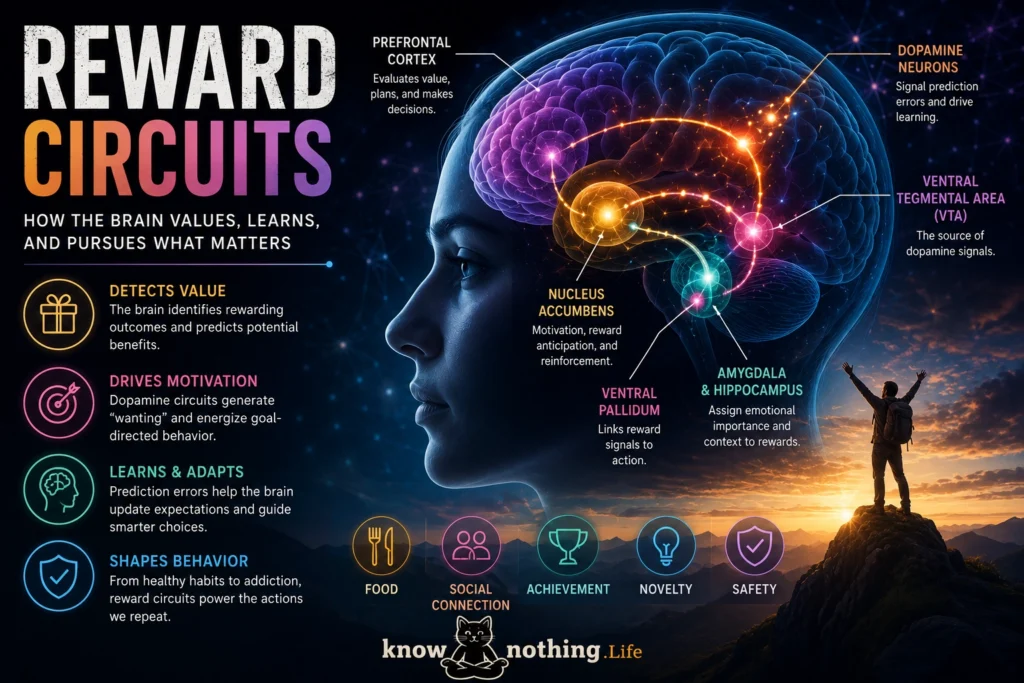
Reward circuits are networks that help the brain identify valuable outcomes, learn which events predict them, mobilize effort, and adjust behavior when expectations are confirmed or violated. Food, water, social connection, achievement, novelty, and safety can all function as rewards because they promote survival, well-being, or goal completion. Reward is not a single feeling generated by one “pleasure center.” It includes partly separable processes: detecting value, anticipating an outcome, wanting it, enjoying it, learning from it, and deciding whether the effort or risk required is worthwhile. These processes recruit overlapping regions including the ventral tegmental area, nucleus accumbens, ventral pallidum, amygdala, hippocampus, hypothalamus, orbitofrontal cortex, anterior cingulate cortex, and medial prefrontal cortex.
Modern reward research grew partly from James Olds and Peter Milner’s 1954 experiment, Positive Reinforcement Produced by Electrical Stimulation of Septal Area and Other Regions of Rat Brain. Rats learned to press a lever to receive brief electrical stimulation in particular forebrain sites, demonstrating that neural activity could reinforce behavior. The discovery encouraged scientists to search for a reward system, but later work replaced the idea of a single pleasure center with a distributed network. Suzanne Haber and Brian Knutson’s review The Reward Circuit: Linking Primate Anatomy and Human Imaging describes interconnected cortical, basal-ganglia, thalamic, and midbrain loops that translate value into learning and action.
The Mesolimbic Dopamine Pathway
The best-known component is the mesolimbic dopamine pathway. Dopamine-producing neurons in the ventral tegmental area project to the nucleus accumbens and other regions, including the amygdala, hippocampus, ventral pallidum, and prefrontal cortex. The nucleus accumbens integrates information about internal needs, emotional significance, remembered contexts, available actions, and expected outcomes, allowing valuable cues to influence attention and behavior. This pathway does not act alone: glutamate, GABA, opioids, endocannabinoids, serotonin, and other signals shape reward-related activity and plasticity.
Dopamine is often called the brain’s pleasure chemical, but that label is too narrow. It is especially important for learning, motivation, behavioral activation, and the influence of reward-predicting cues. Kent Berridge and Terry Robinson showed that dopamine-dependent “wanting” can be distinguished from the pleasurable “liking” produced during consumption. Cindy Wyvell and Berridge increased dopamine-related activity in the nucleus accumbens and intensified cue-triggered pursuit of sugar without increasing positive taste reactions. A person can therefore feel strongly compelled to pursue something without enjoying it proportionally.
Prediction Errors and Learning
Reward circuits must compare outcomes with expectations. Wolfram Schultz and colleagues found that many dopamine neurons respond strongly to an unexpected reward. After learning, the response shifts from the reward to the cue that predicts it. When an expected reward fails to arrive, dopamine activity decreases around the time it should have appeared. This pattern resembles a reward prediction error: the difference between what was obtained and what was expected. Positive errors strengthen learning about unexpectedly favorable events, whereas negative errors indicate that a prediction or strategy should change.
Schultz, Peter Dayan, and Read Montague connected this activity to temporal-difference learning, in which predictions are repeatedly updated as events unfold. Causal experiments strengthened the interpretation. Elizabeth Steinberg and colleagues used optogenetic stimulation to activate dopamine neurons during reward delivery, creating a prediction-error-like signal sufficient to alter learning in rats. Newer evidence indicates that dopamine activity can also reflect novelty, sensory information, movement, and uncertainty, so prediction error is a central principle rather than a complete description of every dopamine neuron.
Wanting, Liking, and Pleasure
Berridge, Robinson, and J. Wayne Aldridge divide reward into wanting, liking, and learning. Wanting refers to incentive salience—the motivational pull that makes a reward or its cue attract attention and provoke approach. Liking refers to the hedonic impact of consumption. Learning includes associations and predictions about where rewards occur and how they are obtained. These components usually cooperate but can separate. Hunger can increase wanting; satiety can reduce pursuit even when food would still taste pleasant; and repeated drug use can produce intense cue-triggered wanting despite declining enjoyment.
Pleasure depends partly on small “hedonic hotspots” in regions such as the nucleus accumbens shell and ventral pallidum, where opioid and endocannabinoid signaling can amplify positive reactions. Morten Kringelbach and Berridge emphasize that these hotspots are more restricted than the widespread circuitry generating motivation. The orbitofrontal cortex contributes to representing subjective value as it changes with context and internal state. Reward therefore cannot be reduced to dopamine release alone: dopamine can energize pursuit, while other mechanisms contribute more directly to pleasure.
Anticipation, Choice, and Action
Human imaging studies show that reward processing unfolds in stages. Brian Knutson and colleagues found that anticipation of increasing monetary rewards selectively recruited the nucleus accumbens. Related experiments distinguished anticipatory activity in ventral striatal regions from outcome-related responses in medial prefrontal areas. Anticipation can become motivating before an outcome is obtained. Advertisements, notifications, smells, places, and social signals gain power because they predict rewards and activate learned expectations.
Choices require the brain to compare magnitude, probability, delay, effort, and risk. Orbitofrontal and ventromedial prefrontal areas help represent changing outcome values, while the anterior cingulate cortex contributes to effort and action evaluation. The hippocampus supplies contextual information, and the amygdala marks emotionally significant cues. Ventral basal-ganglia circuits help translate these evaluations into actions, while dorsal striatal systems increasingly support habits as behaviors are repeated. Reward circuitry links desire to control by helping determine which goal should be pursued, how strongly, and for how long.
Addiction and Disorders of Reward
Addictive drugs act powerfully on reward and learning systems, but addiction is not simply excessive pleasure. Robinson and Berridge’s incentive-sensitization theory proposes that repeated exposure can sensitize systems assigning incentive salience, making drug cues intensely wanted even when the drug becomes less pleasurable. George Koob and Nora Volkow describe addiction as a cycle involving binge and intoxication, withdrawal and negative affect, and preoccupation or anticipation. Reward, stress, habit, memory, and executive-control systems change across this cycle, making behavior increasingly compulsive.
Reward circuits are also relevant to depression, eating disorders, compulsive gambling, schizophrenia, and Parkinson’s disease. Anhedonia in depression may involve reduced anticipation, effort, or motivation rather than a complete inability to experience pleasure. Excessive reward sensitivity can encourage risky choices, while diminished responsiveness can make ordinary goals feel unrewarding. Researchers therefore increasingly examine specific components—such as effort valuation, cue reactivity, learning rate, or hedonic response—rather than treating reward as one unified function.
Reward as an Adaptive Brain Process
Reward circuitry evolved to help organisms learn from consequences and direct limited energy toward valuable opportunities. It enables infants to seek caregivers, animals to locate food, adults to pursue social bonds, and groups to sustain cooperation through approval and shared goals. The same flexibility that makes reward learning adaptive also makes it vulnerable to manipulation. Highly salient cues, intermittent reinforcement, and rapidly repeated rewards can capture attention and reinforce behavior even when long-term consequences are harmful.
Reward circuits are neither a simple pleasure pathway nor a biological switch for happiness. Reward emerges from coordinated networks that predict outcomes, generate motivation, produce pleasure, store associations, compare alternatives, and revise behavior. Dopamine helps the brain learn and pursue, but it operates within a larger system shaped by bodily needs, memory, context, social experience, and conscious goals. Understanding these circuits reveals why rewards can educate, inspire, bind people together, or become compulsive—and why healthy motivation depends not only on what feels good now, but on how the brain learns what is worth seeking.