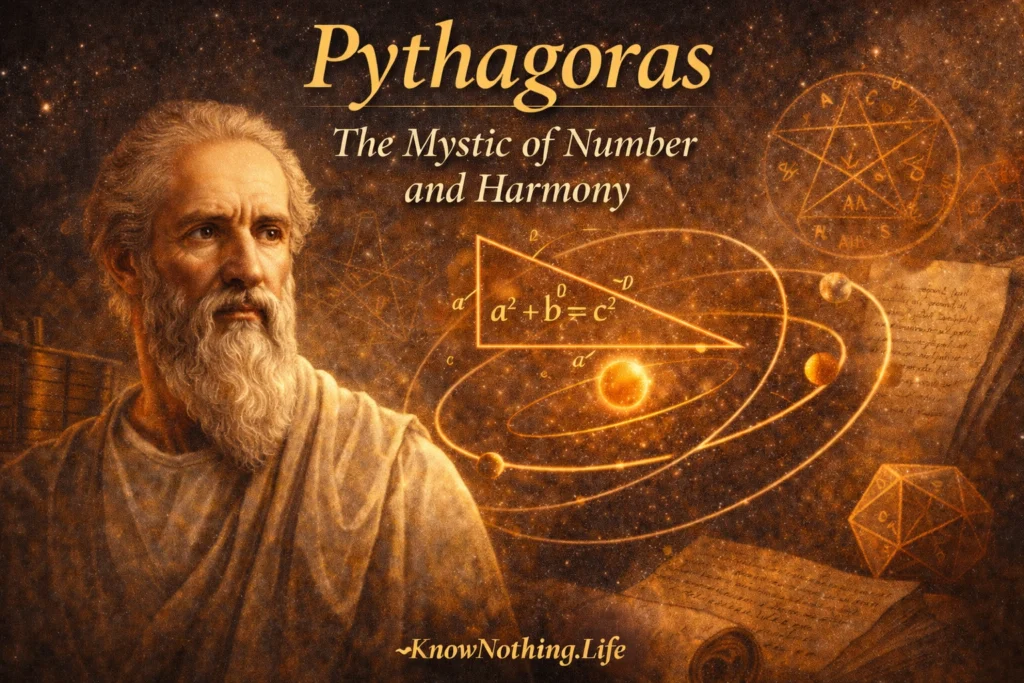
Pythagoras was born around 570 BCE on the island of Samos, a flourishing center of trade and culture in the ancient Greek world. Unlike later philosophers whose lives are well documented, much of what we know about Pythagoras comes from a mixture of historical accounts and legend. This blending of fact and myth reflects both the scarcity of contemporary records and the extraordinary influence he exerted on those who followed him. Even in antiquity, Pythagoras was regarded not merely as a thinker, but as a semi-mystical figure whose teachings transcended ordinary philosophy.
His early life coincided with a period of intellectual awakening in the Greek world, when thinkers began to seek natural explanations for phenomena traditionally attributed to the gods. Philosophers such as Thales and Anaximander had already begun to explore the principles underlying the cosmos. Pythagoras inherited this intellectual momentum but redirected it toward a more abstract and symbolic understanding of reality. Rather than focusing solely on physical substances, he sought to uncover the hidden order that governs existence.
According to tradition, Pythagoras traveled extensively in his youth, studying in Egypt and possibly Babylon, where he encountered advanced mathematical and religious ideas. These journeys are said to have profoundly shaped his worldview, introducing him to concepts of numerical harmony, cosmology, and spiritual discipline. Whether fully historical or partly legendary, these accounts emphasize a central truth: Pythagoras emerged as a thinker who blended mathematical inquiry with philosophical and religious insight, creating a system unlike anything that had come before.
The Pythagorean Brotherhood
After leaving Samos, Pythagoras settled in Croton, a Greek colony in southern Italy, where he founded a philosophical and religious community often referred to as the Pythagorean Brotherhood. This was not merely a school in the modern sense, but a tightly organized society governed by strict rules, rituals, and ethical codes. Members lived communally, shared property, and adhered to practices that emphasized purity, discipline, and self-control.
The Brotherhood operated under a veil of secrecy, which contributed to both its mystique and the difficulty of reconstructing its teachings. Knowledge was transmitted orally, and followers were expected to maintain silence about the inner doctrines of the group. This secrecy has led to ongoing debates among historians about which ideas can be attributed directly to Pythagoras and which were developed by later Pythagoreans. Nevertheless, the central role of number and harmony in their philosophy remains unmistakable.
At the heart of the Pythagorean way of life was the belief that the soul is immortal and undergoes a cycle of reincarnation. This doctrine, known as metempsychosis, linked ethical behavior with spiritual destiny. Pythagoras is often credited with saying, “Do not say a little in many words, but a great deal in few,” reflecting the disciplined and contemplative ethos of his community. The Brotherhood’s combination of mathematics, philosophy, and spirituality set it apart from other intellectual movements of the time, establishing a tradition that would influence both science and religion for centuries.
Mathematics and the Discovery of Numerical Order
Pythagoras is most famously associated with the theorem that bears his name, a fundamental principle of geometry stating that in a right triangle, the square of the hypotenuse is equal to the sum of the squares of the other two sides. While evidence suggests that similar relationships were known in earlier civilizations, it was the Pythagoreans who provided a formal mathematical proof and elevated the theorem to a central place in geometry. This achievement symbolizes a broader shift toward rigorous, deductive reasoning in mathematics.
More important than any single theorem was the Pythagorean insight that numbers are the underlying structure of reality. For Pythagoras and his followers, numbers were not merely tools for measurement; they were the essence of all things. They believed that the relationships between numbers could explain patterns in nature, from the proportions of musical harmony to the movements of celestial bodies. This idea marked a radical departure from earlier philosophies that focused on physical substances as the basis of existence.
The Pythagoreans also explored the mathematical basis of music, discovering that harmonious intervals correspond to simple numerical ratios. For example, the octave corresponds to a 2:1 ratio, while the fifth corresponds to 3:2. These findings reinforced their belief that the universe is governed by a harmonious order, often described as the “music of the spheres.” This concept suggests that the cosmos itself operates according to mathematical principles, a notion that would resonate through the works of later thinkers such as Johannes Kepler.
Philosophy, Cosmology, and the Nature of Reality
Pythagoras’ philosophy extends beyond mathematics into a broader vision of the cosmos as an ordered and intelligible system. He proposed that harmony and proportion are the fundamental principles governing both the physical world and human existence. This perspective represents one of the earliest attempts to unify scientific observation with philosophical reflection, laying the groundwork for later developments in metaphysics and cosmology.
Central to his thought is the idea that opposites—such as limit and unlimited, odd and even, light and darkness—interact to create balance and structure. The Pythagoreans developed a table of opposites to describe these relationships, suggesting that reality emerges from the interplay of contrasting forces. This dualistic framework influenced subsequent philosophical traditions, including those of Plato, who incorporated Pythagorean ideas into his own theory of forms.
Pythagoras also emphasized the importance of purification and self-knowledge, viewing philosophy as a means of aligning the soul with the harmony of the cosmos. He is often associated with the saying, “Number rules the universe,” a phrase that encapsulates his belief in the primacy of mathematical order. While the exact wording and attribution of such quotes remain debated, they capture the essence of his worldview—a universe governed not by chance, but by rational and harmonious principles.
Influence on Later Thought and Intellectual Legacy
The influence of Pythagoras extends far beyond his own time, shaping the development of mathematics, philosophy, and science. His emphasis on numerical relationships laid the foundation for the mathematical tradition that would later be advanced by thinkers such as Euclid and Archimedes. In philosophy, his ideas about harmony and order influenced Plato and, through him, the entire Western intellectual tradition.
Pythagorean concepts also played a role in the development of early scientific thought. The idea that the universe can be understood through mathematical laws became a central principle of the Scientific Revolution. Figures such as Kepler and Galileo Galilei echoed Pythagorean themes in their work, seeking to describe natural phenomena in terms of precise mathematical relationships. In this sense, Pythagoras can be seen as a precursor to modern science, despite the mystical elements of his philosophy.
His legacy is not limited to intellectual history; it also encompasses ethical and spiritual dimensions. The Pythagorean emphasis on discipline, self-control, and the pursuit of knowledge as a form of purification continues to resonate in various philosophical and religious traditions. By integrating mathematics with a broader vision of human existence, Pythagoras created a holistic approach to knowledge that remains influential to this day.
Final Years and Enduring Legacy
The final years of Pythagoras’ life are as shrouded in mystery as his early life. According to some accounts, political tensions in Croton led to the persecution of the Pythagorean community, forcing him to flee. He is believed to have died around 495 BCE, possibly in exile. These events underscore the challenges faced by unconventional thinkers in societies resistant to change, as well as the enduring impact of ideas that challenge established norms.
Despite the uncertainties surrounding his life, Pythagoras’ influence has endured for over two millennia. His name remains synonymous with one of the most fundamental theorems in mathematics, while his broader philosophical vision continues to inspire inquiry into the nature of reality. The blending of numerical precision with metaphysical speculation that characterizes his work has left an indelible mark on both science and philosophy.
Today, Pythagoras is remembered not only as a mathematician, but as a pioneer of a way of thinking that seeks unity between the material and the abstract, the empirical and the spiritual. His legacy invites us to consider the possibility that beneath the complexity of the world lies a simple and elegant order—one that can be understood through the language of numbers. As he is often credited with teaching, “There is geometry in the humming of the strings, there is music in the spacing of the spheres,” a poetic expression of a vision that continues to shape our understanding of the universe.