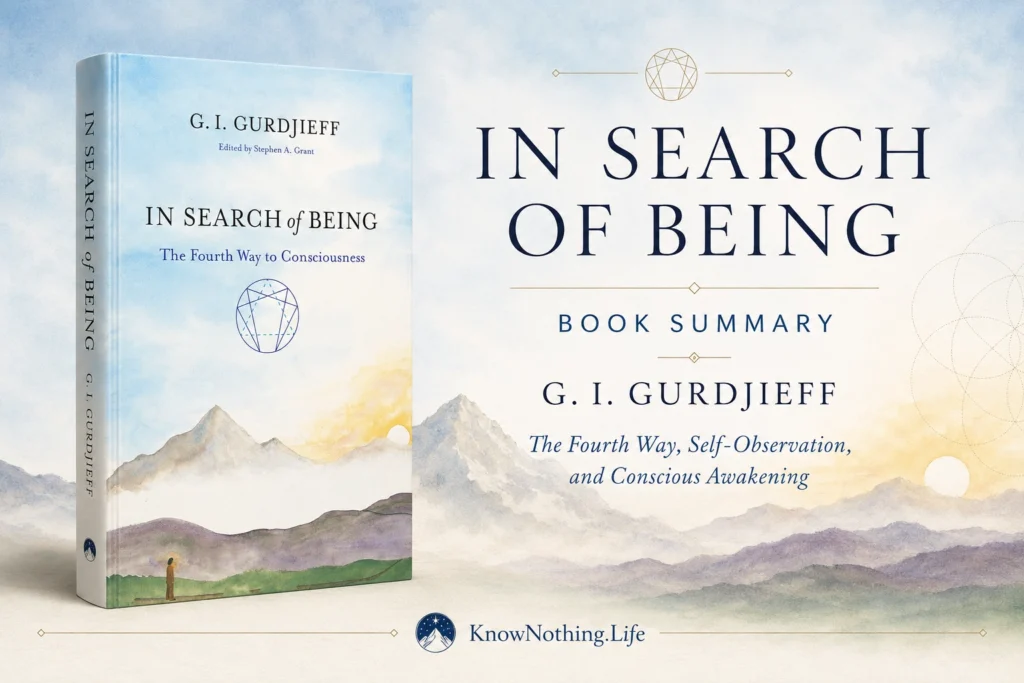
In Search of Being: The Fourth Way to Consciousness presents the central ideas associated with G. I. Gurdjieff in a more orderly and accessible form than readers encounter in his major allegorical writings. Published by Shambhala and edited by Stephen A. Grant, the volume is not a newly discovered manuscript written by Gurdjieff as a continuous book. It is an editorial compilation based primarily on material preserved in P. D. Ouspensky’s In Search of the Miraculous and Gurdjieff’s collected talks in Views from the Real World. The passages were reorganized by theme and adjusted stylistically to create a unified introduction to the Fourth Way.
The book is arranged into ten broad sections: “Know Thyself,” “Our Human Machine,” “World within Worlds,” “The Possibility of Evolution,” “The Aim of Religion,” “Seeking the Way,” “A Practical Study,” “A Work for Consciousness,” “Toward Liberation,” and “Knowledge of Being.” Together, these chapters move from Gurdjieff’s diagnosis of ordinary human life to his proposed method of inner development. The volume covers divided identity, bodily and psychological functions, states of consciousness, self-observation, self-remembering, religious practice, group work, cosmic laws, and the enneagram. Its purpose is not simply to explain what Gurdjieff believed, but to introduce a method readers are expected to test through experience.
“Know Thyself” and the Problem of Self-Knowledge
Gurdjieff begins from the ancient command to know oneself, but he gives it a more radical meaning than ordinary introspection. People commonly believe they know themselves because they recognize their names, preferences, occupations, memories, and opinions. Gurdjieff argues that these describe only the surface of personality. Genuine self-knowledge would require observing how thoughts arise, how emotions alter perception, how bodily habits direct behavior, and how different motives take control in different circumstances. The book therefore treats self-knowledge as an empirical discipline rather than a collection of flattering descriptions.
The approach recalls Socrates, whose philosophical mission involved examining both his own life and the assumptions of others. Yet Gurdjieff doubts that rational dialogue alone is sufficient, because the person conducting the examination is already divided and conditioned. Contemporary philosophy likewise treats introspection as one method of learning about ongoing mental states while questioning how reliable or complete that access is. People possess some privileged awareness of their thoughts and feelings, but this does not mean they understand the causes, contradictions, or behavioral consequences of those states.
The Human Machine and the Illusion of Will
The book’s most severe claim is that ordinary human beings function like machines. External events and internal associations continually produce predictable reactions: criticism generates defensiveness, praise produces vanity, discomfort causes irritation, and social settings activate learned roles. People describe these reactions as deliberate choices because they experience them from within, but Gurdjieff argues that most behavior happens before sustained awareness or independent will appears. Freedom is therefore a possibility to be developed, not a possession automatically granted to every adult.
Modern psychology does not accept Gurdjieff’s totalizing description of people as machines, but habit research provides a meaningful comparison. Wendy Wood and Dennis Rünger describe habits as learned default responses that emerge through repeatedly performing the same actions in recurring contexts. Once established, these responses can operate efficiently with little conscious deliberation, and people may later infer that habitual behavior was intentionally chosen. This supports Gurdjieff’s narrower observation that the subjective feeling of agency may conceal how strongly conduct is organized by repetition and environmental cues.
The Many “I’s” and the Organization of Human Functions
Gurdjieff denies that ordinary personality possesses a single permanent “I.” One part of a person promises to change, another later abandons the promise, and a third explains why the failure was unavoidable. Each temporary desire, fear, mood, or opinion uses the word “I,” creating the appearance of one continuous agent. The problem is not merely inconsistency. Because these different “I’s” know little about one another, commitments made in one psychological state often have almost no authority in another.
The book also divides human functioning into thinking, emotional, moving, and instinctive centers. The intellectual center compares, calculates, and forms concepts; the emotional center experiences attraction, aversion, joy, fear, and anger; the moving center governs learned physical action; and the instinctive center regulates sensation and organic processes. These centers should not be mistaken for scientifically established brain regions. Their value is phenomenological: they encourage readers to distinguish an immediate sensation from a judgment, a practiced movement from a conscious decision, and an emotion from the story later constructed around it.
Waking Sleep and the Possibility of Self-Remembering
According to Gurdjieff, people pass through much of life in “waking sleep.” They can work, speak, travel, and solve problems while remaining only intermittently aware of themselves. Ordinary wakefulness is not the same as reflective consciousness. Attention is repeatedly absorbed by conversation, fantasy, anxiety, entertainment, or internal commentary, and the individual does not notice this disappearance until attention happens to return. The first step toward awakening is therefore recognizing how rarely one is present.
Psychological research on mind wandering and meta-awareness offers a cautious parallel. Meta-awareness is the recognition that one’s attention has drifted; without it, a person may remain lost in unrelated thought while believing that attention is still directed toward the task. Gurdjieff’s practice of self-remembering attempts to maintain awareness in two directions at once: toward the object or activity and toward one’s own presence. Mindfulness theories similarly identify attention regulation, body awareness, emotional regulation, and changes in perspective on the self as interacting processes, although these findings do not verify Gurdjieff’s hierarchy of higher consciousness.
Essence, Personality, and Possible Evolution
The distinction between essence and personality is central to the book’s account of development. Essence refers to innate tendencies and what has genuinely become part of a person, while personality consists largely of acquired opinions, imitated behavior, social roles, education, and defensive habits. Personality is necessary for functioning in society, but it can become so dominant that deeper emotional and moral development stops. A person may possess extensive knowledge and social competence while remaining inwardly dependent, reactive, or immature.
Gurdjieff therefore distinguishes knowledge from being. Knowledge concerns the amount and quality of information a person possesses; being concerns the organization and maturity of the person who possesses it. Understanding emerges when the two develop together. This resembles Aristotle’s argument in Nicomachean Ethics that practical wisdom cannot be obtained by learning general rules alone. Virtue must become a stable disposition affecting perception, feeling, choice, and action. Both thinkers reject the belief that describing a good life is equivalent to becoming capable of living one.
The Fourth Way and the Integration of Human Nature
Gurdjieff describes three traditional paths of spiritual development. The way of the fakir emphasizes mastery of the body, the way of the monk develops faith and emotion, and the way of the yogi trains the mind. Each path concentrates on one side of human nature and often requires withdrawal from ordinary life. The Fourth Way attempts to work with thought, emotion, and the body simultaneously while the practitioner continues living within work, family, relationships, and society.
Ordinary life becomes the field of practice because it constantly reveals mechanical reactions. Irritation, embarrassment, ambition, disappointment, and conflict show where identification is strongest. The practitioner is not asked merely to adopt spiritual beliefs but to observe these reactions while they occur. The method also places importance on groups and schools, where cooperation and friction can reveal patterns hidden during solitary practice. This can provide accountability and corrective feedback, although any system built around a powerful teacher must preserve ethical boundaries, independent judgment, and the freedom to question authority.
Cosmic Laws and the Enneagram
The book expands from psychology into cosmology through the Law of Three, the Law of Seven, the Ray of Creation, degrees of materiality, and the enneagram. The Law of Three proposes that every event results from the interaction of active, passive, and reconciling forces. The Law of Seven describes development as uneven rather than linear: processes change direction or lose momentum unless they receive appropriately timed additional influences. The Ray of Creation places human life within a descending hierarchy of worlds and energies.
These doctrines have not been demonstrated by modern physics and should not be presented as scientific laws. Their strongest use is symbolic and diagnostic. The Law of Seven, for example, captures the familiar experience of a project gradually drifting from its original purpose. The enneagram in this context is not the modern personality-typing system. It is a diagram intended to show the interaction of the Law of Three and the Law of Seven within dynamic processes. Readers may find these models philosophically suggestive without accepting them as literal descriptions of the cosmos.
Religion, Liberation, and Knowledge of Being
Gurdjieff respects the transformative purpose of religion while criticizing what happens when living practices become inherited customs. Prayer, fasting, ritual, and moral commandments may once have belonged to coherent systems of development, but repetition without understanding can turn them into social performances. The true aim of religion, in the book’s account, is not reassurance or group identity. It is the transformation of being and the awakening of conscience.
Liberation consequently begins with freedom from internal compulsion rather than escape from external obligations. A person governed by resentment, vanity, fear, fantasy, and the need for approval remains unfree even when no one is visibly controlling them. Psychological work requires creating distance from these reactions without denying them. Research on self-distancing supports the broader idea that observing an emotional experience from a less immersed perspective can reduce repetitive recounting and encourage reinterpretation. This does not establish Gurdjieff’s metaphysics, but it illustrates how a change in perspective may alter the power of an automatic reaction.
Meaning and Limits of In Search of Being
In Search of Being presents the Fourth Way as a progression from assumed consciousness toward verified presence. Self-observation reveals mechanical behavior; the teaching of centers differentiates human functions; the many “I’s” challenge the illusion of unity; and self-remembering introduces the possibility of a more stable awareness. Knowledge becomes meaningful only when it changes the quality of the person who knows.
The book is most valuable as a carefully organized introduction rather than as a substitute for Gurdjieff’s original works or Ouspensky’s fuller record. Its cosmology, higher centers, conscious evolution, and esoteric history remain speculative. Its psychological questions are more durable: How often are people aware of what they are doing? How much behavior is generated by habit? Can a promise survive a change of mood? Gurdjieff’s central answer is that being cannot be found through theory alone. It begins to appear when attention, feeling, and action are brought together in the effort to become present.