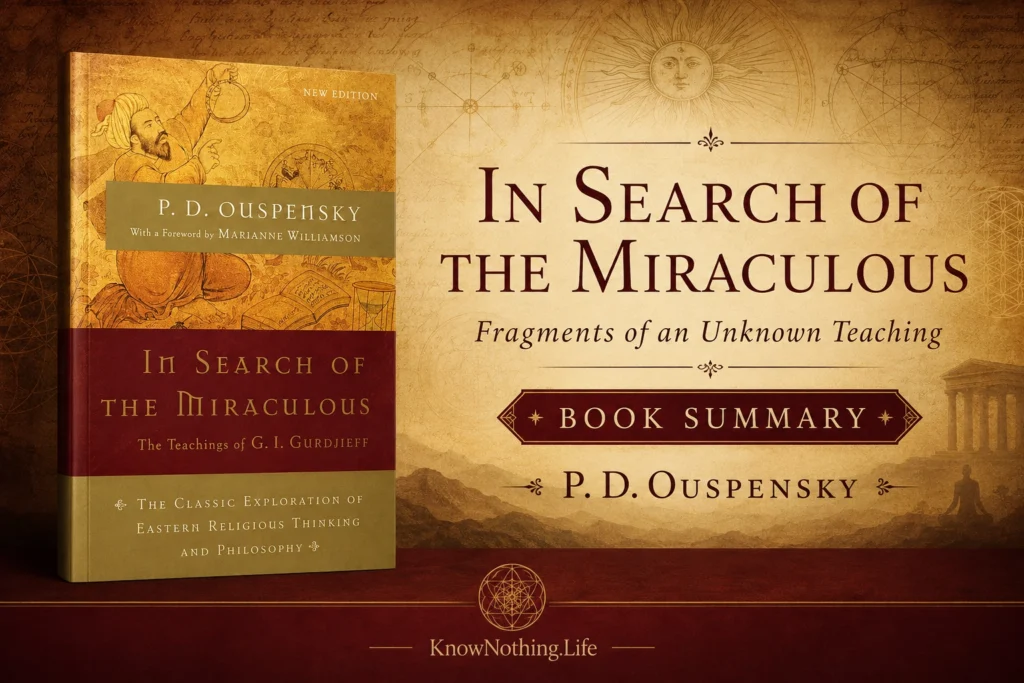
P. D. Ouspensky’s In Search of the Miraculous: Fragments of an Unknown Teaching is both a spiritual memoir and a systematic account of the ideas taught by George Ivanovich Gurdjieff. Published posthumously in 1949, it reconstructs Ouspensky’s meetings with “G.,” as Gurdjieff is called throughout the book, beginning in Russia in 1915 and continuing through revolution, exile, and the development of what became known as the Fourth Way. Scholars of Western esotericism describe Gurdjieff as one of the twentieth century’s most influential and controversial spiritual teachers, while Ouspensky’s narrative remains the clearest sustained exposition of his system.
The story opens after Ouspensky returns from travels through Egypt, India, and Ceylon, dissatisfied with his search for hidden schools of wisdom but convinced that ordinary intellectual culture cannot answer the deepest questions of existence. Meeting Gurdjieff redirects that search. Instead of promising supernatural spectacles, Gurdjieff offers an exacting psychology of transformation. The “miraculous” becomes the possibility that a person might grow conscious, unified, and capable of intentional action. The book is therefore less an occult adventure than a challenge to conventional assumptions about identity, freedom, knowledge, and responsibility.
Human Beings as Machines
The book’s most provocative assertion is that ordinary people are not genuinely awake. Gurdjieff declares that “man is a machine,” meaning that thoughts, emotions, habits, and decisions are usually triggered by external impressions and conditioned reactions. People imagine that they possess stable wills, yet much of life merely “happens” through them. Modern psychology does not accept this absolute formulation, but research on automaticity offers a striking parallel. John Bargh and Tanya Chartrand’s influential review, “The Unbearable Automaticity of Being,” argued that much everyday perception, evaluation, motivation, and behavior occurs without deliberate conscious control.
Ouspensky also attacks the assumption that each person has one permanent, consistent self. Gurdjieff describes personality as a crowd of competing “I’s”: one makes a promise, another breaks it; one wants discipline, another seeks comfort. “Man is a plurality,” he says, because every temporary impulse speaks in the name of the whole person. This can be compared with William James’ picture of human beings as bundles of habits, Freud’s divided model of the psyche, and social-cognitive theories that understand the self as a collection of context-dependent identities. The parallels are suggestive, although Gurdjieff’s metaphysical conclusions extend far beyond the available psychological evidence.
Self-Observation and Self-Remembering
The first practical task of the Fourth Way is self-observation without immediate judgment or correction. Students are instructed to notice thoughts, bodily movements, emotional reactions, speech patterns, and shifts of attention as though examining an unfamiliar mechanism. Ouspensky discovers that ordinary introspection is unreliable because the observer repeatedly becomes absorbed in what is being observed. Richard Nisbett and Timothy Wilson’s classic 1977 paper, “Telling More Than We Can Know,” later reached a related conclusion: people often lack direct access to the mental processes producing their judgments and construct plausible explanations afterward.
Self-remembering is the book’s central practice and its most difficult idea. Ouspensky defines it through divided attention: one part remains directed toward an object, conversation, or task, while another sustains an immediate sense of one’s own presence. It is not self-analysis or embarrassed self-consciousness, but the effort to experience “I am here” while remaining engaged with the world. Jonathan Schooler’s research on meta-awareness shows that people are only intermittently aware that their minds have wandered. Wendy Hasenkamp and colleagues similarly describe meditation as a cycle of wandering, recognition, attentional shifting, and renewed focus. These findings do not verify Ouspensky’s doctrine, but they support his observation that awareness of awareness is fragile and trainable.
The Fourth Way
Gurdjieff distinguishes the Fourth Way from three traditional paths: the fakir’s discipline of the body, the monk’s cultivation of faith and emotion, and the yogi’s training of mind. The Fourth Way attempts to develop body, feeling, and intellect simultaneously while a person remains within ordinary life. Work, family, irritation, ambition, and conflict become the materials of practice because they reveal mechanical reactions. Transformation is tested not by unusual visions but by whether someone can remain present under pressure, resist habitual behavior, and act with greater coherence.
The teaching nevertheless claims that lasting transformation requires a school, teacher, and group because individuals cannot easily see their own defenses. This is both one of the system’s strongest insights and one of its greatest risks. Corrective relationships can expose blind spots, just as psychotherapy and contemplative training use feedback, practice, and accountability. Charismatic authority, however, can create dependency and discourage criticism. Ouspensky emphasizes verification, and the Fourth Way formally rejects blind faith, but readers must still distinguish productive discipline from obedience that makes a teacher’s claims immune to ethical evaluation.
Knowledge, Being, and Understanding
A major philosophical theme is the difference between knowledge and being. A person may accumulate theories and spiritual vocabulary without changing in character. Conversely, intense feeling without discrimination may produce sincerity without understanding. Gurdjieff defines understanding as the union of knowledge and being: comprehension depends not only on information but on attention, emotional maturity, and practical embodiment. This recalls Aristotle’s distinction between knowing moral principles and possessing practical wisdom, as well as the ancient belief that philosophy should transform the knower rather than merely supply ideas.
Ouspensky consequently portrays intellectualism as another possible form of sleep. Someone can discuss consciousness while remaining inattentive, praise discipline while obeying every impulse, or speak of compassion while treating others mechanically. Research on mindfulness partly supports the broader claim that trained attention can affect behavior and emotion. Britta Hölzel and colleagues proposed attention regulation, body awareness, emotion regulation, and changes in self-perspective as interacting mechanisms of mindfulness. A major review led by Madhav Goyal found small-to-moderate reductions in several dimensions of psychological stress. Such findings support disciplined awareness practices, not the full metaphysics of the Fourth Way.
Cosmology, the Enneagram, and Esoteric Science
Large portions of In Search of the Miraculous move from psychology into cosmology. Gurdjieff presents the Ray of Creation, the Law of Three, the Law of Seven, levels of matter, cosmic octaves, and the enneagram as parts of a universal system. These ideas supposedly show that common laws govern galaxies, organisms, music, history, and inner development. The Law of Seven portrays processes as discontinuous: movements lose momentum or change direction at intervals unless they receive an additional “shock.” Psychologically, this becomes a memorable model of why resolutions decay, organizations drift from their purposes, and personal change rarely follows a straight line.
As literal physics or cosmology, these doctrines have not been confirmed by modern science. Their value is symbolic, phenomenological, or metaphysical rather than empirical. The enneagram in Ouspensky’s book should also not be confused with the later nine-personality-type system popular in self-help culture; Gurdjieff used it to represent dynamic processes rather than fixed personality categories. Philosopher Jacob Needleman notes that the book deliberately interweaves cosmic laws with psychological practice, yet Ouspensky repeatedly returns to the claim that universal principles must be observed within oneself. Readers can therefore treat the cosmology as speculation while evaluating the psychological exercises independently.
Meaning and Lasting Influence
The power of In Search of the Miraculous lies in its relentless exposure of self-deception. It asks whether people truly remember their lives, choose their reactions, fulfill their intentions, or understand the motives they confidently explain. Its language of sleep, machinery, and competing selves is severe, but it captures recognizable features of cognition: habit, inattentiveness, rationalization, emotional reactivity, and inconsistency. Research on automatic processing, mind wandering, metacognition, and mindfulness makes parts of Ouspensky’s psychological portrait feel surprisingly contemporary, although these fields use different methods and do not validate his esoteric cosmology.
The book is best read neither as established science nor as mere occult curiosity, but as a demanding work of practical philosophy. It records one intellectual’s attempt to discover whether consciousness can be cultivated rather than simply discussed. Its central question is not whether every cosmic diagram is true, but whether ordinary awareness is as complete and continuous as it appears. Ouspensky’s answer is no. Human beings may possess the possibility of greater unity and freedom, but possibility is not achievement. Awakening begins when a person notices the difference between imagining oneself conscious and actually becoming present.