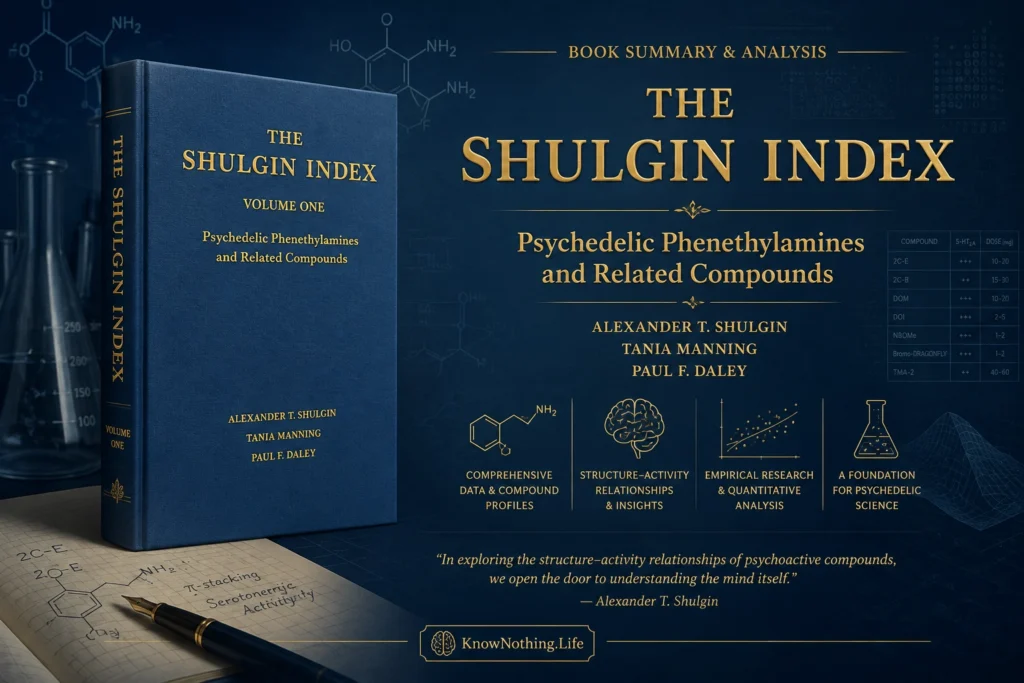
Published in 2011 by Transform Press, The Shulgin Index, Volume One: Psychedelic Phenethylamines and Related Compounds represents a different side of Alexander “Sasha” Shulgin from the autobiographical experimenter encountered in PiHKAL and TiHKAL. Co-authored with Tania Manning and Paul F. Daley, the book is primarily a scientific reference work: a structure-oriented survey of psychedelic phenethylamines, substituted amphetamines, phenylpiperazines, and chemically related substances. Transform Press confirms Manning’s role as Shulgin’s longtime collaborator and co-author alongside Daley. The finished volume describes 126 principal compounds in detail while covering more than 1,300 related substances through its tables and subsidiary entries, supported by more than 2,000 references.
That structure makes The Shulgin Index less a conventional book to be read from beginning to end than an intellectual map. Where PiHKAL combined chemistry with autobiography and subjective reports, the Index organizes a much larger chemical landscape according to molecular relationships, physical characteristics, analytical chemistry, pharmacology, and legal status. Its deeper theme is nevertheless familiar from Shulgin’s earlier work: tiny changes in molecular structure can correspond with remarkably different biological and psychological consequences. The book asks readers to view psychedelic chemistry not as a collection of isolated drugs but as a system of relationships waiting to be compared.
Phenethylamines as a Family of Possibilities
Phenethylamine is a relatively simple molecular scaffold, yet modifications to it have produced compounds with dramatically different effects. Some substituted phenethylamines, such as mescaline and members of the 2C family, are serotonergic psychedelics. Others display stimulant or entactogenic characteristics, while still others have little or no notable psychoactivity. The importance of The Shulgin Index lies partly in placing these substances next to one another so that differences in substitution patterns can be compared with differences in pharmacology. Modern reviews continue to identify serotonin 5-HT2A receptor agonism as a central mechanism of classic psychedelic action, particularly for hallucinogenic phenethylamines.
This relationship between chemical structure and psychological experience is what makes the Index more than a chemist’s catalogue. If changing the position of a methoxy group or another molecular feature substantially alters receptor affinity, potency, duration, or subjective character, then medicinal chemistry becomes a way of probing the biological machinery underlying consciousness. David Nichols’ major review of psychedelic structure–activity relationships demonstrates how decades of work on phenethylamines and other psychedelics have used such comparisons to identify molecular features associated with activity at serotonergic receptors. Shulgin’s catalogue consequently resembles a map of experiments that nature and chemists have performed upon the interface between molecule and mind.
Structure–Activity Relationships and the Logic of Shulgin’s Work
Structure–activity relationships, usually abbreviated SAR, form one of the most important concepts underlying The Shulgin Index. In pharmacology, SAR research examines how alterations in molecular structure change biological activity. Shulgin’s career was unusually devoted to this process. Instead of treating one psychoactive molecule as an endpoint, he repeatedly examined families of analogues, asking what happened when particular portions of a structure were modified. Contemporary research continues this tradition. Studies involving substituted phenethylamines have demonstrated that apparently modest changes in molecular configuration can substantially change activity at the 5-HT2A receptor and other pharmacological targets.
The philosophy behind this approach resembles Francis Bacon’s experimental program in Novum Organum. Bacon argued that knowledge advances through organized comparison and systematic manipulation rather than through speculation alone. Shulgin’s chemical investigations follow a similar logic: change one feature, observe what differs, and gradually infer which structural characteristics matter. Yet psychedelics make this strategy philosophically unusual because one of the outcomes being investigated is consciousness itself. A structural modification can eventually manifest as altered perception, emotion, cognition, or self-awareness. The Index therefore occupies an unusual meeting point between organic chemistry and what philosophers would call the study of subjective experience.
Mescaline and the Historical Foundation of Psychedelic Phenethylamines
Mescaline provides an important reference point for understanding the compounds organized in The Shulgin Index. The naturally occurring psychedelic phenethylamine has played a major role in Western investigations of altered consciousness since the late nineteenth and early twentieth centuries. Writers and psychologists used mescaline experiences to ask whether ordinary waking consciousness represents the only meaningful form of awareness. William James had already developed a similar argument in The Varieties of Religious Experience, proposing that ordinary rational consciousness might be only one among multiple possible states of mind.
Modern controlled research allows these questions to be examined with methods unavailable to James or early psychopharmacologists. A randomized, double-blind study comparing mescaline with LSD and psilocybin found substantial similarities in their acute subjective effects when doses were adjusted to produce comparable psychedelic intensity, while their potency and time courses differed considerably. Such findings reinforce one of the conceptual lessons implicit in Shulgin’s Index: chemical families matter, but classifications do not perfectly predict experience. Molecules can converge on overlapping psychological states through related pharmacological mechanisms while retaining important differences in kinetics, receptor interactions, and experiential profile.
2C-B and the Experimental Expansion of Psychedelic Chemistry
Among the compounds most strongly associated with Shulgin’s research is 2C-B, a substituted phenethylamine derived conceptually from the broader mescaline tradition. Shulgin’s investigations of compounds in the 2C family helped demonstrate how alterations to the phenethylamine scaffold could produce substances with markedly different potency and subjective characteristics. Modern molecular research continues examining precisely these structure–activity relationships, including how substitution patterns influence 5-HT2A receptor activation.
Human research has also begun subjecting some Shulgin-associated compounds to controlled psychological testing. A 2023 double-blind, placebo-controlled study comparing 2C-B with psilocybin found that 2C-B produced clear psychedelic alterations of waking consciousness, along with measurable changes in cognition and cardiovascular function, but generally produced a shorter and somewhat less experientially deep state than psilocybin at the doses studied. This kind of research illustrates why the Index remains scientifically interesting. Compounds once known largely through chemical literature and informal reports can become tools for investigating which features of psychedelic experience are shared across substances and which depend upon particular molecular and pharmacological characteristics.
MDMA and the Limits of Simple Drug Categories
The broader phenethylamine world also demonstrates why words such as “psychedelic,” “stimulant,” and “entactogen” cannot always be treated as rigid molecular categories. MDMA, for example, is structurally related to the larger phenethylamine and amphetamine family but produces a psychological profile substantially different from classical serotonergic psychedelics. Rather than being defined primarily by visual alterations or major changes in the structure of consciousness, MDMA is associated with emotional openness, social closeness, and changes in affective processing.
Controlled psychological studies support parts of this distinction. Research by Cédric Hysek and colleagues found that MDMA increased measures of emotional empathy and prosocial behavior, while other experiments have reported increased subjective feelings of trust, openness, and closeness. Such findings reveal why Shulgin’s structure-oriented approach is so useful. Chemical similarity does not imply psychological identity. A molecular family can contain substances whose effects diverge significantly because of differences in serotonin, dopamine, norepinephrine, transporter, and receptor activity. More recent receptor-screening research likewise suggests that many psychedelics have broader pharmacological profiles than a simple “one drug–one receptor” model implies.
From Molecular Data to Subjective Experience
One of the most intriguing philosophical problems surrounding The Shulgin Index is that molecular information and subjective experience belong to different descriptive levels. Chemistry can specify exactly how atoms are arranged. Pharmacology can measure affinity and functional activity at receptors. Neuroscience can observe changes in neural systems. Yet none of those descriptions alone tells us what a psychedelic experience feels like. This resembles the central concern of phenomenology, particularly the tradition associated with Edmund Husserl: consciousness must also be examined from the standpoint of lived experience.
Shulgin’s earlier writings gave enormous weight to first-person reports, while The Shulgin Index moves much closer to the objective side of the equation. Contemporary psychedelic science increasingly attempts to combine both. Research has demonstrated a strong relationship between psilocin levels, cerebral 5-HT2A receptor occupancy, and reported psychedelic intensity, providing a measurable bridge between pharmacology and subjective consciousness. Yet psychological research also shows that psychedelic effects vary with internal expectations and external surroundings—the traditional variables of “set and setting.” The molecule matters enormously, but it does not act upon an empty psychological landscape.
The Index as a Philosophy of Scientific Organization
The word “Index” accurately captures the book’s intellectual purpose. Its 126 principal entries contain information on physical properties, analytical chemistry, biochemical and pharmacological characteristics, and legal status, while subsidiary tables expand the coverage to more than 1,300 compounds. The volume also includes hundreds of GC-MS analytical records and extensive citations designed to connect entries with the existing scientific literature. This organization turns a fragmented field into something researchers can navigate structurally.
Thomas Kuhn argued in The Structure of Scientific Revolutions that scientific knowledge depends not only upon isolated observations but upon frameworks that allow researchers to recognize meaningful relationships among observations. The Shulgin Index operates at a less theoretical but highly practical level. By placing related compounds beside one another, the book allows differences to become visible. Classification becomes a method of discovery. A database of structures can reveal patterns, unexplored analogues, inconsistencies, and missing information. Shulgin’s contribution here is therefore not merely the invention or investigation of individual substances; it is the construction of a conceptual landscape through which psychedelic medicinal chemistry can be understood.
Scientific Value, Ethical Limits, and Historical Context
The book must also be read with awareness of the unusual research culture from which Shulgin emerged. Much of his earlier psychedelic investigation relied on self-experimentation and small groups of experienced collaborators rather than the randomized, blinded, statistically powered designs expected in contemporary human pharmacology. Such observations were valuable for generating hypotheses, but they cannot independently establish population-level safety, therapeutic efficacy, or reliable estimates of adverse-event risk. Modern studies of mescaline and 2C-B demonstrate the scientific gains that occur when subjective phenomena are investigated with controlled experimental methods.
The Index itself is therefore most valuable as chemistry and documentation rather than as a clinical guide. Its inclusion of legal and pharmacological information acknowledges that psychoactive compounds exist within medical, cultural, and regulatory systems as well as laboratories. The history of psychedelics repeatedly demonstrates the tension between John Stuart Mill’s ideal of personal liberty in On Liberty and society’s responsibility to manage uncertain risks. Shulgin generally favored freedom of inquiry, but the contemporary scientific revival of psychedelic research shows that intellectual openness and rigorous safeguards need not be opposites.
What The Shulgin Index Ultimately Teaches
The Shulgin Index may lack the autobiographical intimacy that made PiHKAL and TiHKAL famous, but it arguably presents Shulgin’s scientific mentality in its purest form. The book treats psychedelic chemistry as a vast space of possibilities in which molecular structures can be organized, compared, tested, and related to biological effects. Its scale—126 principal compounds, more than 1,300 compounds overall, and thousands of literature references—reveals how misleading it is to imagine “psychedelics” as a small collection of familiar substances.
The deeper lesson is that consciousness can be approached experimentally without being reduced to a single chemical explanation. Molecular structure influences receptors; receptors influence neural systems; neural systems interact with memory, personality, expectations, and environment; and from those interactions emerge experiences that may include altered perception, emotional openness, fear, insight, or radical changes in self-awareness. Modern pharmacology has confirmed the importance of 5-HT2A signaling while simultaneously revealing a far more complicated network of receptor interactions than earlier models suggested.
In that sense, The Shulgin Index: Psychedelic Phenethylamines and Related Compounds is ultimately a book about relationships—between one molecule and another, structure and activity, chemistry and psychology, objective measurement and subjective experience. Shulgin, Manning, and Daley provide the map rather than the final explanation. The continuing task of psychedelic science is to determine what those molecular relationships can reveal about the brain and, ultimately, about the remarkable range of states the human mind is capable of producing.