Among the most original and transformative thinkers of the early modern period, Baruch Spinoza stands as a philosopher who reshaped the foundations of metaphysics, ethics, and the philosophy of religion. Writing in the 17th century, Spinoza challenged conventional views of God, nature, and human freedom, offering a vision of reality grounded in reason and necessity rather than superstition or tradition. His work marked a decisive break from earlier philosophical systems, positioning him as one of the central figures of modern philosophy.
What makes Spinoza particularly remarkable is the rigor and boldness of his thought. He approached philosophy with a geometric method, presenting arguments with the clarity and structure of mathematics. At the same time, his ideas were deeply radical, questioning accepted doctrines about divine transcendence, free will, and morality. Through this combination of precision and innovation, Spinoza developed a philosophical system that continues to influence discussions of science, ethics, and spirituality.
Early Life and Excommunication
Spinoza was born in 1632 in Amsterdam, into a community of Portuguese-Jewish immigrants who had fled persecution in Spain and Portugal. His early life was shaped by religious education and the traditions of his community. He studied Hebrew texts, Jewish law, and theology, gaining a strong foundation in religious thought.
However, as he matured, Spinoza began to question traditional beliefs. His philosophical inquiries led him to conclusions that diverged sharply from orthodox teachings. He rejected anthropomorphic views of God and challenged the authority of scripture as a source of literal truth. These views brought him into conflict with religious authorities.
In 1656, Spinoza was formally excommunicated from the Jewish community, an event that marked a turning point in his life. This expulsion, known as the herem, severed his ties with his community and forced him into a life of relative isolation. Yet it also granted him the intellectual freedom to pursue his ideas without constraint, shaping the direction of his philosophical work.
Life of Simplicity and Intellectual Independence
Following his excommunication, Spinoza lived a modest and independent life, supporting himself through the craft of lens grinding. This work not only provided him with a livelihood but also connected him to the scientific developments of his time, particularly in optics and microscopy. His engagement with scientific inquiry reflects the broader intellectual environment of the Dutch Republic, which was characterized by openness and innovation.
Spinoza maintained a small circle of correspondents and admirers, engaging in philosophical discussions through letters and personal interactions. Despite offers of academic positions, he chose to remain independent, valuing intellectual autonomy over institutional recognition. This decision allowed him to pursue his work without compromise.
His lifestyle reflects a central aspect of his philosophy: the pursuit of clarity, simplicity, and freedom from external constraints. By minimizing distractions and focusing on intellectual inquiry, Spinoza created the conditions necessary for developing his ideas. His life serves as an example of philosophical commitment, demonstrating the alignment between his principles and his actions.
The Ethics and the Geometric Method
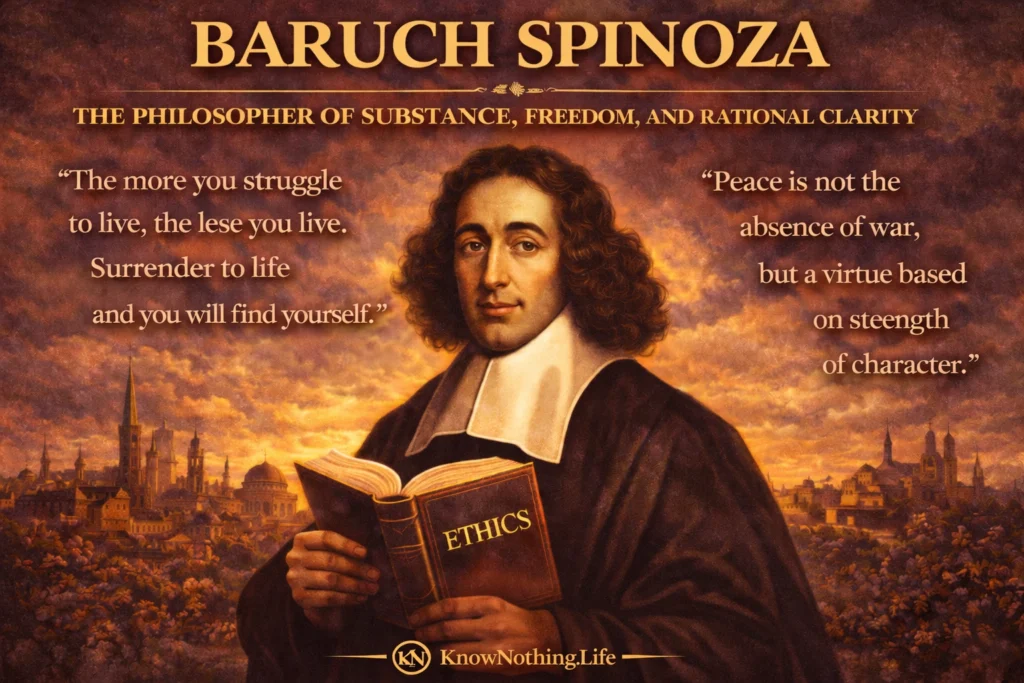
Spinoza’s most important work is the Ethics, a text that presents his philosophical system in a highly structured and systematic form. Written using a geometric method, the Ethics consists of definitions, axioms, propositions, and proofs, mirroring the style of mathematical reasoning. This approach reflects Spinoza’s belief that philosophy should achieve the same level of clarity and certainty as geometry.
The Ethics explores a wide range of topics, including the nature of God, the structure of reality, the human mind, and the path to happiness. At its core is the idea that everything follows from the necessity of divine nature. Spinoza argues that reality is governed by immutable laws, and that understanding these laws is key to achieving freedom.
One of the most striking aspects of the Ethics is its redefinition of God. Spinoza identifies God with nature itself, a concept often summarized as “Deus sive Natura” (“God or Nature”). This view rejects the idea of a personal, transcendent deity, presenting instead a unified and immanent reality. Through this framework, Spinoza offers a radically different understanding of existence.
Metaphysics: Substance, God, and Nature
At the heart of Spinoza’s philosophy is his concept of substance. He argues that there is only one substance in existence, which he identifies as God or Nature. This substance is infinite, self-caused, and encompasses everything that exists. All individual things are modes or expressions of this single substance.
This view has profound implications. By asserting that everything is part of a single, unified reality, Spinoza eliminates the distinction between creator and creation. God is not separate from the world but is identical with it. This perspective challenges traditional theological views while providing a coherent metaphysical framework.
Spinoza expressed this idea in a concise statement: “Whatever is, is in God, and nothing can be or be conceived without God.” This reflects his belief in the interconnectedness of all things and the necessity of understanding reality as a whole. His metaphysics emphasizes unity, necessity, and the rejection of dualism.
Human Nature, Emotions, and Freedom
Spinoza’s philosophy of human nature is deeply connected to his metaphysics. He viewed human beings as part of the natural order, subject to the same laws as everything else. This perspective leads to a deterministic view of human behavior, in which actions are determined by prior causes rather than free will in the traditional sense.
However, Spinoza redefines freedom in a way that does not depend on indeterminacy. For him, true freedom consists in understanding the causes that shape our actions and aligning ourselves with reason. By gaining knowledge of ourselves and the world, we can achieve a form of autonomy grounded in clarity rather than illusion.
He also developed a detailed analysis of emotions, or “affects,” exploring how they arise and how they can be transformed. Spinoza believed that negative emotions, such as fear and hatred, result from inadequate understanding, while positive emotions, such as joy, arise from increased knowledge and power. Through rational insight, individuals can move from passive experience to active engagement with life.
Key Teachings and Quotes
Spinoza’s writings contain numerous insights that capture the essence of his philosophy. One of his most famous statements is: “The more you struggle to live, the less you live. Surrender to life and you will find yourself.” This reflects his emphasis on understanding and acceptance rather than resistance.
Another important teaching is: “Freedom is understanding necessity.” This concise formulation encapsulates his redefinition of freedom, highlighting the role of knowledge in achieving autonomy. By recognizing the necessity of events, individuals can move beyond confusion and frustration.
He also observed: “Peace is not the absence of war, but a virtue based on strength of character.” This statement reflects his ethical perspective, emphasizing the importance of internal stability and rational clarity in achieving harmony.
Influence and Legacy
The influence of Spinoza extends across philosophy, science, and political thought. His ideas challenged established doctrines and contributed to the development of Enlightenment thinking. By emphasizing reason, natural law, and intellectual freedom, he helped shape the modern intellectual landscape.
Philosophers such as Kant, Hegel, and Nietzsche engaged with Spinoza’s work, recognizing its depth and originality. His concept of a unified reality influenced developments in metaphysics, while his analysis of emotions anticipated later work in psychology.
In modern times, Spinoza’s philosophy continues to inspire discussions about the nature of reality, the role of reason, and the pursuit of happiness. His integration of science and philosophy resonates with contemporary efforts to understand the world through a unified framework.
Conclusion
Baruch Spinoza stands as one of the most daring and systematic thinkers in the history of philosophy. Through his exploration of substance, nature, and human experience, he developed a vision of reality that challenges conventional boundaries and invites deeper understanding.
His work demonstrates that clarity and freedom arise not from escaping the world, but from understanding it. By aligning ourselves with the natural order and cultivating rational insight, we can achieve a form of liberation that is both intellectual and emotional.
In a world often marked by confusion and division, Spinoza’s philosophy offers a path toward unity and clarity. His legacy reminds us that the pursuit of truth is not only an intellectual endeavor but a way of life—one that seeks to harmonize thought, action, and existence itself.