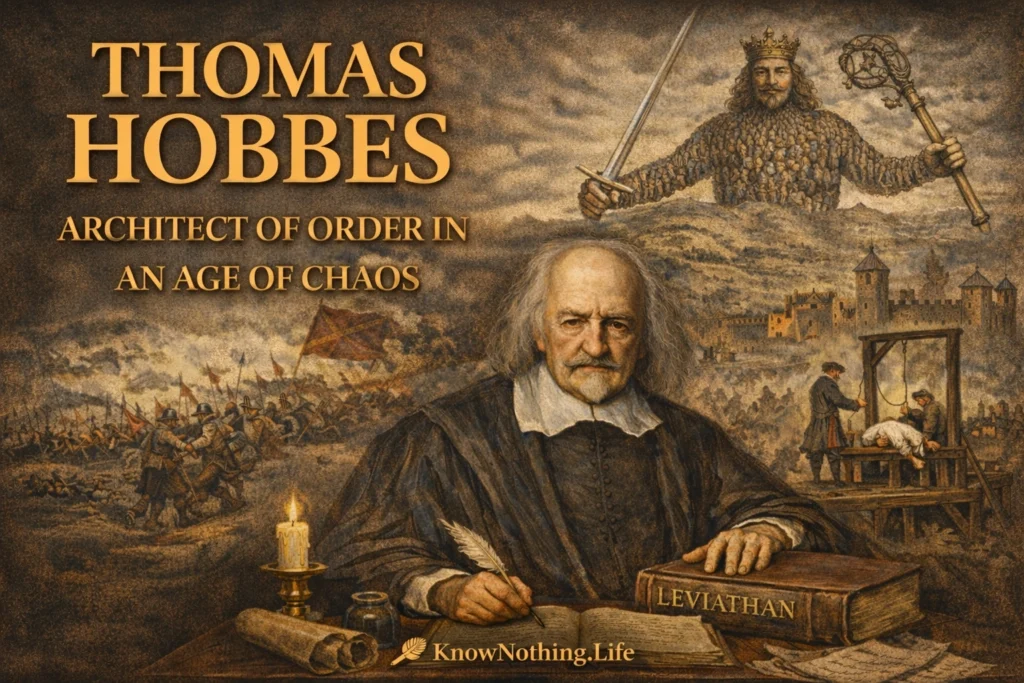
Few thinkers have shaped political philosophy as decisively as Thomas Hobbes, a man whose ideas emerged from one of the most turbulent periods in English history. Writing in the shadow of civil war, regicide, and social collapse, Hobbes sought to answer a question that remains urgent even today: what must exist to prevent human society from descending into violence and disorder? His answer—both stark and controversial—redefined the relationship between individuals and authority.
Hobbes approached philosophy not as abstract speculation but as a practical response to instability. He believed that understanding human nature was the key to constructing a durable political system. His work is often described as pessimistic, yet it is better understood as unflinchingly realistic, grounded in a mechanistic view of human behavior and a deep fear of anarchy. The clarity and force of his arguments ensured that his influence would extend far beyond his own century, shaping debates about sovereignty, rights, and the foundations of government.
Early Life and Intellectual Formation
Thomas Hobbes was born in 1588 in Westport, near Malmesbury, England, in a year famously marked by the looming threat of the Spanish Armada. Hobbes later remarked that “fear and I were born twins,” a phrase that captures both the historical moment of his birth and the central role that fear would play in his philosophical system. His father, a clergyman, abandoned the family early, leaving Hobbes to be raised by relatives who recognized his intellectual promise.
Educated at Magdalen Hall, Oxford, Hobbes received a traditional scholastic education, though he later criticized its reliance on Aristotelian logic. His intellectual development accelerated when he entered the service of the Cavendish family, where he worked as a tutor and companion. This position granted him access to elite intellectual circles and allowed him to travel extensively across Europe. During these journeys, Hobbes encountered leading thinkers of the Scientific Revolution, including Galileo Galilei, whose mechanistic view of the universe profoundly influenced Hobbes’s own philosophy.
Exposure to continental thought encouraged Hobbes to adopt a scientific approach to human behavior. He began to see individuals not as moral or spiritual entities guided by higher purposes, but as physical bodies governed by motion, desire, and aversion. This shift laid the groundwork for his later political theory, which would treat society as a system that could be analyzed—and constructed—according to rational principles.
Historical Context and the English Civil War
The defining context of Hobbes’s life was the upheaval of the English Civil War, a conflict that pitted royal authority against parliamentary power and plunged England into chaos. The war shattered traditional hierarchies, destabilized institutions, and exposed the fragility of social order. For Hobbes, these events were not merely political developments but existential threats to human security.
Witnessing the collapse of authority reinforced Hobbes’s belief that peace is the highest political good. He became convinced that without a strong, centralized power, human beings would inevitably fall into conflict. The violence and uncertainty of the civil war provided empirical evidence for his theory of human nature, which emphasized competition, distrust, and the pursuit of self-preservation.
Hobbes spent part of this period in exile in France, where he continued to refine his ideas. The distance from England allowed him to reflect on the causes of political instability and to develop a comprehensive account of how societies could avoid such disasters in the future. His most famous work would emerge directly from this context, offering a radical solution to the problem of order.
Major Works and Philosophical Contributions
Hobbes’s intellectual legacy is anchored in several key works, most notably Leviathan, a text that remains one of the most influential treatises in Western political thought. In this work, Hobbes constructs a vision of society grounded in a social contract, arguing that individuals must surrender certain freedoms to a sovereign authority in exchange for security. The title itself evokes the biblical sea monster, symbolizing the immense power of the state necessary to maintain order.
Before Leviathan, Hobbes explored related themes in De Cive and The Elements of Law. These earlier writings laid the foundation for his mature theory, examining the nature of human behavior, the origins of political authority, and the conditions required for stable governance. Across these works, Hobbes consistently emphasized the role of fear and rational calculation in shaping human decisions.
One of Hobbes’s most enduring contributions is his description of the “state of nature,” a hypothetical condition in which no political authority exists. In this state, he argued, life would be “solitary, poor, nasty, brutish, and short.” This famous phrase captures his belief that without a common power to enforce rules, individuals would exist in a constant state of conflict. His conclusion—that peace requires absolute authority—challenged both religious and republican traditions, making his work both influential and controversial.
Human Nature and the Social Contract
At the core of Hobbes’s philosophy is a distinctive account of human nature. He rejected the notion that humans are inherently social or guided by moral instincts. Instead, he portrayed individuals as driven by desires and fears, constantly seeking to secure their own survival and advantage. This perspective led him to a fundamentally materialist understanding of human behavior, in which thoughts and emotions are the result of physical processes.
From this view of human nature, Hobbes derived his theory of the social contract. He argued that rational individuals, recognizing the dangers of the state of nature, would agree to establish a common authority to maintain peace. This agreement is not based on altruism but on self-interest; individuals consent to authority because it offers protection from violence and uncertainty.
Hobbes’s social contract differs significantly from later versions proposed by thinkers such as John Locke and Jean-Jacques Rousseau. While these philosophers emphasized individual rights and limited government, Hobbes insisted on the necessity of absolute sovereignty. For him, any division of authority risked returning society to the chaos of the state of nature. His stark conclusion underscores the central tension in political philosophy between freedom and security.
Sovereignty, Authority, and Religion
Hobbes’s conception of sovereignty is both radical and uncompromising. He argued that the sovereign—whether a monarch or an assembly—must possess absolute authority to enforce laws and maintain order. This authority extends to all aspects of life, including religion, which Hobbes believed should be subordinated to the state. By placing religious institutions under political control, he sought to eliminate sources of conflict that could destabilize society.
This position brought Hobbes into conflict with religious authorities, who viewed his ideas as undermining the autonomy of the church. Yet Hobbes saw his approach as necessary for preventing sectarian violence. In a period marked by religious wars and divisions, he argued that unity under a single authority was essential for peace.
Despite his emphasis on absolute power, Hobbes did not advocate tyranny for its own sake. His justification for sovereignty was grounded in its ability to provide security. If a ruler failed to protect the lives of subjects, the rationale for obedience would collapse. This pragmatic approach distinguishes Hobbes’s theory from purely authoritarian doctrines, highlighting his focus on stability rather than domination.
Style, Method, and Scientific Influence
Hobbes’s philosophical method reflects the influence of the Scientific Revolution, particularly the mechanistic worldview associated with figures like Galileo. He sought to apply the principles of geometry and physics to the study of human behavior, treating society as a system governed by laws that could be understood and predicted. This approach marked a departure from earlier traditions that relied on moral or theological explanations.
His writing style is characterized by clarity, precision, and rhetorical force. Hobbes employed vivid imagery and memorable phrases to convey his ideas, ensuring that his work would resonate with readers across generations. The metaphor of the Leviathan, for example, captures the power and necessity of the state in a way that abstract arguments alone could not.
By grounding his philosophy in empirical observation and logical reasoning, Hobbes helped to establish political theory as a discipline that could be studied systematically. His work paved the way for later developments in social science, influencing fields ranging from economics to psychology.
Legacy and Influence
The impact of Thomas Hobbes extends far beyond his own time. His ideas have shaped debates about the nature of authority, the limits of government, and the role of fear in human behavior. While his advocacy of absolute sovereignty has been widely criticized, his analysis of the state of nature and the social contract remains foundational to modern political thought.
Hobbes’s influence can be seen in the work of later philosophers who grappled with similar questions, often in response to his arguments. Thinkers such as Locke and Rousseau sought to refine or challenge his conclusions, leading to the development of alternative models of governance. Even critics of Hobbes have acknowledged the power of his insights, recognizing that his pessimistic view of human nature captures enduring aspects of political life.
In contemporary discussions, Hobbes’s ideas continue to resonate in debates about security, authority, and the balance between freedom and control. His work serves as a reminder that the stability of society cannot be taken for granted, and that the structures we rely on for order are the result of deliberate choices shaped by human fears and aspirations.
Final Thoughts
Thomas Hobbes remains a central figure in the history of philosophy, not because he offered comforting answers, but because he confronted uncomfortable truths. His vision of human nature and political order challenges readers to reconsider assumptions about morality, freedom, and the role of authority. By grounding his theory in the realities of conflict and insecurity, he provided a framework for understanding the conditions necessary for peace.
His famous assertion that life without authority would be “solitary, poor, nasty, brutish, and short” continues to provoke reflection on the foundations of society. Whether one agrees with his conclusions or not, Hobbes’s work demands engagement, forcing us to grapple with the enduring question of how order can be achieved in a world shaped by competing desires and fears.