Few philosophers have constructed a system as ambitious, intricate, and influential as Georg Wilhelm Friedrich Hegel. Writing in the aftermath of revolution and during the rise of modern Europe, Hegel sought nothing less than to explain reality as a dynamic, unfolding process driven by reason itself. His philosophy attempts to unify logic, history, politics, and human consciousness into a single, coherent framework—one in which contradiction is not a flaw, but the engine of progress.
Hegel’s work is often regarded as difficult, even opaque, yet beneath its complexity lies a powerful insight: reality is not static but constantly evolving through tension and resolution. He rejected the idea that truth could be understood in isolated fragments, arguing instead that it emerges through a total process—what he famously called the development of Spirit (Geist). His ideas would go on to influence fields as diverse as political theory, theology, and psychology, leaving a legacy that continues to shape modern thought.
Early Life and Intellectual Formation
Georg Wilhelm Friedrich Hegel was born in 1770 in Stuttgart, in the Duchy of Württemberg, into a middle-class family. His early education was rigorous and steeped in classical literature, theology, and philosophy. From a young age, Hegel demonstrated an exceptional intellectual discipline, immersing himself in Greek philosophy and Enlightenment thought, which would later form the foundation of his own system.
Hegel’s intellectual trajectory took a decisive turn when he enrolled at the Tübinger Stift, a Protestant seminary, where he studied alongside two figures who would become central to German philosophy: Friedrich Schelling and Friedrich Hölderlin. These friendships exposed Hegel to radical ideas about freedom, nature, and subjectivity, particularly in the context of the political upheavals sweeping Europe at the time.
The influence of the French Revolution was especially profound. Hegel initially saw the revolution as the realization of human freedom in history, a moment in which abstract ideals became concrete reality. Although he would later adopt a more nuanced view, the revolution left a lasting imprint on his thought, reinforcing his belief that history is a rational process driven by the unfolding of human freedom.
The Philosophical Project: System and Method
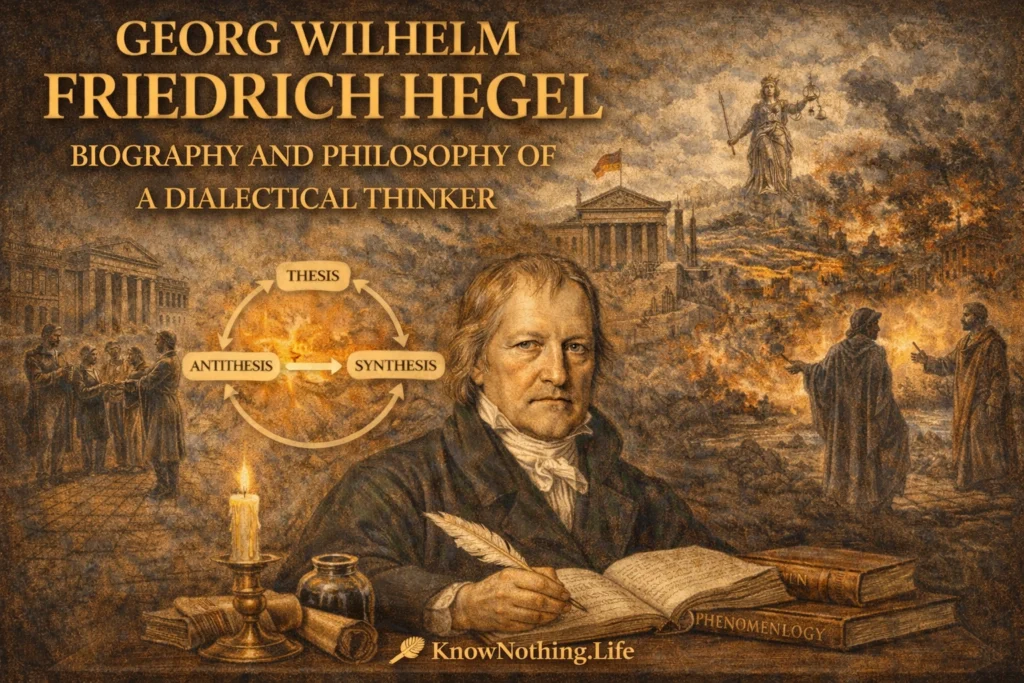
Hegel’s philosophy is defined by its systematic ambition. Unlike many thinkers who focused on specific domains, Hegel aimed to construct a comprehensive account of reality that would encompass logic, nature, and human society. His system is built on the idea that truth is not a fixed entity but a process—one that unfolds through a dialectical movement of contradiction and resolution.
The dialectical method, often simplified as a progression of thesis, antithesis, and synthesis, is central to Hegel’s approach. While Hegel himself did not use these exact terms in a rigid formula, the underlying idea remains: concepts develop through internal tensions that lead to higher levels of understanding. This dynamic process reflects the structure of reality itself, which Hegel saw as inherently self-developing.
One of his most famous assertions captures this vision: “What is rational is actual; and what is actual is rational.” This statement reflects his belief that reality is not chaotic or arbitrary, but structured by reason. For Hegel, philosophy’s task is to comprehend this rational structure, revealing how seemingly disparate elements are connected within a unified whole.
Major Works and Intellectual Contributions
Hegel’s philosophical system is articulated across several major works, each addressing a different dimension of his thought. Among these, Phenomenology of Spirit stands as one of his most influential texts. In it, Hegel traces the development of consciousness from immediate sense experience to absolute knowledge, illustrating how human awareness evolves through stages of conflict and reconciliation.
Another foundational work, Science of Logic, presents his most abstract and systematic exploration of thought itself. Here, Hegel examines the structures of logic not as static rules, but as dynamic processes that mirror the development of reality. The work challenges traditional conceptions of logic, proposing instead that contradiction is an essential component of truth.
In Elements of the Philosophy of Right, Hegel turns to the realm of social and political life, offering a sophisticated account of freedom, law, and the state. He argues that true freedom is not merely the absence of constraint, but the realization of individual will within ethical institutions such as family, civil society, and the state. Across these works, Hegel constructs a vision of reality as an interconnected, evolving totality.
Consciousness, Self, and Recognition
One of Hegel’s most enduring contributions lies in his analysis of consciousness and selfhood. In the Phenomenology of Spirit, he explores how individuals come to understand themselves not in isolation, but through relationships with others. This insight is captured in his famous discussion of the master-slave dialectic, a narrative that illustrates the struggle for recognition between self-conscious beings.
Hegel argues that self-consciousness emerges through a process of mutual recognition. Individuals seek affirmation from others, and this desire creates a dynamic interplay of power, dependence, and transformation. The master-slave relationship reveals that domination does not lead to true independence; rather, genuine selfhood arises through reciprocal recognition and shared humanity.
This idea has had a profound influence on later thinkers, including Karl Marx, who adapted the dialectical framework to analyze social and economic relations. Hegel’s exploration of recognition also anticipates modern discussions in psychology and social theory, highlighting the importance of interpersonal relationships in the formation of identity.
History and the Unfolding of Spirit
For Hegel, history is not a random sequence of events, but a rational process through which human freedom gradually realizes itself. He viewed historical development as the unfolding of Spirit (Geist), a collective consciousness that evolves through cultural, political, and intellectual transformations. Each stage of history represents a moment in this larger process, contributing to the realization of freedom.
Hegel famously described history as “the progress of the consciousness of freedom.” In his view, different civilizations embody different understandings of freedom, with each stage building upon and transcending the previous one. Ancient societies, for example, recognized freedom only for a few, while modern states aim to extend it universally.
This teleological view of history has been both influential and controversial. While it offers a powerful framework for understanding historical development, it has also been criticized for its tendency to impose a linear narrative on complex events. Nevertheless, Hegel’s conception of history as meaningful and structured continues to shape philosophical and political discourse.
The State, Freedom, and Ethical Life
Hegel’s political philosophy centers on the idea that freedom is realized through participation in ethical life (Sittlichkeit). He rejected the notion that freedom consists solely in individual autonomy, arguing instead that it is achieved within the institutions that structure social existence. The family, civil society, and the state each play a role in mediating individual desires and collective needs.
In the Philosophy of Right, Hegel presents the state as the highest expression of ethical life, a rational institution that embodies the general will. Unlike earlier thinkers such as Jean-Jacques Rousseau, who emphasized direct popular sovereignty, Hegel envisioned the state as a complex system of laws and institutions that reconcile individual and collective interests.
His view of the state has been interpreted in various ways, with some critics accusing him of justifying authoritarianism. However, Hegel’s emphasis on rationality and ethical life suggests a more nuanced position, one in which the legitimacy of the state depends on its ability to realize freedom. His work invites ongoing debate about the nature of political authority and the conditions under which freedom can flourish.
Legacy and Influence
The influence of Hegel’s philosophy extends across multiple disciplines and intellectual traditions. His dialectical method and emphasis on historical development profoundly shaped the work of later thinkers, including Marx, as well as existentialists, phenomenologists, and critical theorists. Even those who rejected his conclusions often engaged deeply with his ideas, demonstrating their enduring significance.
Hegel’s impact is particularly evident in the development of modern social theory, where his insights into history, recognition, and institutional life continue to inform contemporary debates. His work also played a crucial role in the evolution of German idealism, influencing both his contemporaries and subsequent generations of philosophers.
Despite the challenges posed by his dense and complex writing, Hegel remains a central figure in the history of philosophy. His ambition to understand reality as a unified, dynamic process continues to inspire those who seek to grasp the deeper structures of human existence.
Final Thoughts
Georg Wilhelm Friedrich Hegel stands as one of the most ambitious and challenging thinkers in the philosophical tradition. His vision of reality as an unfolding process driven by reason offers a powerful framework for understanding the world, even as it demands careful and sustained engagement. By embracing contradiction as a source of development, Hegel transformed the way we think about truth, history, and human life.
His assertion that “the real is rational” continues to provoke reflection, inviting us to consider the extent to which the world we inhabit reflects deeper patterns of meaning and necessity. Whether one agrees with his conclusions or not, Hegel’s work compels us to confront the complexity of existence and the possibility that understanding lies not in simplicity, but in the dynamic interplay of opposing forces.