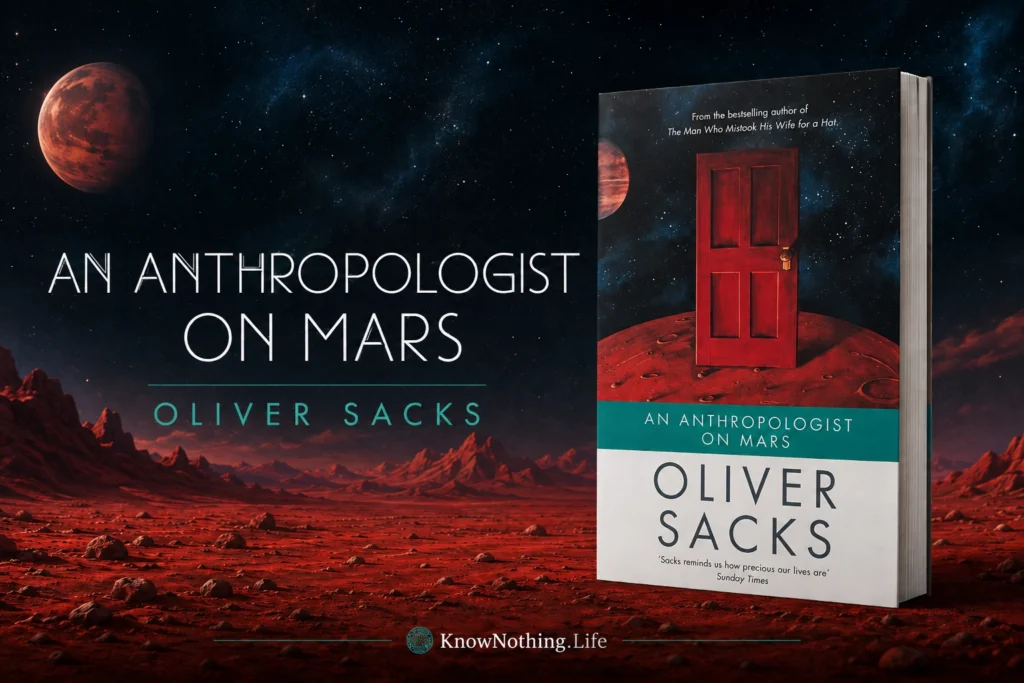
Oliver Sacks’ An Anthropologist on Mars: Seven Paradoxical Tales, published in 1995, expands the neurological storytelling he developed in The Man Who Mistook His Wife for a Hat. Instead of short clinical sketches, Sacks presents seven extended portraits of people whose neurological conditions have transformed perception, memory, movement, creativity, or social understanding. His subjects include a painter who loses the ability to perceive color, a man whose memory is devastated by a brain tumor, a surgeon with Tourette syndrome, a man who gains sight after decades of blindness, an artist possessed by extraordinarily vivid childhood memories, the autistic artist Stephen Wiltshire, and animal scientist Temple Grandin. Sacks himself described the book as a return to individuals and their stories, but explored with greater depth than in his earlier collection.
The organizing idea is one of the most important in Sacks’ work: neurological illness does not simply remove abilities. Sometimes it forces the nervous system and the person to construct another way of being. A deficit may be devastating, but adaptation can create skills, habits, identities, and perceptual worlds that would never otherwise have existed. This is not an argument that disability is secretly beneficial or that loss should be romanticized. Several of Sacks’ subjects suffer profoundly. Rather, he challenges the assumption that health can be understood only by comparing individuals with a fixed neurological “normal.” The human brain is plastic, and people respond creatively to conditions they did not choose. The seven cases therefore become philosophical investigations into a larger question: if perception, memory, social intuition, and bodily control can all be radically reorganized, how many different ways are there for a human mind to construct a meaningful world?
The Colorblind Painter and the Loss of an Entire Dimension
“The Case of the Colorblind Painter” concerns an accomplished artist whom Sacks calls Mr. I. After an accident, the painter develops cerebral achromatopsia: he can still see shapes, depth, motion, and detail, but color disappears completely. His world is not merely desaturated. Foods become visually repulsive, faces lose their familiar vitality, and paintings created before the accident become almost incomprehensible because their color relationships can no longer be experienced. Even memory and imagination are affected. Color had been so deeply integrated into Mr. I’s professional identity that its disappearance feels like the destruction of an entire mode of existence.
Modern neuroscience confirms that color perception can be selectively impaired by cortical injury even when the eyes themselves remain capable of receiving light. Areas in the ventral visual stream, particularly regions commonly associated with V4 and neighboring cortex, contribute importantly to color processing; bilateral damage can produce cerebral achromatopsia while leaving other visual abilities relatively intact. What fascinates Sacks is what happens next. Mr. I eventually develops a new artistic life in black, white, and gray. His visual system does not simply wait for color to return. His aesthetic preferences, memories, habits, and creative techniques reorganize around the world he now inhabits. Sacks thus turns a neurological deficit into an inquiry resembling Maurice Merleau-Ponty’s Phenomenology of Perception: perception is not a neutral recording of external properties but part of the structure through which a person experiences meaning. Losing color changes not merely what Mr. I sees but what food, faces, art, memory, and beauty are like for him.
“The Last Hippie” and the Fragility of Personal Time
In “The Last Hippie,” Sacks describes Greg, whose enormous brain tumor damaged frontal structures and produced severe amnesia along with blindness and profound changes in initiative. Greg retains an intense attachment to the music and culture of the 1960s, particularly the Grateful Dead, but much of his later life seems unable to establish itself with equal permanence. The result recalls Sacks’s earlier patient Jimmie in “The Lost Mariner”: the biological organism continues aging while autobiographical consciousness remains strangely anchored in an earlier period. Greg can converse, joke, sing, and respond emotionally, yet his capacity to build a continuously updated narrative of himself has been profoundly impaired.
The case illuminates a distinction between existing through time and experiencing oneself as a continuous person through time. William James, in The Principles of Psychology, famously wrote about consciousness as a stream. Sacks shows how much that stream depends on mechanisms that continually relate present experience to remembered past and anticipated future. Memory is therefore not simply a mental archive from which old facts can be retrieved. It participates in identity. Greg’s attraction to familiar music is especially revealing because emotional and musical responsiveness can survive despite severe impairment elsewhere. Sacks repeatedly finds preserved “islands” of self inside damaged systems, an approach indebted to neuropsychologist Alexander Luria’s insistence that clinicians investigate the organization of the whole person rather than reduce a patient to the site of a lesion.
Tourette Syndrome and the Surgeon Who Changes While Operating
“A Surgeon’s Life” follows a physician with Tourette syndrome whose ordinary behavior contains conspicuous motor tics, sudden movements, touching, vocalizations, and compulsive actions. Yet while performing surgery, he becomes remarkably calm and controlled. The transformation appears almost paradoxical: the same nervous system that produces disruptive movements in ordinary circumstances can maintain extraordinary precision when absorbed in a demanding professional task. Sacks is interested not only in how Tourette syndrome works neurologically but in how the surgeon has built a life in which the condition is sometimes incorporated rather than simply defeated.
Current research helps clarify why describing tics as purely involuntary can be misleading. Many people with Tourette syndrome experience premonitory urges—uncomfortable bodily sensations or mounting tension that precede a tic and diminish after it occurs. A recent review of 155 studies likewise found that these urges are highly prevalent and that many people experience their tics as responses to an urge, complicating any sharp boundary between voluntary and involuntary action. Sacks’ surgeon consequently becomes a case study in agency. Intense attention, professional routine, practiced motor sequences, and meaningful activity can reorganize how symptoms are expressed. The story anticipates modern ideas about context-dependent motor control while raising a philosophical problem: if a neurological impulse is unwanted but partially suppressible, does it belong to the self, happen to the self, or occupy some intermediate territory between the two?
“To See and Not See” and the Difference Between Eyesight and Vision
Perhaps the most philosophically ambitious chapter is “To See and Not See.” Virgil had been almost completely blind since childhood when surgery restored significant optical function in middle age. His family naturally expected that being able to receive visual information would mean that he could simply begin seeing the world as sighted people do. Instead, Virgil initially confronts a confusing collection of colors, edges, surfaces, movements, and shapes that often fail to organize themselves into recognizable objects. His eyes transmit information, but decades without useful vision have prevented the automatic visual interpretation that sighted adults normally take for granted. Sacks’ case thus demonstrates that receiving an image and understanding an image are different achievements.
The problem has an extraordinary philosophical history. In 1688, William Molyneux asked John Locke whether a person born blind who could distinguish a cube from a sphere through touch would immediately recognize those shapes by sight if vision were suddenly restored. Modern Project Prakash experiments have provided an intriguing answer. Newly sighted participants could identify objects through a single sense but initially performed poorly when asked to match an object felt by touch with one seen visually. Within weeks, however, cross-modal matching improved dramatically, showing both the need for learning and the continuing plasticity of the visual system. Other research on people gaining sight after prolonged early blindness likewise demonstrates substantial visual improvement beyond traditional critical periods, although recovery can remain incomplete. Virgil’s story therefore overturns the commonsense idea that vision resides simply in the eyes. The brain must learn how to see.
Memory, Art, and the Landscape of an Imagined Home
“The Landscape of His Dreams” examines Franco Magnani, an Italian-born artist living in California whose paintings obsessively reconstruct the village of Pontito, where he spent his childhood. Magnani produces images of streets, stone buildings, views, and architectural perspectives from memory, often with remarkable detail despite having left the village decades earlier. Sacks is fascinated by the way memory can become not merely recollection but an inhabitable visual world. Pontito persists internally with such strength that painting seems to allow Magnani to return to a place that exists simultaneously in geography, autobiography, and imagination.
The case raises questions that psychologists have long asked about autobiographical memory: do we retrieve memories like stored photographs, or do we reconstruct them each time they are recalled? Contemporary psychology strongly favors reconstruction. Memories are shaped by later knowledge, emotional significance, repetition, narrative, and imagination. Magnani’s paintings therefore need not be perfectly photographic records to reveal something psychologically profound. They show how memory can become central to identity by repeatedly organizing the past into a stable personal landscape. In this sense, the case complements Marcel Proust’s literary exploration of involuntary memory in In Search of Lost Time. For both Proust and Sacks, remembering is not simply possessing information about what once happened. Memory can temporarily restore an entire way of inhabiting the world.
Stephen Wiltshire and the Problem of Savant Ability
In “Prodigies,” Sacks turns to Stephen Wiltshire, an autistic artist whose extraordinary architectural drawings had already attracted international attention. Wiltshire could inspect complicated city scenes and later reproduce striking quantities of visual and architectural detail. Sacks traveled with him and observed that his artistic capacity could coexist with substantial difficulties in communication and social interaction. The contrast is exactly the kind of uneven cognitive profile that fascinated Sacks: intellectual abilities do not necessarily rise and fall together. A person can struggle in domains routinely measured by conventional assessments while possessing exceptional capacities elsewhere.
Wiltshire later became the subject of research examining how artistic training interacts with savant ability. A 1997 study by Linda Pring, Beate Hermelin and colleagues found evidence that his art continued developing through training, challenging the idea that savant abilities are completely fixed or isolated from learning. Later research has likewise concluded that savant syndrome has a distinctive psychological profile and that extraordinary skills may emerge from combinations of perceptual sensitivity, memory, obsessive practice, and individual cognitive style, although no single explanation is sufficient. Sacks’ enduring insight is less about explaining “genius” than about resisting global judgments of intelligence. Cognitive ability is multidimensional. An unusual nervous system may contain striking weaknesses and equally striking strengths without either cancelling the other.
Temple Grandin and the Mind of the “Anthropologist”
The final essay gives the book its title. Temple Grandin, an autistic animal scientist and designer of livestock facilities, tells Sacks that interacting with non-autistic people can make her feel like “an anthropologist on Mars”—someone studying a society whose rules other people seem to understand instinctively. Grandin describes difficulty interpreting subtle social signals and emotional conventions, yet she has developed an unusually sophisticated understanding of animal perception and behavior. She also describes her thought as intensely visual, imagining engineering problems through detailed internal images rather than primarily through verbal abstractions.
Grandin later described this cognitive style scientifically, explaining that her mind works somewhat like a search engine for photographs and that she can mentally simulate equipment designs in vivid visual form. Importantly, she also cautioned against assuming that every autistic person thinks this way, proposing several different forms of specialized thinking within autism. Modern research strongly supports the need for such caution: autism is highly heterogeneous, and studies show wide variation in cognition, sensory processing, language, social functioning, and neural organization. Sacks’ portrait is valuable precisely when read as a portrait of one individual, not as a universal explanation of autism. Grandin’s achievements undermine a deficit-only account while her struggles prevent an equally simplistic romanticization.
Disorder, Adaptation, and Neuroplasticity
The seven stories are connected by Sacks’ fascination with adaptation. A colorblind painter develops a monochromatic aesthetic. A surgeon finds a professional state in which Tourette symptoms recede. A newly sighted man must laboriously learn to interpret visual information. An autistic scientist converts visual cognition into an engineering advantage. These are not miraculous compensations that erase impairment. Instead, they reveal the nervous system as something dynamic. When ordinary pathways become unavailable, people may construct alternative strategies—sometimes consciously through practice, sometimes through neural adaptation, and often through a combination of both.
This idea is now central to neuroscience. Studies of sight restoration, for example, show substantial learning after prolonged deprivation even though early experience continues to place constraints on eventual performance. Rehabilitation research across neurological conditions similarly emphasizes experience-dependent reorganization rather than treating adult brain function as permanently fixed. Sacks’ distinctive contribution was to recognize that neuroplasticity is not only a cellular or cortical phenomenon. People themselves are plastic. They reorganize occupations, environments, routines, expectations, identities, and relationships around the brains and bodies they have. Neurological adaptation is therefore simultaneously biological and biographical.
Why An Anthropologist on Mars Still Matters
Modern neuroscience can describe many of Sacks’ cases more precisely than was possible in 1995. Cerebral achromatopsia can be situated within specialized visual networks; Tourette syndrome can be studied through cortico-striatal circuitry and premonitory urges; sight restoration can be tested experimentally; and autism is now understood as a highly heterogeneous neurodevelopmental condition rather than a single cognitive type. Yet the progress of neuroscience has strengthened rather than eliminated the central question of Sacks’ book. Knowing which brain networks contribute to a capacity does not tell us what it is like to lose that capacity, rebuild a life without it, or discover an alternative route around it.
An Anthropologist on Mars therefore belongs as much to philosophy and psychology as to clinical neurology. It echoes Luria’s “romantic science,” Merleau-Ponty’s account of embodied perception, Locke and Molyneux’s questions about the acquisition of vision, and modern research into neuroplasticity and cognitive diversity. Its seven subjects demonstrate that neurological difference can alter the boundaries of perception, memory, agency, creativity, and social understanding without erasing personhood. Sacks’s deepest lesson is that a human being cannot be understood simply by listing what the nervous system can no longer do. We must also ask what the person has learned to do instead, what kind of world has emerged around those adaptations, and who that individual has become within it.
That is the paradox at the center of An Anthropologist on Mars. Disease can destroy possibilities, but the story of a person does not end where the neurological deficit begins. New patterns of perception and action can emerge, sometimes painfully and sometimes with extraordinary creativity. Sacks does not ask readers to deny the reality of disability. He asks us to broaden our conception of human possibility enough to recognize that there is no single neurological route by which a meaningful life must be lived.