Ludwig Wittgenstein was born on April 26, 1889, in Vienna, into one of the wealthiest and most culturally influential families of the Austro-Hungarian Empire. His father, Karl Wittgenstein, was a steel magnate, and the household was frequented by leading artists, musicians, and intellectuals of the era. Despite this environment of cultural refinement, Wittgenstein’s early life was marked by emotional intensity and a profound sense of inner conflict. Several of his brothers struggled with mental health and tragically took their own lives, casting a shadow over his upbringing and shaping his deeply introspective character.
Initially trained in engineering, Wittgenstein pursued studies in aeronautics before turning to philosophy, a shift that would transform the course of twentieth-century thought. His intellectual journey led him to Cambridge, where he studied under Bertrand Russell. Russell quickly recognized Wittgenstein’s extraordinary talent, describing him as perhaps the most perfect example of genius he had ever encountered. Wittgenstein became absorbed in the foundations of logic, driven by a singular question: how does language represent reality? This question would guide his early work and define his lifelong philosophical project.
The Tractatus and the Picture Theory of Language
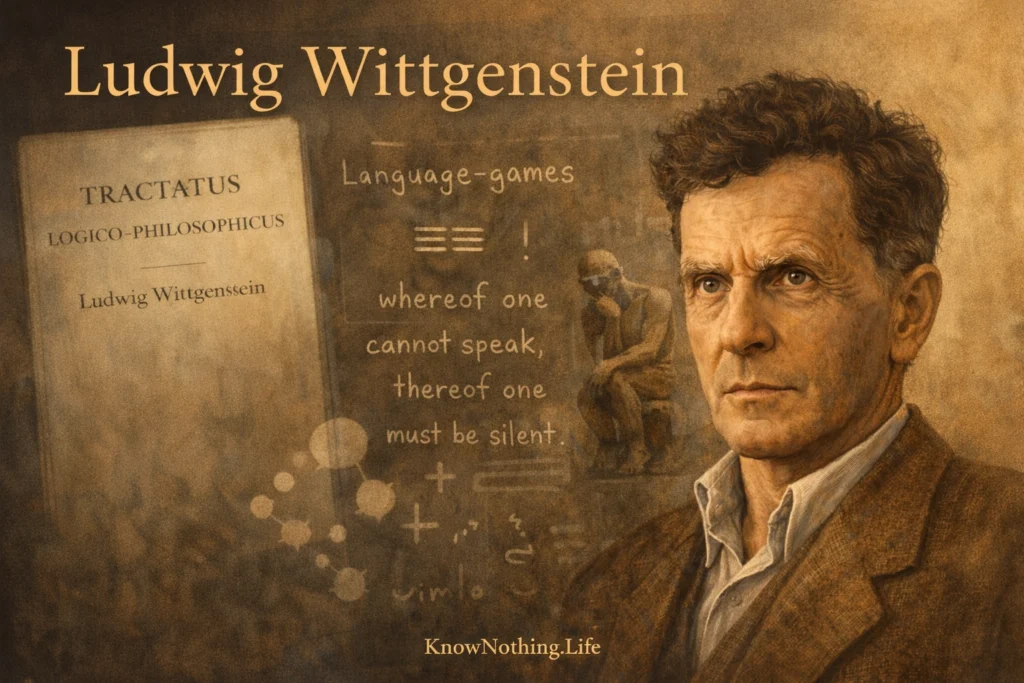
Wittgenstein’s first major work, Tractatus Logico-Philosophicus, was composed during World War I, while he served in the Austro-Hungarian army. Written in a terse, almost mathematical style, the Tractatus sought to establish the limits of language and, by extension, the limits of thought. Wittgenstein proposed that the world consists of facts rather than things, and that language functions by picturing these facts. According to this “picture theory,” meaningful propositions correspond to possible states of affairs in reality.
The structure of the Tractatus reflects its ambition: a series of numbered propositions that build toward a radical conclusion about the nature of philosophy itself. Wittgenstein argued that philosophical problems arise from misunderstandings of language and that once these misunderstandings are resolved, such problems dissolve. His famous closing line captures this vision: “Whereof one cannot speak, thereof one must be silent.” This statement has been interpreted as both a boundary-setting principle and a profound acknowledgment of the limits of human expression.
Despite its brevity, the Tractatus had a profound impact on logical positivism and the development of analytic philosophy. Wittgenstein himself, however, came to believe that the work was fundamentally flawed. He later remarked that he had been mistaken in assuming that language possesses a single underlying logical structure. This realization marked the beginning of a dramatic shift in his philosophical outlook, leading to the development of his later philosophy.
From Logic to Language Games
After the publication of the Tractatus, Wittgenstein temporarily withdrew from academic philosophy, believing he had solved its central problems. He worked as a schoolteacher in rural Austria, a gardener in a monastery, and even considered becoming a monk. Yet his dissatisfaction with his earlier conclusions gradually drew him back to philosophical inquiry. Returning to Cambridge in the late 1920s, he began to rethink the nature of language, abandoning the rigid logical framework of his earlier work.
This new approach culminated in Philosophical Investigations, published posthumously. In this work, Wittgenstein introduced the concept of “language games,” emphasizing that meaning arises from use rather than from a fixed correspondence between words and reality. Language, he argued, is not a single, unified system but a collection of diverse practices embedded in forms of life. Words acquire meaning through their role in specific social contexts, and philosophical confusion often results from taking words out of these contexts.
Wittgenstein’s later philosophy represents a profound departure from his earlier views, yet it retains a continuity in its focus on dissolving philosophical problems. Instead of constructing theories, he sought to clarify the ways in which language operates, exposing the assumptions that give rise to confusion. “Philosophy,” he wrote, “is a battle against the bewitchment of our intelligence by means of language.” This shift from logical analysis to ordinary language marked one of the most significant transformations in modern philosophy.
Ethics, Religion, and the Unsayable
Although Wittgenstein is best known for his work on logic and language, his philosophical concerns extended into ethics, religion, and the nature of value. In the Tractatus, he suggested that ethical and aesthetic values lie beyond the limits of language, belonging to what can only be shown rather than said. This perspective reflects a deeply held belief that the most important aspects of life cannot be captured by propositional language.
Wittgenstein’s views on religion were similarly unconventional. He did not approach religious belief as a set of empirical claims but as a form of life with its own internal logic. For him, religious language was not subject to the same criteria of truth and falsity as scientific statements. This approach influenced later developments in the philosophy of religion, particularly in the work of thinkers who emphasized the role of language and practice in shaping belief.
His ethical outlook was marked by a sense of seriousness and personal responsibility. Wittgenstein lived a life of extreme austerity, often giving away his wealth and subjecting himself to rigorous self-discipline. He believed that philosophy should not merely be an intellectual exercise but a transformative activity that shapes one’s way of living. This fusion of thought and life distinguishes Wittgenstein from many other philosophers and contributes to the enduring fascination with his work.
Teaching, Influence, and Intellectual Legacy
Wittgenstein’s teaching at Cambridge was as unconventional as his philosophy. He rejected formal lectures in favor of intense, often confrontational discussions with his students, challenging them to think independently and critically. Among those influenced by his teaching were philosophers who would go on to shape the course of analytic philosophy, including G.E. Moore and later figures in ordinary language philosophy.
Despite publishing relatively little during his lifetime, Wittgenstein’s influence has been immense. His work reshaped debates in logic, philosophy of language, epistemology, and the philosophy of mind. The distinction between his early and later philosophy has generated extensive scholarship, with some interpreting the two phases as fundamentally opposed and others emphasizing their continuity. In either case, his ideas have proven remarkably fertile, inspiring new approaches to longstanding philosophical problems.
Wittgenstein’s legacy also extends beyond philosophy into fields such as linguistics, psychology, and literary theory. His emphasis on the contextual nature of meaning and the limitations of formal systems has influenced a wide range of disciplines. Yet his work resists easy categorization, reflecting a thinker who consistently challenged the boundaries of intellectual inquiry.
Final Years and Enduring Significance
In his final years, Wittgenstein continued to refine his ideas, working on manuscripts that would later be published posthumously. He remained deeply engaged with philosophical questions, even as his health declined. Diagnosed with cancer, he faced his illness with characteristic honesty and composure. His last recorded words, “Tell them I’ve had a wonderful life,” offer a glimpse into the complex interplay of struggle and fulfillment that defined his existence.
Wittgenstein died on April 29, 1951, leaving behind a body of work that continues to provoke debate and inspire reflection. His philosophy challenges us to reconsider the nature of language, the limits of thought, and the role of philosophy itself. Rather than providing definitive answers, he invites us to examine the assumptions that shape our understanding of the world.
The enduring significance of Wittgenstein lies in his ability to transform the way we think about thinking. By exposing the ways in which language shapes our perception of reality, he revealed both the power and the limitations of human reason. His work serves as a reminder that philosophy is not merely a search for answers but an ongoing process of clarification and self-examination. In this sense, Wittgenstein remains one of the most original and influential thinkers of the modern era, a philosopher whose insights continue to resonate across disciplines and generations.