A.J. Ayer, born Alfred Jules Ayer on October 29, 1910, in London, emerged as one of the most influential proponents of logical positivism in the English-speaking world. Raised in a cultured and intellectually stimulating environment, Ayer was educated at Eton College and later at Christ Church, Oxford. From an early age, he displayed a sharp intellect and a natural inclination toward philosophical inquiry, particularly in questions concerning truth, meaning, and the limits of knowledge. His formative years coincided with a period of intense philosophical transformation, as traditional metaphysical systems were increasingly challenged by new approaches grounded in logic and science.
A decisive turning point in Ayer’s intellectual development came during his visit to Vienna in the early 1930s, where he encountered members of the Vienna Circle, a group of philosophers and scientists dedicated to the principles of logical empiricism. Figures such as Moritz Schlick and Rudolf Carnap profoundly influenced Ayer’s thinking, introducing him to the verification principle and a rigorous critique of metaphysics. This experience shaped his philosophical trajectory, leading him to adopt and popularize logical positivism in Britain, where it had previously gained little traction.
Language, Verification, and Language, Truth and Logic
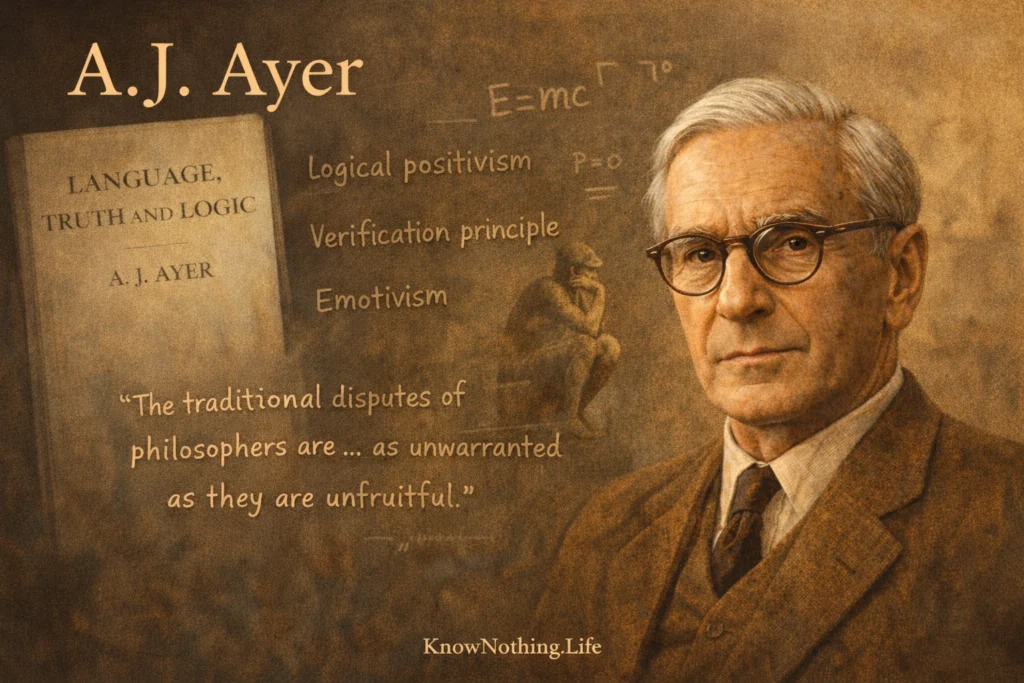
Ayer’s most famous work, Language, Truth and Logic, was published when he was only twenty-six years old. Despite its brevity, the book became one of the most influential philosophical texts of the twentieth century, serving as a manifesto for logical positivism. At its core is the verification principle, which asserts that a statement is meaningful only if it can be empirically verified or is analytically true. This principle led Ayer to reject vast areas of traditional philosophy—particularly metaphysics, theology, and ethics—as literally meaningless.
In Language, Truth and Logic, Ayer argued that many philosophical disputes arise from misunderstandings about language. Statements that cannot be tested by observation or reduced to logical truths, he claimed, do not convey genuine knowledge. This radical stance challenged centuries of philosophical tradition, dismissing metaphysical claims about reality, causation, and the existence of God as nonsensical. One of his most striking assertions encapsulates this view: “The traditional disputes of philosophers are, for the most part, as unwarranted as they are unfruitful.”
Ayer’s emphasis on clarity and precision aligned him with the broader analytic tradition, influenced by thinkers such as Bertrand Russell and Ludwig Wittgenstein. However, his uncompromising application of the verification principle distinguished his work, making it both highly influential and deeply controversial. Critics argued that the principle itself could not be empirically verified, raising questions about its own validity. Nevertheless, Ayer’s work succeeded in reshaping philosophical discourse, shifting the focus toward language, logic, and empirical science.
Ethics, Emotivism, and Moral Language
Ayer’s rejection of metaphysics extended into the realm of ethics, where he developed a theory known as emotivism. According to this view, moral statements do not express objective truths but rather convey emotional attitudes or prescriptions. In other words, when someone declares that an action is “good” or “bad,” they are not stating a fact but expressing approval or disapproval. This perspective radically transformed the way moral language was understood, removing it from the domain of factual discourse.
In articulating emotivism, Ayer argued that ethical disagreements are not disputes about objective reality but conflicts of attitude. This does not render ethical discussion meaningless, but it does change its nature, emphasizing persuasion and emotional influence rather than factual argumentation. His analysis challenged traditional moral philosophy, which had long sought to ground ethics in reason, divine command, or natural law. By contrast, Ayer’s approach situated morality within human psychology and social interaction.
Despite its controversial implications, emotivism had a lasting impact on metaethics, influencing subsequent debates about the nature of moral language and the possibility of objective values. Ayer’s work in this area exemplifies his broader philosophical method: a commitment to analyzing language in order to clarify the limits of meaningful discourse. As he succinctly put it, “If a putative proposition falls outside the scope of empirical verification, it is not merely false but meaningless.”
War, Public Life, and Later Philosophy
During World War II, Ayer served in British intelligence, an experience that exposed him to the practical complexities of political and ethical decision-making. After the war, he returned to academic life, holding positions at University College London and later at Oxford, where he became Wykeham Professor of Logic. His teaching and writing during this period continued to reflect his commitment to clarity and analytical rigor, though his views evolved in response to criticisms of logical positivism.
In his later work, Ayer adopted a more moderate stance, acknowledging some of the limitations of the verification principle. While he never fully abandoned his earlier commitments, he recognized that strict verificationism could not account for all meaningful discourse, particularly in areas such as history, ethics, and everyday language. This shift reflects a broader trend within analytic philosophy, as thinkers moved away from rigid frameworks toward more flexible approaches to language and meaning.
Ayer also became a prominent public intellectual, known for his engaging style and willingness to address a wide range of topics. His essays and lectures brought philosophical ideas to a broader audience, reinforcing his belief that philosophy should be accessible and relevant. He remained an advocate of secularism and rational inquiry, often engaging in debates about religion, politics, and education. His intellectual presence extended beyond academia, making him one of the most recognizable philosophers of his time.
Major Works and Philosophical Influence
In addition to Language, Truth and Logic, Ayer produced a substantial body of work that explored various aspects of philosophy. His books The Foundations of Empirical Knowledge and The Problem of Knowledge addressed issues in epistemology, examining the nature and limits of human knowledge. These works reflect his ongoing engagement with questions about perception, certainty, and the relationship between experience and belief.
Ayer’s contributions to philosophy are inseparable from his role in popularizing logical positivism in the English-speaking world. While the movement itself eventually declined, many of its core ideas—such as the emphasis on linguistic analysis and the rejection of speculative metaphysics—continued to shape philosophical practice. Ayer’s work helped to establish a methodological framework that prioritized clarity, precision, and empirical grounding, influencing generations of philosophers.
His influence also extended into related disciplines, including linguistics and the philosophy of science. By emphasizing the importance of language in shaping thought, Ayer contributed to a broader intellectual shift that redefined the scope and methods of philosophical inquiry. Even critics of logical positivism acknowledge the transformative impact of his work, which challenged entrenched assumptions and opened new avenues for analysis.
Final Years and Enduring Legacy
In his later years, Ayer remained intellectually active, continuing to write and engage with philosophical debates. One of the most widely discussed episodes of his life occurred in 1988, when he reportedly had a near-death experience that he described in an essay titled “What I Saw When I Was Dead.” Although some interpreted this as a challenge to his earlier skepticism, Ayer maintained his commitment to empirical reasoning, suggesting that the experience did not provide evidence for an afterlife.
Ayer died on June 27, 1989, leaving behind a legacy that continues to influence contemporary philosophy. His work represents a decisive moment in the development of analytic philosophy, marking a shift away from metaphysical speculation toward a focus on language, logic, and empirical verification. While logical positivism is no longer dominant, its impact endures in the methods and assumptions that shape modern philosophical inquiry.
Perhaps Ayer’s greatest contribution lies in his insistence that philosophy must strive for clarity and intellectual honesty. By challenging philosophers to examine the meaning of their statements and the basis of their claims, he helped to redefine the discipline’s purpose and scope. His work serves as a reminder that philosophy is not merely about answering questions but about asking them in the right way. In this sense, A.J. Ayer remains a central figure in the ongoing effort to understand the relationship between language, knowledge, and reality.