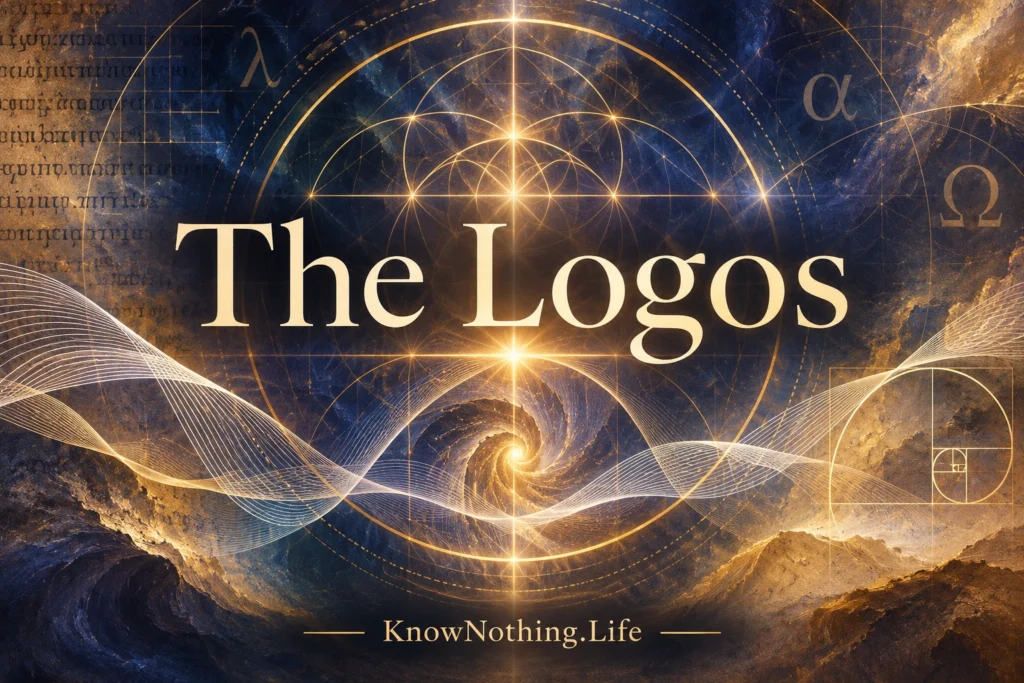
The Logos is one of the most profound and influential concepts in the history of philosophy, representing the relationship between reason, language, existence, and the underlying order of reality. Originating in ancient Greek thought, the Logos has been interpreted as rational explanation, the organizing principle of the universe, divine intelligence, and the foundation of meaningful communication. Across more than two thousand years, philosophers and theologians have used the concept to investigate whether the cosmos possesses an intelligible structure and whether human consciousness can participate in understanding that structure.
From the mysterious fragments of Heraclitus to the systematic philosophy of the Stoics, the religious writings of Philo of Alexandria, and the theological foundations of Christianity, the Logos has undergone remarkable transformations. Despite their differences, these traditions share a fundamental concern: the apparent relationship between human reason and the order encountered in nature. The Logos therefore connects metaphysics, logic, theology, epistemology, and the philosophy of language through a central philosophical question: Is reason merely a human capacity for interpreting reality, or does rationality belong in some fundamental sense to reality itself?
What Is the Logos?
The ancient Greek word logos (λόγος) possesses an unusually broad range of meanings, including word, speech, account, explanation, argument, reason, and rational principle. Its meaning depends heavily upon the philosophical and historical context in which it appears. In everyday Greek, it could refer to something spoken or an explanation offered. In philosophical writing, however, it acquired deeper significance as thinkers investigated how language and rational thought might reveal the structure of existence. The connection between speaking, explaining, and understanding made Logos particularly important to philosophical traditions concerned with truth.
The concept should not be confused with a single universal doctrine accepted by every philosopher who employed the term. Heraclitus understood Logos differently from Aristotle, while the Stoic conception differed substantially from its interpretation in Christianity. Some thinkers described Logos as a principle governing cosmic processes; others emphasized argumentation, divine mediation, or spiritual revelation. These distinctions are essential because the history of Logos is not simply the gradual discovery of one fixed idea. It is the development of several interconnected philosophical traditions addressing the relationship between thought, language, and reality.
Heraclitus and the Logos as the Order of the Universe
The earliest influential philosophical treatment of Logos is associated with Heraclitus of Ephesus, a pre-Socratic philosopher active around the beginning of the fifth century BCE. Heraclitus is famous for emphasizing change, opposition, and the dynamic relationships through which reality maintains its organization. Although he regarded the world as constantly changing, he did not consider this transformation fundamentally chaotic. Instead, his surviving fragments suggest that change occurs according to an intelligible pattern that human beings frequently fail to recognize. Logos became a central expression of this relationship between apparent disorder and underlying coherence.
In fragment B50, Heraclitus declares, in one familiar translation, “Having harkened not to me but to the Word (Logos) it is wise to agree that all things are one.” The statement suggests that genuine understanding requires attending to something beyond an individual philosopher’s opinions. Heraclitus also describes Logos as common, while criticizing people who behave as though they possess entirely private understanding. The philosophical implication is that reality contains relationships accessible to human intelligence, even when ordinary perception becomes distracted by isolated events. Nevertheless, scholars continue to debate whether Heraclitus intended Logos to mean an objective cosmic law, a truthful account of reality, or a concept combining both meanings.
Unity, Opposition, and the Hidden Harmony of Existence
Heraclitus’s conception of Logos becomes clearer through his treatment of opposing forces. His surviving fragments repeatedly explore relationships between apparent contradictions, including day and night, life and death, and movement in opposite directions. Fragment B60 states that the road upward and downward is one and the same. Rather than denying the existence of differences, Heraclitus suggests that opposing conditions can belong to a larger unity. A road acquires its upward or downward direction relative to the traveler, illustrating how seemingly contradictory descriptions may reveal complementary aspects of one underlying reality.
This interpretation distinguishes Heraclitus from philosophers who imagined cosmic order as a permanently motionless arrangement. Harmony does not necessarily require the elimination of conflict; it may emerge through the relationships among changing and opposing processes. Charles H. Kahn’s The Art and Thought of Heraclitus (1979) examines the linguistic and philosophical complexity of these fragments, emphasizing their layered meanings. Heraclitus thus established an enduring philosophical possibility: that the world becomes intelligible not because everything remains fixed, but because transformation itself possesses recognizable relationships and patterns.
Plato, Aristotle, and the Development of Rational Explanation
Although Plato did not establish a systematic doctrine of Logos equivalent to that of the Stoics, his philosophical dialogues helped develop its association with rational inquiry. In works such as Theaetetus, Sophist, and Republic, Plato investigates how reasoned explanation distinguishes knowledge from mere opinion. The relationship between knowledge and logos is especially significant in Theaetetus, where Socrates examines whether knowledge can be understood as true judgment accompanied by an account. The dialogue does not settle the question, but it establishes rational explanation as essential to philosophical investigation.
Aristotle extended the concept into logic, ethics, and rhetoric. In Rhetoric, he distinguishes three principal means of persuasion: ethos, concerning the speaker’s character; pathos, concerning the audience’s emotional condition; and logos, concerning the argument itself. His logical works, later collected as the Organon, investigate the structures of valid reasoning. Aristotle’s treatment differs from the idea of a universal divine intelligence, yet it reinforces the relationship between thought and intelligibility. Through argument, demonstration, and conceptual analysis, human reason attempts to explain why things are as they are rather than merely describing their appearances.
The Stoic Logos and the Rational Structure of Nature
The Stoic philosophers developed one of antiquity’s most influential interpretations of Logos. Beginning with Zeno of Citium in the third century BCE and continuing through thinkers such as Cleanthes and Chrysippus, Stoicism presented the universe as an interconnected physical system organized by an immanent rational principle. Unlike philosophies that separate divine intelligence from the material world, Stoic cosmology understood rational order as active within nature itself. Logos was associated with divine reason, providence, and the organizing activity through which physical reality develops.
The Stoics also described nature through the concept of pneuma, a structuring breath or tension permeating physical things. Their doctrine of logos spermatikos, often translated as seminal reason, portrayed nature as containing formative principles responsible for the development of particular beings. These ideas connected cosmology with ethics because human rationality was understood as participating in the wider rational organization of existence. For the Stoics, living well required understanding one’s place within nature and responding intelligently to circumstances rather than demanding that reality conform to personal desires.
Marcus Aurelius, Epictetus, and Living According to the Logos
Later Roman Stoicism transformed the philosophical understanding of Logos into a practical approach to everyday existence. Epictetus, whose teachings were recorded by his student Arrian in the Discourses and Enchiridion, emphasized the distinction between what human beings can control and what lies beyond their authority. Although individuals cannot determine every external event, they can cultivate their judgments, intentions, and responses. This ethical discipline reflects the Stoic conviction that rational freedom emerges through cooperation with nature rather than resistance to its fundamental conditions.
Marcus Aurelius developed related ideas in Meditations, written during the second century CE. He repeatedly reflects upon the relationship between individual reason and the rational organization of the cosmos. Because human beings participate in a common rational nature, ethical conduct involves justice, self-restraint, cooperation, and awareness of mutual dependence. His philosophy does not suggest that every event is pleasant or morally desirable. Instead, it encourages the individual to recognize the difference between external circumstances and the judgment through which those circumstances acquire personal meaning. The Logos becomes a principle connecting inner discipline with participation in a larger natural order.
Philo of Alexandria and the Logos as Divine Mediation
Philo of Alexandria, a Jewish philosopher who lived approximately from 20 BCE to 50 CE, developed a distinctive interpretation of Logos by combining Jewish scriptural traditions with Greek philosophical concepts. Influenced especially by Platonism and Stoicism, Philo investigated how a transcendent God could create and govern the material universe. The Logos became an important explanatory concept linking divine transcendence with the ordered world of human experience. In works such as On the Creation and On the Confusion of Tongues, Philo describes the Logos through multiple images, including divine reason, an intelligible pattern of creation, and an agent associated with God’s activity.
In On the Confusion of Tongues, section 146, Philo refers to God’s “first-born word,” associating the Logos with divine authority and the image according to which human beings are created. His terminology is complex and does not always correspond to the categories of later Christian theology. Philo’s philosophical achievement was to articulate how the universe might express intelligible divine order while preserving the distinction between God and creation. His writings became particularly significant for later discussions of the relationship between Greek philosophy, Jewish theology, and early Christian thought.
The Logos in Christianity and the Gospel of John
The Christian interpretation of Logos appears most famously in the opening of the Gospel of John, traditionally dated to the late first century CE. Its first verse declares, “In the beginning was the Word,” identifying the Logos with a reality existing before creation. The prologue subsequently associates the Word with God and describes the world’s creation through this divine agency. John 1:14 introduces the central Christian claim: “And the Word was made flesh.” Within Christian theology, the Logos is therefore identified with Jesus Christ, whose incarnation expresses divine revelation within human history.
This interpretation represents an important transformation of earlier philosophical ideas. The Logos is no longer understood exclusively as an impersonal principle of rational organization or an abstract mediation between God and the cosmos. In Christian thought, the divine Word possesses personal significance and becomes central to the doctrines of creation, revelation, salvation, and the relationship between God and humanity. Scholars debate the relative influences of Greek philosophy, Jewish wisdom traditions, and scriptural interpretations upon the Johannine prologue. Its language recalls philosophical discussions of Logos while also drawing upon biblical traditions in which God’s word creates, commands, and reveals.
Early Christian Philosophy and the Development of Logos Theology
Early Christian theologians expanded the meaning of Logos while attempting to explain Christianity within the philosophical environment of the Roman world. Justin Martyr, writing during the second century, developed the concept in his First Apology and Second Apology. He argued that human beings possess a capacity to participate in rational truth and interpreted figures such as Socrates as having recognized aspects of truth before Christianity. Justin’s doctrine of the logos spermatikos drew upon philosophical terminology while identifying the fullness of divine reason with Christ.
Origen of Alexandria explored related questions in On First Principles, examining the relationship between divine unity, the Son, creation, and rational beings. Athanasius later emphasized the incarnation in On the Incarnation, arguing that the divine Word’s assumption of human nature was central to humanity’s restoration. These developments contributed to theological debates concerning the relationship between Father and Son and the eventual formulation of Nicene Christianity. Although classical Greek philosophy supplied important concepts, Christian Logos theology established distinctive commitments that cannot be reduced to Stoicism or Neoplatonism.
The Logos, Reason, and the Search for Truth
Beyond its religious significance, Logos raises fundamental questions about the relationship between rational thought and the intelligibility of reality. Scientific investigation assumes that natural phenomena display patterns that can be examined through observation, mathematical description, and logical inference. Philosophers have long debated why the universe should possess structures that human reason can successfully investigate. The historical concept of Logos provides one philosophical framework for expressing this mystery, suggesting a connection between the rational capacities of human beings and the organization of the world they inhabit.
However, the success of scientific reasoning does not establish that the universe is governed by a conscious divine intelligence. Regularities in nature can be described without assuming intentional purpose, and competing philosophical traditions offer different explanations for the relationship between mind and reality. The Logos therefore remains a metaphysical interpretation rather than an experimentally demonstrated cosmic entity. Its continuing importance lies in encouraging investigation of why explanation is possible, what counts as rational understanding, and whether intelligibility requires a foundation beyond observable physical processes.
The Logos in Modern Philosophy and Psychology
Modern thinkers have revisited Logos through the philosophy of language, existentialism, and theories of human meaning. Martin Heidegger investigated the ancient Greek concept in essays such as Logos (Heraclitus, Fragment B50), arguing that conventional translations emphasizing reason or speech can conceal older dimensions of its philosophical significance. For Heidegger, Logos concerns the disclosure and gathering through which beings become intelligible. His interpretation remains controversial but demonstrates that the ancient concept continues to influence discussions about language, existence, and the limits of conceptual understanding.
Psychiatrist Viktor Frankl employed the Greek term in developing logotherapy, an approach to psychotherapy centered upon the human search for meaning. In Man’s Search for Meaning (1946), Frankl explored how individuals might discover purpose even under extreme suffering. His understanding of Logos concerns meaning rather than the complete metaphysical framework of Heraclitus or the Stoics. Contemporary psychological research has also investigated meaning as a measurable dimension of human experience. Michael Steger and colleagues developed the Meaning in Life Questionnaire in 2006, distinguishing between the presence of meaning and the search for meaning. Frank Martela and Steger further examined coherence, purpose, and significance in their 2016 research. These studies illuminate the psychological importance of intelligibility and purpose, although they do not demonstrate the existence of a universal cosmic Logos.
Criticisms and Philosophical Challenges
The concept of Logos has attracted criticism because its different meanings can be confused with one another. Rational argument, universal physical order, divine intelligence, and personal meaning are not equivalent concepts, even when they share a historical vocabulary. A philosophical account demonstrating that nature follows regular patterns does not automatically establish that those patterns possess intentions or moral purposes. Likewise, the human desire for coherence cannot independently prove that existence is organized around a predetermined meaning. These distinctions are particularly important when applying ancient metaphysical theories to modern science or psychology.
Other philosophical challenges concern the relationship between reason and experiences that resist rational explanation. Existentialist thinkers emphasized ambiguity, suffering, contingency, and the limitations of abstract systems. Friedrich Nietzsche questioned inherited claims about universal moral order, while Albert Camus examined the tension between humanity’s demand for meaning and a universe that does not necessarily provide it. Their arguments challenge the assumption that reality must possess a rational purpose compatible with human expectations. Yet such criticism does not eliminate the value of Logos as a philosophical concept. Instead, it clarifies the difference between discovering regularities, constructing explanations, and claiming knowledge of ultimate meaning.
Why the Logos Still Matters
The enduring significance of Logos lies in its ability to connect questions that modern intellectual disciplines frequently investigate separately. Logic examines valid reasoning, science studies natural regularities, theology explores divine purpose, and psychology investigates the human need for meaning. The Logos provides a historical framework for considering how these concerns relate without assuming that they must possess identical answers. It also reminds us that ancient philosophers understood rationality as more than a technical instrument for solving problems. Reason involved the larger question of how human beings should understand themselves within reality.
Whether interpreted as universal order, divine Word, rational explanation, or a principle of meaningful understanding, the Logos challenges individuals to examine the relationship between their thoughts and the world. Its value does not depend upon universal agreement about its metaphysical status. The concept remains philosophically important because it asks whether knowledge is simply the construction of useful descriptions or whether the possibility of understanding reveals something deeper about existence itself.
Final Thoughts on the Logos
The Logos has traveled through an extraordinary intellectual history, beginning with ancient Greek reflections upon cosmic order and developing into Stoic philosophy, Jewish theological interpretation, Christian doctrine, and modern investigations of language and meaning. Each tradition transformed the concept according to its philosophical commitments, yet all confronted the relationship between rational understanding and the nature of reality.
Ultimately, the Logos represents one of philosophy‘s most persistent attempts to explain why existence can be understood at all. Human beings inhabit a universe whose complexity extends far beyond their individual experience, yet they possess the extraordinary ability to recognize patterns, construct explanations, and question the foundations of knowledge itself. Whether this capacity reflects participation in a universal intelligence or emerges through natural processes remains an open philosophical debate. The central question of the Logos endures: Is the universe intelligible because human beings possess reason, or do human beings possess reason because intelligibility is woven into the structure of reality?