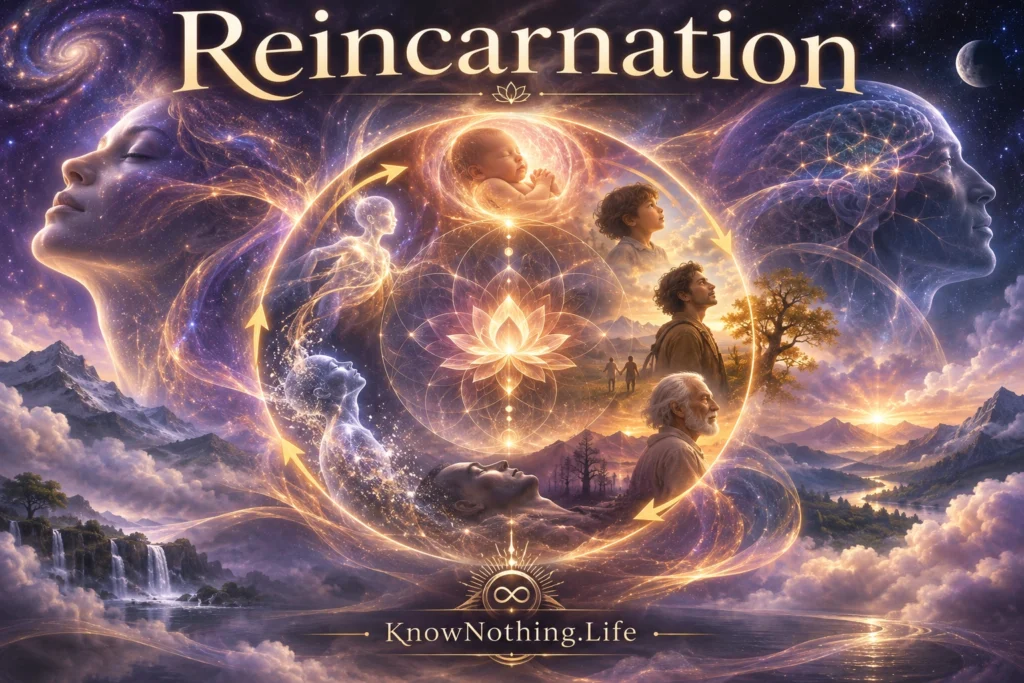
What if death is not the end of individual existence but a transition into another life? What if consciousness, identity, or some essential aspect of a living being survives the destruction of the physical body and eventually becomes associated with a new one? These questions form the foundation of reincarnation, one of humanity’s oldest and most enduring beliefs about the nature of existence. Across religious traditions, philosophical systems, and modern investigations of consciousness, reincarnation challenges the assumption that biological death necessarily marks the absolute termination of personal existence.
Yet reincarnation is far more than a comforting promise of life after death. In Hinduism, Buddhism, Jainism, and several ancient Greek traditions, rebirth is closely connected with moral responsibility, personal identity, suffering, and liberation. Philosophers have debated what could survive death if memories, personalities, and physical bodies continually change. Meanwhile, researchers have investigated unusual reports of children apparently remembering previous lives, raising questions about the reliability of memory and the limits of scientific explanation. Although reincarnation has not been established as a scientific fact, its philosophical significance remains profound: If something continues after death, what exactly survives, and what would make that future existence the continuation of the person who lived before?
What Is Reincarnation?
Reincarnation is the belief that some aspect of an individual survives physical death and becomes associated with another living existence. Depending upon the philosophical or religious tradition, this continuing element may be understood as an immortal soul, a stream of consciousness, a pattern of karmic causation, or an enduring spiritual principle. The term derives from Latin roots associated with entering flesh again, while related concepts such as rebirth, transmigration, and metempsychosis describe processes that do not always involve the survival of an identical personal self.
These distinctions are essential because reincarnation does not possess one universally accepted definition. Some traditions maintain that an enduring soul passes from one body to another, while others explicitly reject the existence of a permanent self. Rebirth may occur as a human, animal, celestial being, or another form of existence, depending upon the tradition. Moreover, many philosophical systems regard repeated existence not as an endless opportunity for personal enjoyment but as a condition from which liberation should ultimately be achieved. Understanding reincarnation therefore requires examining the deeper questions of consciousness, identity, causation, and moral responsibility that different traditions attempt to resolve.
The Ancient Origins of Reincarnation
Beliefs concerning existence beyond death appeared in numerous ancient civilizations, although not every doctrine of an afterlife involved reincarnation. Ancient Egyptian religion emphasized survival after death and the continued existence of the deceased, but its elaborate funerary traditions should not be confused with systematic doctrines of rebirth into successive earthly bodies. More explicit philosophical accounts of transmigration developed in ancient India and Greece, where thinkers attempted to explain how an individual’s existence might extend across multiple lifetimes. The historical relationships among these traditions remain debated, and similarities do not automatically establish that one culture borrowed its beliefs from another.
In ancient India, teachings concerning rebirth and the cycle of existence became particularly influential during the development of the Upanishads and the religious traditions that followed. The Brihadaranyaka Upanishad and Chandogya Upanishad contain important discussions of action, death, and postmortem existence. These teachings gradually contributed to the concept of samsara, the recurring cycle of birth, death, and rebirth. Rather than treating a single lifetime as the complete horizon of human existence, these philosophical systems placed ordinary life within a much larger process shaped by conduct, knowledge, and the pursuit of spiritual freedom.
Reincarnation in Hindu Philosophy
Within many Hindu philosophical traditions, reincarnation is associated with the relationship between Atman, the enduring self, and Brahman, ultimate reality. The Bhagavad Gita presents one of the most recognizable descriptions of rebirth. In Chapter 2, verse 22, Krishna compares the soul’s transition between bodies to a person replacing worn-out garments with new clothing. The analogy suggests that bodily death does not necessarily destroy the essential self. Instead, the physical body is temporary, while the deeper principle of existence continues beyond its dissolution.
However, Hindu traditions disagree about the precise nature of this continuing self and its relationship to ultimate reality. Advaita Vedanta, associated with Adi Shankara, maintains that the deepest self is ultimately nondual with Brahman, while other Vedanta traditions preserve distinctions between individual souls and the divine. Reincarnation is also connected with karma, through which actions influence future conditions of existence. The ultimate objective is often moksha, liberation from the cycle of rebirth. Consequently, the highest spiritual goal is not necessarily to experience countless future lives, but to overcome ignorance and attachment so that compulsory rebirth is no longer necessary.
Buddhism and Rebirth Without a Permanent Soul
Buddhist philosophy introduces one of the most challenging interpretations of reincarnation because it rejects the existence of an eternal, unchanging personal self. The doctrine of anatta, or non-self, maintains that what individuals ordinarily call the self consists of changing physical and mental processes rather than an independent metaphysical substance. These processes include bodily form, feelings, perceptions, mental formations, and consciousness. Yet traditional Buddhist teachings also maintain that karmic actions can condition future rebirth. This creates an apparent paradox: if there is no permanent soul, what continues from one lifetime to another?
Buddhist philosophers have addressed this problem through the concept of dependent origination, according to which phenomena arise through interconnected causes and conditions. The Milindapanha, a classical Buddhist dialogue between King Milinda and the monk Nagasena, uses analogies involving lamps and flames to illustrate continuity without numerical identity. One flame can ignite another without an identical substance passing between them. Similarly, rebirth can be understood as causal continuation rather than the migration of an immortal individual. Buddhist scholar Steven Collins examines related questions in Selfless Persons (1982), emphasizing the complex relationship between personal identity, moral responsibility, and the absence of a permanent self.
Jainism and the Journey of the Individual Soul
Jain philosophy offers another important interpretation of reincarnation, emphasizing the existence of individual souls known as jiva. Unlike Buddhist traditions that reject an enduring self, Jainism maintains that each living being possesses a soul whose essential nature includes consciousness. These souls become bound within the cycle of rebirth through karma, which Jain philosophy understands as a form of subtle material accumulation associated with actions and passions. The consequences of behavior therefore influence the soul’s future embodiment and its ability to attain liberation.
The Jain commitment to ahimsa, or nonviolence, follows directly from this understanding of life. Because living beings possess souls involved in the cycle of existence, harming them carries profound ethical significance. Texts such as the Tattvartha Sutra, traditionally attributed to Umasvati or Umasvami, systematize Jain teachings concerning souls, karma, rebirth, and liberation. The ultimate objective is to eliminate karmic bondage and attain moksha, freeing the soul from further rebirth. Reincarnation thus becomes part of an ethical framework in which compassion, restraint, and disciplined conduct possess consequences extending beyond a single lifetime.
Reincarnation in Ancient Greek Philosophy
The belief in transmigration also occupied an important position in ancient Greek thought. Pythagoras, who lived during the sixth century BCE, became associated with the doctrine of metempsychosis, or the movement of souls between bodies. Because the surviving evidence concerning Pythagoras is fragmentary and frequently retrospective, historians remain cautious about reconstructing the precise teachings of his early community. Nevertheless, later Greek philosophical traditions connected Pythagoreanism with the idea that human and animal lives participate in a larger cycle of existence.
Plato developed more extensive philosophical treatments of reincarnation in dialogues including Phaedo, Phaedrus, and Republic. In the Phaedo, Socrates examines the possibility that the soul survives bodily death and presents arguments concerning recollection and immortality. The Myth of Er, appearing at the conclusion of Republic, describes souls selecting future lives after judgment. Plato’s narratives connect rebirth with ethical responsibility and the cultivation of wisdom. Their philosophical significance lies partly in the suggestion that the soul’s destiny depends upon the character and understanding developed through its choices, although scholars debate how literally Plato intended these mythological accounts to be interpreted.
Reincarnation, Resurrection, and Religious Differences
Reincarnation should be distinguished from resurrection, which occupies a central position in mainstream Christian and Islamic teachings. Resurrection generally concerns the restoration or transformation of personal existence through divine action rather than repeated embodiment across successive earthly lives. Most Christian and Islamic theological traditions reject reincarnation as an account of human destiny. Nevertheless, reincarnation-like teachings have appeared in some esoteric religious movements, and Jewish mystical traditions developed the concept of gilgul, involving the transmigration of souls. The sixteenth-century Kabbalistic teachings associated with Isaac Luria became especially influential in elaborating this doctrine.
Modern spiritual movements have introduced additional interpretations that sometimes differ considerably from classical religious teachings. Theosophy, developed during the nineteenth century through figures including Helena Blavatsky, incorporated reincarnation into an expansive account of spiritual evolution. Contemporary New Age beliefs frequently describe successive lifetimes as opportunities for learning, healing, or personal development. Such interpretations should not automatically be identified with Hindu, Buddhist, or Jain doctrines, many of which regard repeated rebirth as a condition involving suffering and bondage rather than an inherently desirable process of personal advancement.
Karma, Moral Responsibility, and the Cycle of Rebirth
Karma is frequently associated with reincarnation, but the concept is more complex than the popular assumption that every good action produces an immediate reward and every harmful action generates an equivalent punishment. In Sanskrit, karma fundamentally refers to action, although philosophical traditions interpret the relationship between actions and consequences differently. Within many Hindu, Buddhist, and Jain systems, morally significant actions can influence future circumstances without requiring a supernatural judge who distributes rewards and punishments. Karma becomes part of a broader causal framework connecting intention, conduct, character, and continued existence.
The philosophical attraction of karmic rebirth is that it extends moral responsibility beyond the apparent inequalities of a single lifetime. However, this interpretation also creates ethical difficulties. If present suffering is automatically attributed to actions in previous lives, the belief may encourage unjustified judgments about people experiencing poverty, illness, or oppression. Such conclusions do not follow uniformly from traditional teachings, which frequently recognize complex causes and emphasize compassion. Nevertheless, the danger of blaming individuals for circumstances beyond their present control remains significant. A responsible interpretation must distinguish metaphysical claims about karma from evidence-based explanations of social and personal suffering.
Personal Identity and the Problem of Remembering Previous Lives
Perhaps the deepest philosophical difficulty facing reincarnation concerns personal identity. Suppose someone dies and another person is born who possesses no memories, personality traits, relationships, or recognizable characteristics connecting them with the deceased. In what meaningful sense could these individuals be considered the same person? If identity depends upon an enduring soul, philosophers must explain what that soul is and how its continued existence could be established. If identity depends upon psychological continuity, the absence of memory becomes a serious problem.
John Locke examined related questions in An Essay Concerning Human Understanding (1689), arguing that personal identity is closely associated with continuity of consciousness rather than simply the persistence of a substance. Derek Parfit further investigated identity in Reasons and Persons (1984), questioning whether strict personal identity is always what matters in survival. His analysis of psychological continuity suggests that the relationships connecting mental states may be philosophically important even when conventional identity becomes difficult to define. These arguments do not establish reincarnation, but they clarify what a theory of rebirth must explain: not merely continued existence, but the relationship between one life and another.
Scientific Investigations of Reported Past-Life Memories
One of the most extensively discussed research programs concerning reincarnation was developed by psychiatrist Ian Stevenson at the University of Virginia. Beginning during the twentieth century, Stevenson investigated reports of young children who spontaneously described experiences they or their families interpreted as memories of previous lives. His book Twenty Cases Suggestive of Reincarnation (1966) presented detailed investigations of children whose statements reportedly corresponded with aspects of deceased individuals’ lives. He later expanded his research in Children Who Remember Previous Lives (1987), examining behavioral patterns, reported memories, and possible alternative explanations.
Psychiatrist Jim B. Tucker continued this research through publications including Life Before Life (2005) and Return to Life (2013). The University of Virginia’s Division of Perceptual Studies has accumulated thousands of reports involving apparent past-life memories. Some cases include children describing unfamiliar locations, deceased individuals, or circumstances surrounding a death. Stevenson also investigated unusual birthmarks and birth defects that appeared to correspond with injuries attributed to deceased persons. Researchers regard certain cases as difficult to explain through ordinary information transfer alone, but the findings remain controversial. Case reports cannot by themselves establish that memories or consciousness survive death, and independent verification of their strongest claims remains essential.
What Research Actually Demonstrates About Reincarnation
A 2021 scoping review by Lucam Moraes, Gabrielle Barbosa, João Pedro Castro, Jim Tucker, and Alexander Moreira-Almeida, titled Academic Studies on Claimed Past-Life Memories: A Scoping Review, examined 78 published studies investigating reports of previous-life memories. Most research involved children, and case reports represented the most common study design. The review documented the existence of an organized body of observational research, but it did not demonstrate that reincarnation had been scientifically established. The predominance of retrospective investigations, culturally concentrated samples, and observational methods creates substantial limitations.
Critics emphasize several possible explanations for apparently accurate memories, including information acquired indirectly, family influence, selective reporting, inaccurate recollections, and the reconstruction of events after a supposed match has been identified. Stronger investigations attempt to document children’s statements before possible identifications are made and examine whether families could have exchanged relevant information. Even when ordinary explanations remain incomplete, the absence of an identified explanation does not automatically establish reincarnation. The scientific challenge is to distinguish genuinely anomalous information from processes that can produce convincing accounts without requiring survival after death.
Past-Life Regression, Hypnosis, and False Memories
Past-life regression involves attempts to recover supposed memories of earlier existences, often through hypnosis or guided imagery. Participants sometimes report vivid scenes, unfamiliar identities, historical settings, and emotionally powerful experiences. However, the vividness of a recollection does not establish its historical accuracy. Psychological research has repeatedly demonstrated that memory is reconstructive and vulnerable to suggestion. Hypnotic procedures can increase subjective confidence in imagined events without providing a reliable method for distinguishing genuine memories from constructed narratives.
Psychologist Elizabeth Loftus and Jacqueline Pickrell demonstrated the possibility of creating false autobiographical recollections in their 1995 research, The Formation of False Memories. Their findings contributed to a substantial body of evidence showing that suggestion can influence what individuals come to remember. Nicholas Spanos also examined hypnotically generated past-life experiences, arguing that expectations, cultural beliefs, and situational cues can influence the identities and narratives participants produce. Consequently, past-life regression is not an established method of historical verification, and its use can create risks when imagined experiences are presented as recovered facts. Reports arising spontaneously in childhood and narratives produced through hypnotic suggestion must therefore be evaluated separately.
Neuroscience, Consciousness, and the Possibility of Survival
Modern neuroscience has established extensive relationships between brain activity and conscious experience. Changes in neural functioning can alter memory, personality, perception, decision-making, and the sense of personal identity. These findings provide substantial support for the view that ordinary human consciousness depends upon the functioning brain. However, philosophical debates continue concerning whether this dependence establishes that consciousness is entirely produced by physical processes or whether some aspects of experience require a different explanation.
David Chalmers examined this broader difficulty in The Conscious Mind (1996), distinguishing explanations of cognitive functioning from the philosophical problem of subjective experience. Nevertheless, uncertainty about the ultimate nature of consciousness does not constitute evidence that it survives death or enters another body. Reincarnation would require an account of how information, identity, or conscious continuity persists after biological death and becomes associated with another organism. No established scientific mechanism currently explains such a transfer, and claims that quantum mechanics proves reincarnation extend beyond what existing physical research demonstrates.
The Psychological Appeal of Reincarnation
Belief in reincarnation can profoundly influence how individuals understand mortality, suffering, and personal meaning. For some people, it reduces the apparent finality of death by placing a single lifetime within a longer process of existence. For others, it offers a framework through which moral choices appear to possess consequences extending beyond immediate circumstances. These interpretations can encourage reflection upon responsibility, compassion, and the possibility of spiritual development. Yet the effects of such beliefs vary according to personality, cultural context, and the broader religious meanings attached to them.
Psychological research on death anxiety provides useful context without establishing the truth of reincarnation. Jeff Greenberg, Sheldon Solomon, and Tom Pyszczynski developed terror management theory, which investigates how awareness of mortality can influence beliefs, values, and social behavior. Their work, including The Worm at the Core (2015), examines how cultural worldviews can provide psychological security in the face of death. Reincarnation beliefs may perform such a function for some individuals, but psychological usefulness and metaphysical truth are separate questions. A belief can provide genuine comfort without being scientifically verified, just as a difficult or unsettling proposition can be true regardless of its emotional consequences.
The Ethical and Philosophical Meaning of Reincarnation
Reincarnation challenges the tendency to define human existence entirely through one biological lifetime. If identity or consciousness could continue beyond death, ordinary assumptions concerning responsibility, individuality, and personal destiny would require reconsideration. The possibility also raises questions about relationships between human beings and other living creatures, particularly within traditions that recognize rebirth across different forms of life. Ethical obligations might then be understood through a perspective extending beyond temporary social identities or species boundaries.
Nevertheless, these implications depend upon philosophical premises that remain contested. Reincarnation does not automatically establish moral equality, spiritual progress, or a meaningful cosmic purpose. Its ethical value must be examined separately from claims about its metaphysical truth. The most defensible philosophical approach recognizes both the historical importance of rebirth doctrines and the limitations of current evidence. Reincarnation remains a legitimate subject for religious reflection, philosophical investigation, and carefully designed empirical research, but the available findings do not justify presenting it as an established fact about what happens after death.
Final Thoughts on Reincarnation
Reincarnation remains one of humanity’s most compelling attempts to understand the relationship between life, death, consciousness, and identity. From the philosophical teachings of the Upanishads and the Bhagavad Gita to Buddhist accounts of rebirth without a permanent self, Jain theories of the soul, and Plato’s reflections on transmigration, the idea has inspired radically different explanations of what it means to exist. Its enduring significance lies not merely in the possibility of future lives, but in the questions it raises about the continuity of experience and the foundations of personal identity.
Modern investigations of apparent past-life memories have introduced additional evidence to evaluate, but they have not resolved the central mystery. The brain’s relationship to consciousness, the reliability of memory, and the possibility of survival beyond biological death remain subjects of philosophical debate and scientific inquiry. Whether reincarnation is ultimately understood as a literal process, a spiritual teaching, or an expression of humanity’s search for meaning, it confronts us with a profound question: If our bodies, memories, and personalities are constantly changing, what—if anything—makes us the same conscious being across time, and could that continuity extend beyond death itself?