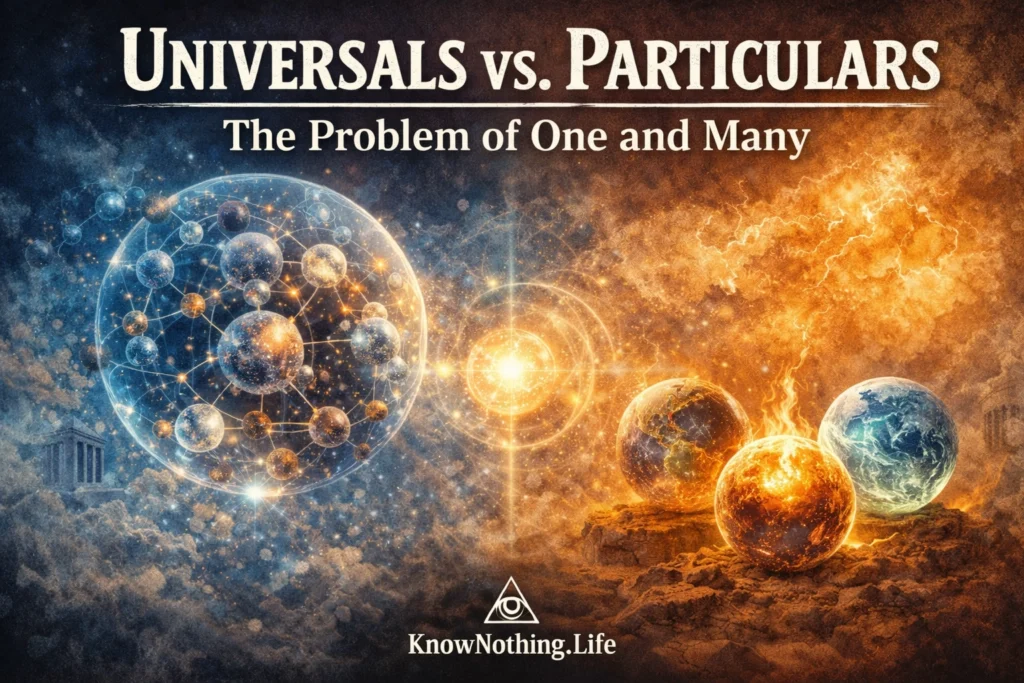
The distinction between universals and particulars lies at the core of metaphysics, addressing one of philosophy’s most enduring questions: how can many different things share the same properties? When we describe multiple objects as “red,” “round,” or “human,” we are appealing to something common among them. But what exactly is this shared feature? Does it exist independently as a universal, or is it merely a convenient way of speaking about similar particulars?
This problem, often called the “problem of universals,” reaches into nearly every area of philosophy, from ontology and language to science and logic. It challenges how we classify reality and raises questions about whether general concepts reflect something real or are simply constructs of the mind. The debate between universals and particulars is not merely abstract—it shapes how we understand categories, knowledge, and even truth itself.
Plato and the Reality of Universals
The most influential defense of universals comes from Plato, who argued that universals exist as real, independent entities. In dialogues such as The Republic and Phaedo, Plato developed the theory of Forms, proposing that properties like beauty, justice, and equality exist in a higher, non-physical realm. These Forms are perfect, eternal, and unchanging, while the objects in the physical world are merely imperfect copies.
For Plato, when we recognize common features among different objects, we are not inventing similarities but perceiving a deeper reality. A red apple and a red cloth share “redness” because they participate in the Form of Redness. This Form exists independently of any particular object, providing a stable reference for knowledge and meaning.
Plato’s position offers a powerful solution to the problem of universals by grounding shared properties in a real, objective realm. However, it also raises challenges. How do these Forms interact with the physical world? And how can humans access them? Despite these questions, Plato’s realism about universals set the foundation for centuries of philosophical debate.
Aristotle and Universals in Particulars
Aristotle, Plato’s student, rejected the idea that universals exist in a separate realm. In his work Metaphysics, Aristotle argued that universals are real but exist only within particular things. Rather than existing independently, universals are instantiated in individual objects.
For example, “humanity” does not exist as a separate entity but is present in each individual human being. This view, often called “immanent realism,” maintains that universals are not abstract entities floating beyond the world but are embedded within it. Aristotle’s approach preserves the reality of shared properties while avoiding the need for a separate realm of Forms.
This perspective also emphasizes the importance of substances—individual entities that serve as the foundation of reality. Universals, in this framework, are secondary; they depend on particulars for their existence. Aristotle’s synthesis provided a more grounded alternative to Plato’s theory and became highly influential in both medieval and modern philosophy.
Medieval Debates: Realism vs. Nominalism
The problem of universals became a central issue in medieval philosophy, leading to intense debates between realists and nominalists. Realists, following Plato and Aristotle, argued that universals have some form of real existence. Nominalists, on the other hand, denied this, claiming that only particular objects exist and that universals are merely names or labels.
Thomas Aquinas developed a moderate realist position, building on Aristotle. In works like Summa Theologica, Aquinas argued that universals exist in three ways: before things (in the mind of God), in things (as their essence), and after things (in the human mind as concepts). This layered approach attempted to reconcile the reality of universals with their dependence on both divine and human understanding.
By contrast, William of Ockham championed nominalism, arguing that universals are not real entities but linguistic constructs. Ockham’s famous principle, often summarized as “entities should not be multiplied beyond necessity,” led him to reject unnecessary metaphysical commitments. For him, only individual objects exist; general terms are simply tools for organizing experience.
This debate had far-reaching implications, influencing not only metaphysics but also theology, science, and logic. It marked a shift toward greater skepticism about abstract entities and laid the groundwork for modern philosophical approaches.
Early Modern Philosophy: Concepts and Perception
In the early modern period, philosophers continued to grapple with the status of universals, often shifting the focus toward human cognition. John Locke, in An Essay Concerning Human Understanding, argued that universals are formed through abstraction. By observing similarities among particular objects, the mind creates general ideas that can be applied to multiple instances.
For Locke, universals do not exist independently in reality but arise from mental processes. This view bridges realism and nominalism, acknowledging the usefulness of universals while denying their independent existence. It also emphasizes the role of perception and cognition in shaping knowledge.
George Berkeley took this further by rejecting abstract ideas altogether. In his view, all knowledge is based on particular perceptions, and the notion of a universal is an illusion created by language. Berkeley argued that we never perceive “redness” in general, only specific instances of red objects.
These perspectives reflect a growing emphasis on the human mind as the source of universals. Rather than being features of the external world, universals become tools for organizing experience, shaped by perception and language.
Contemporary Perspectives: Language, Logic, and Science
In contemporary philosophy, the debate over universals and particulars has evolved into more technical discussions involving language, logic, and science. Some philosophers defend a form of realism, arguing that universals are necessary to explain scientific laws and regularities. For example, the concept of “mass” or “charge” appears to apply universally across different objects, suggesting that such properties have a real basis.
Others adopt nominalist or conceptualist positions, emphasizing the role of language and theory in constructing universals. Willard Van Orman Quine questioned the necessity of universals, arguing that ontological commitments should be guided by the requirements of our best scientific theories. His approach reframes the debate in terms of practical usefulness rather than metaphysical certainty.
In analytic philosophy, the problem of universals is often addressed through discussions of properties, predicates, and sets. These frameworks provide tools for analyzing how general terms function in language and how they relate to the world. While the terminology has become more precise, the underlying question remains the same: what is the nature of shared properties?
The Philosophical Significance of the Debate
The debate between universals and particulars is not merely a technical issue; it has profound implications for how we understand reality. If universals are real, then the world has an underlying structure that transcends individual objects. If only particulars exist, then reality is fundamentally fragmented, and general concepts are human constructions.
This distinction affects how we approach knowledge, science, and even ethics. Scientific laws, for example, rely on the assumption that similar phenomena share common properties. Ethical principles often depend on the idea that certain values apply universally. The acceptance or rejection of universals shapes how these domains are understood.
Moreover, the debate highlights the tension between unity and diversity—the problem of how the many can be one. It reflects a deeper philosophical concern with finding order in complexity, a theme that runs through the history of thought.
Conclusion
The problem of universals and particulars remains one of the most enduring questions in philosophy. From Plato’s vision of eternal Forms to William of Ockham’s nominalist critique, it has inspired a wide range of perspectives on the nature of reality.
By examining how properties are shared among objects, this debate reveals fundamental assumptions about existence, knowledge, and language. It challenges us to consider whether the patterns we perceive in the world reflect an underlying reality or are simply products of human thought.
Ultimately, the question of universals and particulars does not yield a simple answer. Instead, it invites ongoing inquiry, encouraging us to explore the relationship between the general and the specific, the abstract and the concrete. In doing so, it deepens our understanding of what it means to know—and to be.