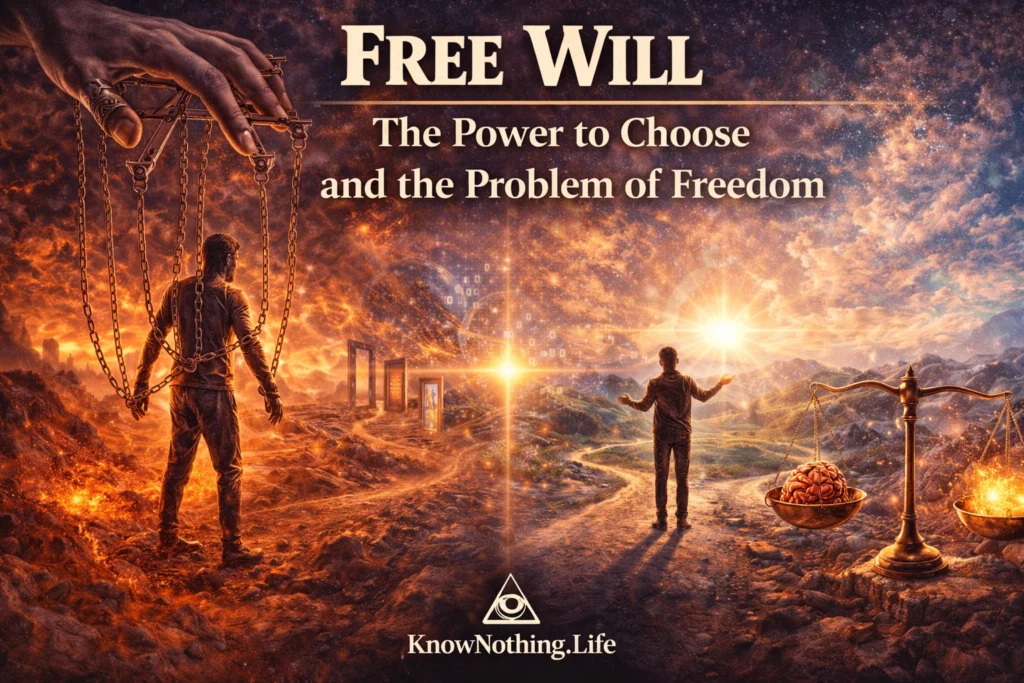
Free will is one of the most enduring and complex questions in philosophy: are human beings truly free to choose their actions, or are those actions determined by prior causes beyond their control? At stake in this debate is not only a metaphysical issue about causation and determinism, but also a deeply human concern about responsibility, morality, and identity. If individuals are not free, then praise, blame, and accountability may lose their meaning. If they are free, then the nature of that freedom must be explained.
The concept of free will sits at the intersection of multiple philosophical domains, including metaphysics, ethics, psychology, and neuroscience. It raises questions about whether the mind can act independently of physical laws, whether choices are genuine alternatives, and whether freedom is compatible with a deterministic universe. Throughout history, philosophers have offered competing accounts, each attempting to reconcile the intuitive sense of freedom with the apparent order of the world.
Ancient Perspectives: Freedom and Rational Agency
In ancient philosophy, free will was often linked to rationality and self-control. Aristotle, in Nicomachean Ethics, argued that human actions are voluntary when they originate from the individual and are performed with knowledge of the circumstances. For Aristotle, freedom is not the absence of causation but the ability to act in accordance with reason.
This view emphasizes the role of deliberation. A person is free when they can reflect on alternatives and choose based on rational judgment. Aristotle distinguished between voluntary and involuntary actions, suggesting that responsibility depends on the capacity for choice. This framework connects free will with moral accountability, laying the groundwork for later ethical theories.
Similarly, Epictetus, in his Discourses, focused on inner freedom rather than external conditions. He argued that while external events may be beyond our control, our responses to them are within our power. Epictetus famously stated, “It’s not what happens to you, but how you react to it that matters.” This perspective highlights a form of freedom rooted in attitude and judgment, rather than in the ability to alter external outcomes.
Determinism and the Challenge to Freedom
The rise of modern science introduced a powerful challenge to the idea of free will. Determinism, particularly as articulated by Isaac Newton and later by Pierre-Simon Laplace, suggested that all events are governed by laws of nature. If every action is the result of prior causes, then human behavior may be no exception.
Laplace famously imagined an intelligence capable of predicting the entire future based on complete knowledge of the present. In such a deterministic universe, every choice would be the inevitable outcome of preceding conditions. This raises a fundamental question: if our actions are determined, in what sense can we be free?
This challenge has led some philosophers to adopt hard determinism, the view that free will does not exist. According to this perspective, human actions are fully caused by prior events, leaving no room for genuine choice. While this view aligns with a scientific understanding of causation, it conflicts with common intuitions about responsibility and agency.
Hume and Compatibilism
David Hume offered a different approach, arguing that free will and determinism are not necessarily incompatible. In An Enquiry Concerning Human Understanding, Hume defined freedom as the ability to act according to one’s desires and intentions, without external coercion.
Hume wrote, “By liberty, then, we can only mean a power of acting or not acting, according to the determinations of the will.” This view, known as compatibilism, suggests that freedom does not require the absence of causation. Instead, it requires that actions stem from the individual’s internal motivations rather than external constraints.
Compatibilism preserves the idea of responsibility while accepting the causal structure of the universe. It shifts the focus from metaphysical independence to practical agency, emphasizing the conditions under which actions can be considered free. This approach has been highly influential, shaping much of the modern debate on free will.
Kant and Moral Freedom
Immanuel Kant approached free will from a moral perspective, arguing that freedom is a necessary condition for ethical responsibility. In Critique of Practical Reason, Kant distinguished between the phenomenal world, governed by deterministic laws, and the noumenal realm, where freedom exists.
For Kant, moral action requires autonomy—the ability to act according to rational principles rather than external influences. He believed that individuals must be free in order to be held accountable for their actions. This freedom is not empirical but transcendental, existing beyond the realm of observable phenomena.
Kant’s view provides a way of reconciling determinism with moral responsibility. While actions may appear determined in the empirical world, the capacity for rational decision-making introduces a form of freedom that is essential for ethics. This dual perspective continues to influence discussions of free will and morality.
Existentialism: Radical Freedom
In the 20th century, existentialist philosophers emphasized the radical nature of human freedom. Jean-Paul Sartre argued that humans are fundamentally free, unbound by predetermined essences or external determinants. In Existentialism Is a Humanism, he declared, “Man is condemned to be free.”
For Sartre, freedom is not optional but unavoidable. Individuals must choose, and in doing so, they define themselves. This freedom comes with a burden: without predetermined values or purposes, individuals are responsible for creating meaning in their lives. Sartre’s view rejects both determinism and traditional notions of fixed identity, emphasizing the role of choice in shaping existence.
Existentialism highlights the subjective experience of freedom, focusing on how individuals confront their own possibilities. It underscores the tension between freedom and responsibility, revealing the complexity of human agency. This perspective offers a powerful account of free will as a lived reality rather than a purely theoretical concept.
Neuroscience and the Modern Debate
In contemporary discussions, neuroscience has introduced new challenges to the concept of free will. Studies suggest that brain activity associated with decisions may occur before individuals become consciously aware of their choices. This has led some to argue that free will is an illusion, with decisions being determined by unconscious processes.
These findings raise important questions about the relationship between mind and brain. If choices are initiated at the neural level before conscious awareness, what role does conscious intention play? Some philosophers argue that this does not eliminate free will but redefines it, suggesting that freedom operates at a different level of explanation.
Others maintain that neuroscience undermines traditional notions of agency, supporting a deterministic view of human behavior. The debate remains ongoing, reflecting the complexity of integrating scientific insights with philosophical concepts. It demonstrates that the question of free will extends beyond philosophy into empirical inquiry.
The Significance of Free Will
The concept of free will has far-reaching implications for how individuals understand themselves and their place in the world. It influences notions of responsibility, justice, and personal identity. Without free will, concepts such as blame and praise may lose their foundation, challenging the basis of moral and legal systems.
At the same time, the belief in free will shapes how people approach life. It encourages a sense of agency and empowerment, suggesting that individuals have control over their actions and decisions. This belief plays a crucial role in motivation, goal-setting, and personal development.
Philosophically, free will represents the tension between necessity and possibility, between the constraints of the world and the capacity for choice. It reflects the broader human struggle to understand freedom in a structured universe, making it one of the most enduring and significant questions in philosophy.
Conclusion
The debate over free will reveals the depth and complexity of human existence. From the rational agency of Aristotle to the compatibilism of David Hume, the moral framework of Immanuel Kant, and the existential freedom of Jean-Paul Sartre, it has inspired a wide range of perspectives.
These views demonstrate that free will is not a simple concept but a multifaceted phenomenon that touches on metaphysics, ethics, and psychology. Whether understood as compatibility with determinism, transcendental autonomy, or radical freedom, it remains central to how we understand human life.
Ultimately, the question of free will invites ongoing reflection. It challenges us to consider the nature of our choices, the limits of our control, and the meaning of our actions. In doing so, it continues to shape philosophical inquiry and human self-understanding.