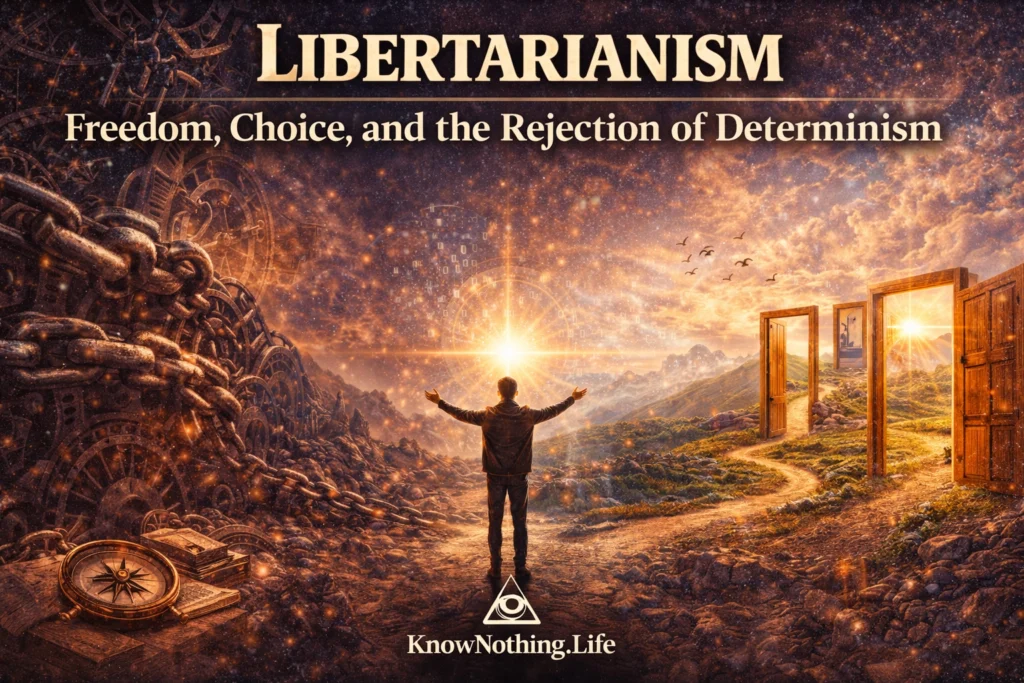
Libertarianism, in the philosophical sense, is the view that human beings possess genuine free will and that this freedom is incompatible with determinism. It stands as one of the central positions in the debate over free will, opposing both hard determinism—which denies freedom altogether—and compatibilism, which attempts to reconcile freedom with a determined universe. Libertarianism insists that for individuals to be truly free, their choices must not be fully caused or predetermined by prior events.
At its core, libertarianism is a defense of agency. It asserts that individuals are not merely passive participants in a causal chain but active originators of actions. This view has profound implications for ethics, responsibility, and personal identity. If libertarianism is correct, then individuals have the power to choose otherwise, making them fully accountable for their decisions. The challenge lies in explaining how such freedom is possible in a world that appears governed by causal laws.
The Foundations of Libertarian Thought
The roots of libertarianism can be traced to early philosophical reflections on human freedom, particularly in opposition to deterministic frameworks. While ancient philosophers such as Aristotle emphasized voluntary action and rational deliberation, the explicit formulation of libertarian free will emerged more clearly in later philosophical developments.
In early modern philosophy, thinkers began to grapple more directly with the implications of determinism. The rise of mechanistic science, influenced by figures like Isaac Newton, suggested that the universe operates according to fixed laws. Against this backdrop, libertarianism developed as a defense of human autonomy, insisting that not all events are determined by prior causes.
Libertarianism is grounded in the intuition that individuals could have acted differently in the same circumstances. This principle of alternative possibilities is central to the theory. It suggests that genuine choice requires more than the ability to act according to one’s desires—it requires the openness of multiple possible outcomes. Without this openness, libertarians argue, freedom becomes an illusion.
Agent Causation and the Source of Action
One of the key challenges for libertarianism is explaining how free actions occur without being determined by prior causes. A prominent solution is the concept of agent causation, which holds that individuals themselves are the originators of actions. Rather than being caused by events, actions are caused by agents.
Thomas Reid was one of the earliest proponents of this idea. In his work Essays on the Active Powers of Man, Reid argued that humans possess a unique power to initiate actions. He rejected the view that actions are merely the result of prior events, asserting that individuals have genuine control over their choices.
Reid wrote, “The determination of the will is the determination of the man.” This statement captures the essence of agent causation: the individual is not just a link in a causal chain but the source of action itself. This view preserves the notion of responsibility, as actions originate from the agent rather than external forces.
However, agent causation raises its own questions. How can an action be caused by an agent without being determined by prior states of the agent? Critics argue that this notion may be difficult to reconcile with a coherent understanding of causation. Despite these challenges, agent causation remains a central component of libertarian theory.
Indeterminism and the Role of Chance
Another approach within libertarianism involves the introduction of indeterminism into the process of decision-making. If not all events are determined, then there may be room for genuine choice. However, this raises a critical issue: if actions are not determined, are they simply random?
Libertarians must navigate a delicate balance. On one hand, they reject determinism to preserve freedom. On the other hand, they must avoid reducing actions to mere chance. Some philosophers argue that indeterminism operates at the level of decision-making, allowing for multiple possible outcomes without eliminating agency.
Robert Kane, a contemporary defender of libertarianism, has developed a sophisticated account of this idea. In his work The Significance of Free Will, Kane argues that certain decisions—what he calls “self-forming actions”—involve indeterminacy that allows individuals to shape their own character. These moments of choice are not random but reflect the agent’s struggle between competing motivations.
Kane’s approach seeks to integrate indeterminism with responsibility, suggesting that freedom arises from the interplay between chance and agency. While this view addresses some of the challenges facing libertarianism, it also highlights the complexity of explaining how freedom operates within an indeterminate framework.
Libertarianism and Moral Responsibility
Libertarianism is closely tied to the concept of moral responsibility. If individuals are truly free, then they can be held accountable for their actions in a meaningful way. This connection has been a major motivation for defending libertarian views.
Philosophers such as Roderick Chisholm have argued that moral responsibility requires agent causation. In his essay “Human Freedom and the Self,” Chisholm claimed that individuals must be “prime movers unmoved” in order to be responsible for their actions. This means that actions must originate from the agent without being fully caused by prior events.
This perspective emphasizes the importance of control. If actions are determined by factors beyond the individual’s control, then holding them responsible becomes problematic. Libertarianism seeks to preserve this control by asserting that individuals have the power to initiate actions independently.
However, critics argue that libertarianism may not fully resolve the problem of responsibility. If actions involve indeterminacy, it is unclear how they can be attributed to the agent in a meaningful way. This tension between freedom and responsibility remains a central issue in the debate.
Criticisms of Libertarianism
Libertarianism faces several significant challenges, both philosophical and scientific. One major criticism is that it conflicts with the apparent causal structure of the universe. If all events have causes, as suggested by scientific laws, then it is difficult to see how free actions can escape this framework.
Another criticism concerns the coherence of agent causation. Critics argue that the idea of an agent causing an action without being caused by prior events may be unintelligible. It raises questions about how such causation fits within a broader understanding of the world.
Additionally, developments in neuroscience suggest that decisions may be influenced by unconscious processes, challenging the notion of conscious control. These findings have led some to question whether libertarian free will is compatible with empirical evidence.
Despite these challenges, libertarianism continues to be defended by philosophers who argue that the intuitive sense of freedom and responsibility cannot be easily dismissed. They maintain that any adequate account of human agency must preserve the possibility of genuine choice.
The Significance of Libertarianism
Libertarianism represents a powerful affirmation of human freedom. It asserts that individuals are not merely products of their circumstances but active participants in shaping their own lives. This view has important implications for how people understand themselves and their actions.
By emphasizing the ability to choose otherwise, libertarianism highlights the openness of the future. It suggests that the course of events is not fixed, allowing for creativity, innovation, and moral growth. This perspective resonates with the human experience of decision-making, where choices appear to involve real alternatives.
Philosophically, libertarianism challenges deterministic views of reality, insisting that freedom is a fundamental feature of human existence. It invites a reconsideration of the relationship between causation and agency, encouraging deeper reflection on the nature of choice.
Conclusion
Libertarianism stands as a central position in the philosophy of free will, defending the idea that individuals possess genuine freedom incompatible with determinism. From the early insights of Thomas Reid to the contemporary theories of Robert Kane, it has developed into a rich and complex framework.
While libertarianism faces significant challenges, it continues to offer a compelling account of human agency. It preserves the intuition that individuals can choose otherwise, grounding notions of responsibility and moral accountability.
Ultimately, the debate over libertarianism reflects a deeper question about the nature of human existence. Are we determined by forces beyond our control, or do we possess the power to shape our own destiny? In exploring this question, libertarianism remains a vital and enduring perspective in philosophical inquiry.