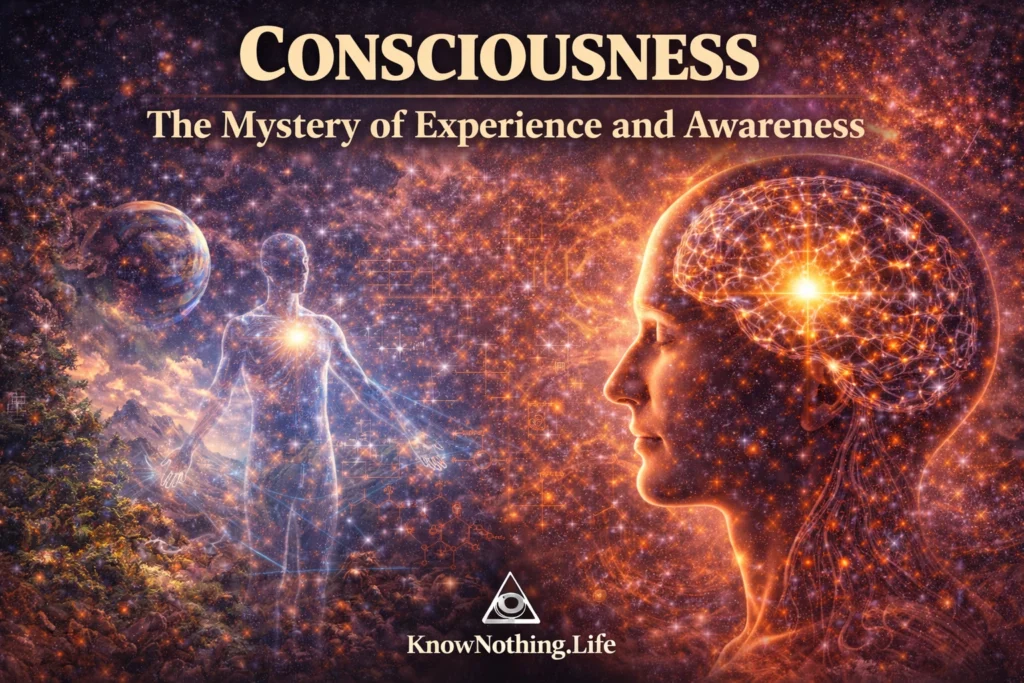
Consciousness is one of the most profound and enigmatic aspects of existence. It refers to the subjective experience of being aware—of perceiving, thinking, feeling, and knowing that one exists. While science has made extraordinary progress in understanding the brain, consciousness itself remains deeply resistant to explanation. How does physical matter give rise to experience? Why is there something it is like to see, hear, or feel?
The philosophical study of consciousness seeks to answer these questions by examining both its nature and its place in reality. It sits at the intersection of metaphysics, epistemology, neuroscience, and psychology, raising issues about the relationship between mind and body, the limits of knowledge, and the structure of reality itself. Despite centuries of inquiry, consciousness remains one of the most challenging problems in philosophy.
Descartes and the Certainty of Consciousness
The modern philosophical investigation of consciousness begins with René Descartes, who placed conscious awareness at the foundation of knowledge. In Meditations on First Philosophy, Descartes employed radical doubt, questioning everything that could possibly be uncertain. Through this process, he arrived at the one indubitable truth: the existence of the thinking self.
Descartes famously declared, “Cogito, ergo sum” (“I think, therefore I am”). This statement emphasizes that consciousness is self-validating. Even if all external reality is doubted, the fact that one is thinking cannot be denied. Consciousness thus becomes the most certain aspect of existence, providing a starting point for philosophical inquiry.
Descartes’ emphasis on the mind as a distinct, thinking substance led to dualism, the view that mind and body are fundamentally different. While this perspective highlights the uniqueness of consciousness, it also introduces the challenge of explaining how mental and physical realms interact. Nevertheless, Descartes’ focus on subjective awareness remains central to discussions of consciousness.
Locke and the Continuity of Experience
John Locke contributed to the understanding of consciousness by linking it to personal identity. In An Essay Concerning Human Understanding, Locke argued that consciousness is what unifies experiences over time, allowing individuals to recognize themselves as the same person.
Locke defined consciousness as the perception of what passes in one’s own mind. This introspective capacity enables memory and self-awareness, forming the basis of identity. He wrote that identity extends “as far as this consciousness can be extended backwards to any past action or thought.” This view emphasizes the role of memory and continuity in shaping the self.
Locke’s account highlights the temporal dimension of consciousness. It is not merely a momentary awareness but a continuous process that connects past, present, and future. This perspective has influenced later theories of personal identity and remains relevant in contemporary discussions of the mind.
Hume and the Bundle Theory
In contrast to the idea of a unified self, David Hume offered a radically different account of consciousness. In A Treatise of Human Nature, Hume argued that the self is not a stable entity but a collection—or “bundle”—of perceptions.
Hume famously wrote, “I never can catch myself at any time without a perception.” According to this view, consciousness consists of a constantly changing stream of sensations, thoughts, and emotions. There is no underlying substance that unifies these experiences; the sense of self is an illusion created by the mind.
This perspective challenges traditional notions of identity and continuity. It suggests that consciousness is dynamic and fragmented, rather than stable and unified. Hume’s analysis has had a lasting impact, influencing both philosophy and psychology by emphasizing the fluid nature of mental life.
The Hard Problem of Consciousness
In contemporary philosophy, one of the most influential discussions of consciousness comes from David Chalmers, who introduced the distinction between the “easy problems” and the “hard problem” of consciousness. The easy problems involve explaining cognitive functions such as perception, memory, and behavior. The hard problem, by contrast, concerns the existence of subjective experience itself.
Chalmers argues that even a complete physical account of the brain would not explain why these processes are accompanied by experience. He describes consciousness as “the most familiar thing in the world and the most mysterious.” This highlights the gap between objective explanation and subjective awareness.
The hard problem has led to a range of responses, from physicalist attempts to reduce consciousness to brain activity, to dualist and panpsychist theories that treat consciousness as a fundamental aspect of reality. The persistence of this problem underscores the difficulty of integrating consciousness into a scientific worldview.
Qualia and Subjective Experience
A key aspect of consciousness is the existence of qualia—the qualitative features of experience. These include the redness of a rose, the bitterness of coffee, or the sensation of pain. Qualia are inherently subjective, accessible only from a first-person perspective.
Thomas Nagel famously illustrated this issue in his essay What Is It Like to Be a Bat? He argued that no amount of objective knowledge about a bat’s physiology would allow us to understand its subjective experience. This demonstrates the limits of physical explanation in capturing consciousness.
The problem of qualia raises questions about whether consciousness can be fully explained by science. If subjective experience cannot be reduced to physical processes, then it may require a different kind of explanation. This challenge continues to drive philosophical inquiry into the nature of the mind.
Consciousness and the Brain
Advances in neuroscience have provided valuable insights into the relationship between consciousness and the brain. Studies have identified neural correlates of consciousness—specific patterns of brain activity associated with particular experiences. These findings suggest a close connection between mental states and physical processes.
However, identifying correlations does not necessarily explain causation. While brain activity is linked to consciousness, it remains unclear how or why it gives rise to subjective experience. This gap between correlation and explanation is at the heart of the philosophical problem.
Some philosophers argue that consciousness emerges from complex neural systems, while others suggest that it may be a fundamental property of matter. These competing views reflect the ongoing effort to reconcile scientific findings with the phenomenology of experience.
Consciousness in Artificial Intelligence
The question of consciousness extends beyond human beings to the possibility of artificial minds. If consciousness arises from physical or functional processes, then it may be possible to create conscious machines. This raises both philosophical and ethical questions.
Functionalist theories, which define mental states in terms of their roles, suggest that machines could possess consciousness if they replicate the appropriate processes. However, critics argue that machines lack genuine subjective experience, even if they can simulate intelligent behavior.
The debate over artificial consciousness highlights the complexity of defining and understanding consciousness. It challenges assumptions about the uniqueness of human experience and the limits of technological replication.
The Significance of Consciousness
Consciousness is central to human existence, shaping perception, thought, and identity. It provides the basis for knowledge, as all experience is mediated through awareness. Without consciousness, there would be no experience of the world, no sense of self, and no capacity for reflection.
Philosophically, consciousness represents a boundary between the objective and the subjective. It challenges reductionist approaches, emphasizing the importance of first-person experience. This dual perspective reveals the richness and complexity of reality.
The study of consciousness also has practical implications, influencing fields such as psychology, neuroscience, and artificial intelligence. It informs debates about the nature of the mind, the possibility of machine intelligence, and the ethical treatment of conscious beings.
Conclusion
Consciousness remains one of the most profound mysteries in philosophy. From the foundational insights of René Descartes and John Locke to the skeptical analysis of David Hume and the contemporary work of David Chalmers and Thomas Nagel, it has inspired a wide range of perspectives.
These approaches demonstrate that consciousness is not easily explained within a single framework. It involves both physical processes and subjective experiences, each presenting unique challenges. The ongoing debate reflects the depth of the problem and the limits of current understanding.
Ultimately, the exploration of consciousness invites a deeper reflection on what it means to be aware, to think, and to exist. It remains a central pursuit in philosophy, bridging the gap between science and experience in the search for understanding.