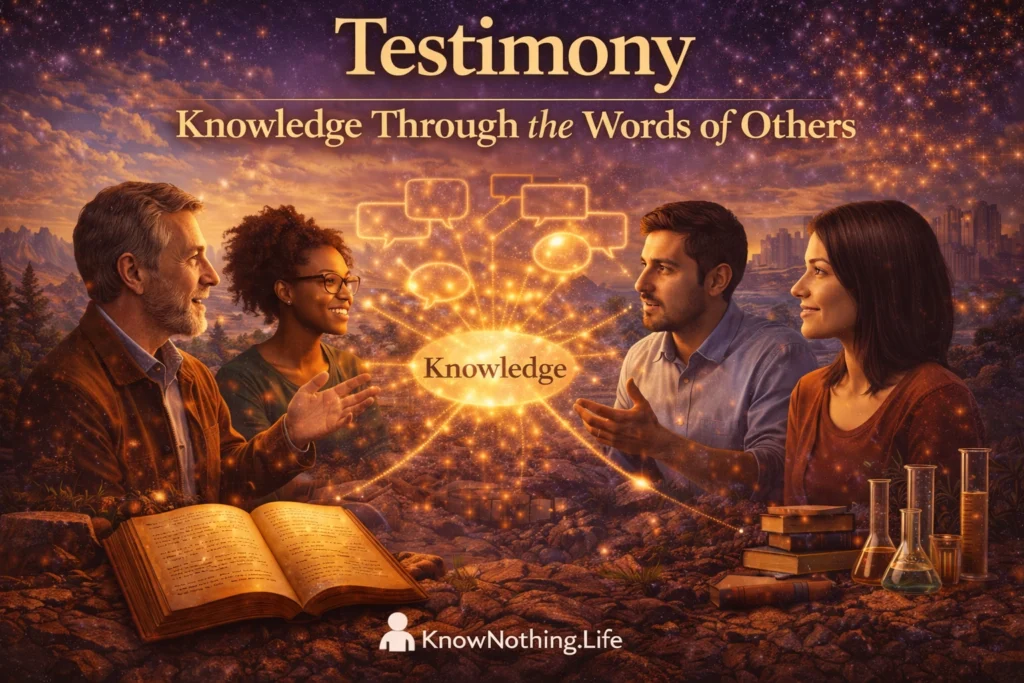
Testimony is one of the most pervasive yet philosophically complex sources of knowledge. Much of what we know—about history, science, geography, and even everyday facts—comes not from direct experience but from what others tell us. From childhood learning to expert knowledge, testimony forms the backbone of human understanding, allowing individuals to access information far beyond their personal experience.
Despite its importance, testimony raises fundamental epistemological questions. Why should we trust what others say? Is testimony a basic source of knowledge, or must it be justified by other means such as perception and inference? How do we evaluate the credibility of speakers in a world where misinformation and bias are ever-present? These questions place testimony at the center of social epistemology.
Philosophers such as Thomas Reid, David Hume, C. A. J. Coady, and Alvin Goldman have contributed significantly to the study of testimony. Their work explores the nature of testimonial knowledge, the role of trust, and the conditions under which testimony can be considered reliable.
The Nature of Testimonial Knowledge
Testimony refers to the communication of information from one person to another, typically through language. When someone tells us that a historical event occurred, or that a scientific theory is supported by evidence, we often accept this information as knowledge. This reliance on testimony is not incidental but essential to human life.
Unlike perception or reasoning, testimony is inherently social. It depends on the relationship between speaker and listener, involving issues of trust, credibility, and authority. The listener must decide whether to accept the speaker’s claim, often without direct access to the underlying evidence. This makes testimonial knowledge both powerful and potentially vulnerable.
Philosophically, testimony raises the question of whether it is a fundamental source of knowledge or reducible to other sources. Some argue that testimonial knowledge ultimately depends on perception and inference, while others maintain that it is a basic and irreducible form of knowledge. This debate has shaped much of the modern discussion on testimony.
Hume’s Reductionism
David Hume offers one of the earliest and most influential accounts of testimony in An Enquiry Concerning Human Understanding. Hume adopts a reductionist view, arguing that the reliability of testimony must be grounded in experience.
According to Hume, we trust testimony because past experience has shown that people generally tell the truth. Our belief in testimony is therefore based on inductive reasoning: we observe that testimony is often reliable and infer that it will continue to be so. However, this trust is not absolute. Hume emphasizes that we must weigh testimony against other evidence, particularly when dealing with extraordinary claims.
Hume famously writes, “No testimony is sufficient to establish a miracle, unless the testimony be of such a kind, that its falsehood would be more miraculous, than the fact, which it endeavors to establish.” This statement highlights his cautious approach to testimony, emphasizing the need for critical evaluation. For Hume, testimony is not a basic source of knowledge but one that must be justified through experience and reasoning.
Reid’s Anti-Reductionism
In contrast to Hume, Thomas Reid defends an anti-reductionist view of testimony. Reid argues that trust in testimony is a fundamental aspect of human cognition, not something that requires justification from other sources.
Reid suggests that humans are naturally disposed to trust others, and that this trust is essential for the acquisition of knowledge. Without it, communication and learning would be impossible. He compares trust in testimony to trust in perception, arguing that both are basic faculties that do not require further justification.
This perspective shifts the burden of proof from the listener to the skeptic. Rather than needing reasons to trust testimony, we need reasons to doubt it. Reid’s approach highlights the social nature of knowledge and emphasizes the importance of trust in human interaction. His anti-reductionism remains a central position in contemporary debates about testimony.
Coady and the Modern Defense of Testimony
C. A. J. Coady revitalized the study of testimony in his influential work Testimony: A Philosophical Study. Coady defends a form of anti-reductionism, arguing that testimony is a fundamental and indispensable source of knowledge.
Coady emphasizes the ubiquity of testimonial knowledge, noting that even scientific knowledge relies heavily on the testimony of others. No individual can verify all the information they rely on; instead, they must trust the reports of experts and institutions. This reliance is not a weakness but a necessary feature of human knowledge.
By highlighting the centrality of testimony, Coady challenges the reductionist view that it must be justified by other sources. He argues that such a requirement would lead to skepticism, as it would be impossible to independently verify all testimonial claims. His work has had a significant impact on contemporary epistemology, reinforcing the importance of testimony as a basic source of knowledge.
Testimony, Trust, and Credibility
The reliability of testimony depends on the credibility of the speaker and the context in which the information is provided. Factors such as expertise, honesty, and consistency play a crucial role in determining whether testimony should be trusted.
Alvin Goldman has explored these issues within the framework of social epistemology. In works such as Knowledge in a Social World, Goldman examines how individuals can evaluate the credibility of sources and make informed decisions about whom to trust. He emphasizes the importance of epistemic practices that promote reliable information exchange.
Trust is not blind acceptance but a reasoned judgment based on available evidence. In many cases, we rely on indicators such as credentials, reputation, and corroboration to assess the reliability of testimony. These practices are essential for navigating complex information environments, particularly in the modern digital age.
Testimony and Epistemic Injustice
Testimony is not only a source of knowledge but also a site of potential injustice. Miranda Fricker has highlighted how social biases can affect the credibility of speakers in Epistemic Injustice. Fricker identifies testimonial injustice as a form of epistemic harm that occurs when a speaker’s credibility is unfairly diminished due to prejudice. For example, individuals from marginalized groups may have their testimony dismissed or undervalued, limiting their ability to contribute to knowledge.
This insight underscores the importance of fairness and inclusivity in epistemic practices. Addressing epistemic injustice requires recognizing and correcting biases that distort the evaluation of testimony. It also highlights the ethical dimension of epistemology, emphasizing the responsibility to treat others as credible knowers.
Testimony in the Digital Age
The rise of digital technology has transformed the landscape of testimonial knowledge. Social media, online platforms, and artificial intelligence have created new channels for information dissemination, but they have also introduced challenges related to misinformation and credibility.
In this environment, evaluating testimony becomes more complex. The sheer volume of information makes it difficult to verify sources, while the speed of communication can amplify false or misleading claims. Social epistemology provides tools for understanding these dynamics and developing strategies for navigating them.
The digital age also raises questions about the role of algorithms and automated systems in shaping testimonial knowledge. As information is increasingly filtered and curated by technology, the nature of testimony itself is evolving, presenting new challenges for epistemology.
Conclusion
Testimony is a fundamental and indispensable source of knowledge, enabling individuals to access information beyond their direct experience. From the reductionist skepticism of David Hume to the anti-reductionist insights of Thomas Reid and C. A. J. Coady, philosophical debates have highlighted both the power and complexity of testimonial knowledge.
By examining issues of trust, credibility, and social dynamics, the study of testimony reveals the deeply interconnected nature of knowledge. It shows that knowing is not merely an individual achievement but a collaborative process that depends on communication and shared understanding.
As our reliance on testimony continues to grow in an increasingly interconnected world, understanding its strengths and limitations becomes ever more important. Testimony reminds us that knowledge is not only something we discover, but something we share—and that the pursuit of truth is ultimately a collective endeavor.