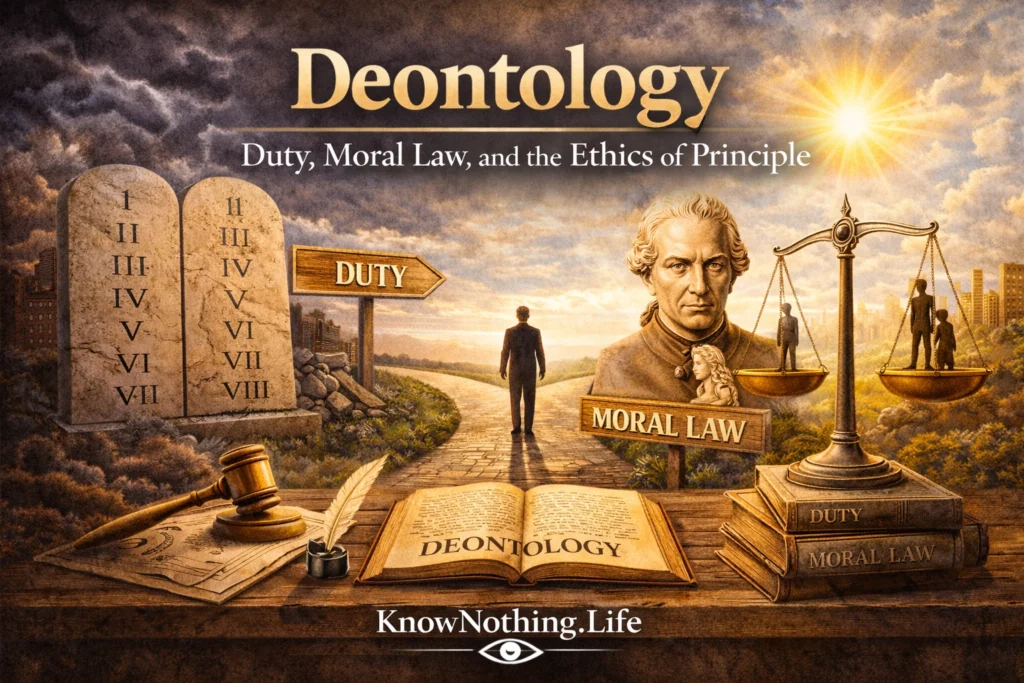
Deontology is a central tradition within normative ethics that evaluates actions based on adherence to moral duties, rules, or principles rather than their consequences. The term itself derives from the Greek deon, meaning “duty” or “obligation,” reflecting its core concern with what individuals ought to do regardless of outcomes. In contrast to consequentialist theories like utilitarianism, which assess actions by their results, deontology maintains that certain actions are inherently right or wrong, grounded in moral laws that bind all rational agents.
The most influential formulation of deontological ethics is associated with Immanuel Kant, whose work in Groundwork of the Metaphysics of Morals and Critique of Practical Reason established a rigorous framework for duty-based morality. Kant argued that moral principles must be derived from reason and must apply universally, independent of personal desires or situational contingencies. “Act only according to that maxim whereby you can at the same time will that it should become a universal law,” he famously wrote, capturing the essence of his categorical imperative.
Deontology appeals to the intuition that morality is not merely about producing good outcomes, but about respecting certain boundaries and obligations. It resonates with everyday moral judgments that condemn actions like lying, cheating, or harming others—even when such actions might lead to beneficial consequences. By emphasizing duty, rights, and respect for persons, deontology provides a powerful framework for understanding moral responsibility in both personal and institutional contexts.
Historical Origins and Philosophical Foundations
Although deontology is most closely associated with modern philosophy, its roots can be traced to earlier traditions that emphasized moral law and obligation. In ancient thought, Socrates insisted that ethical principles must be grounded in reason and that wrongdoing harms the soul, regardless of external consequences. His commitment to justice—even in the face of death—illustrates an early form of deontological reasoning, where adherence to principle outweighs considerations of personal benefit.
The Enlightenment period provided the intellectual conditions for the formal development of deontology. Immanuel Kant sought to establish morality on a foundation as secure as that of mathematics or logic. Rejecting both empirical and theological bases for ethics, Kant argued that moral law arises from the structure of rationality itself. In Groundwork of the Metaphysics of Morals, he distinguished between hypothetical imperatives, which depend on individual goals, and categorical imperatives, which apply universally and unconditionally.
Kant’s emphasis on autonomy—the capacity of rational agents to legislate moral law for themselves—was revolutionary. Rather than viewing morality as imposed from outside, he argued that individuals are both the authors and subjects of moral law. This idea transformed ethics into a domain of self-governance, where moral obligation is inseparable from rational freedom. As Kant wrote, “Autonomy is the property of the will by which it is a law to itself,” highlighting the intrinsic connection between duty and human dignity.
The Categorical Imperative and Moral Reasoning
At the heart of Kantian deontology lies the categorical imperative, a principle that provides a test for determining the morality of actions. Unlike rules derived from experience or authority, the categorical imperative is grounded in reason and applies universally to all rational beings. It requires individuals to act only on maxims that can be consistently willed as universal laws, ensuring that moral principles are coherent and impartial.
One formulation of the categorical imperative emphasizes universalizability: before acting, one must consider whether the underlying principle of the action could be adopted by everyone without contradiction. For example, if lying were universalized, trust would collapse, making communication itself impossible. Therefore, lying is morally impermissible, not because of its consequences in a particular case, but because it cannot be consistently universalized. This approach highlights the logical structure of moral reasoning in deontology.
Another formulation focuses on respect for persons: individuals must be treated as ends in themselves, never merely as means to an end. This principle has profound implications for human rights and ethical conduct, as it prohibits exploitation, coercion, and manipulation. It asserts that every person possesses intrinsic worth, independent of their utility or social role. This idea has influenced modern legal and political frameworks, reinforcing the importance of dignity and equality in moral and institutional life.
Duties, Rights, and Moral Obligations
Deontological ethics is deeply concerned with the nature and scope of moral duties. Duties are obligations that individuals must fulfill, regardless of their personal preferences or the outcomes of their actions. These duties can be categorized in various ways, including perfect and imperfect duties. Perfect duties, such as the duty not to lie or harm others, are strict and must always be followed. Imperfect duties, such as the duty to help others, allow for flexibility in how and when they are fulfilled.
The concept of rights is closely linked to deontological thinking. If individuals have duties not to harm or deceive others, then others possess corresponding rights to be treated with respect and honesty. This relationship between duties and rights forms the foundation of many modern ethical and legal systems. John Locke, though not a deontologist in the Kantian sense, contributed to this tradition by emphasizing natural rights to life, liberty, and property, which impose moral constraints on both individuals and governments.
Contemporary philosophers have expanded on these ideas, exploring how duties and rights apply in complex social contexts. W. D. Ross, in The Right and the Good, introduced the concept of prima facie duties—obligations that are binding unless overridden by stronger competing duties. This approach acknowledges the complexity of moral life, where individuals must navigate conflicting responsibilities and make judgments based on context and experience.
Critiques and Limitations of Deontology
Despite its strengths, deontology has been subject to significant criticism. One of the primary objections is its rigidity. By emphasizing adherence to rules, deontology can lead to morally counterintuitive conclusions in situations where following a rule produces harmful outcomes. For example, telling the truth to a malicious actor might result in harm that could have been avoided through deception. Critics argue that a moral theory must account for consequences to remain practical and humane.
Philosophers such as John Stuart Mill have challenged deontology from a utilitarian perspective, arguing that morality should be concerned with promoting happiness rather than following abstract principles. Mill contended that rigid rules can fail to capture the nuances of real-world situations, where outcomes matter deeply. Similarly, critics from the virtue ethics tradition argue that deontology neglects the importance of character and moral development, focusing too narrowly on actions rather than the person performing them.
Another challenge lies in the application of universal principles across diverse cultural and social contexts. While deontology preaches universality, moral intuitions and practices vary widely, raising questions about whether a single set of principles can adequately guide all human behavior. These critiques have led to the development of more flexible and context-sensitive approaches within deontological ethics, as well as hybrid theories that integrate elements from multiple traditions.
Deontology in Contemporary Ethical Life
Deontological principles continue to play a crucial role in modern ethical and legal systems. Concepts such as human rights, justice, and equality are deeply rooted in the idea that individuals possess intrinsic worth and must be treated with respect. International frameworks like the Universal Declaration of Human Rights reflect deontological commitments to dignity and moral obligation, establishing standards that transcend cultural and national boundaries.
In professional ethics, deontological frameworks guide conduct in fields such as medicine, law, and journalism. For example, medical ethics emphasizes duties of care, confidentiality, and informed consent, reflecting the principle that patients must be treated as autonomous individuals. Similarly, legal systems rely on rules and procedures designed to ensure fairness and protect rights, even when doing so may not produce the most efficient outcomes.
Emerging ethical challenges, such as those posed by artificial intelligence and biotechnology, further highlight the relevance of deontology. As technology advances, questions about responsibility, accountability, and the limits of human intervention become increasingly urgent. Deontological principles provide a framework for addressing these issues, emphasizing the importance of respecting human dignity and maintaining moral boundaries in the face of rapid change.
Conclusion
Deontology offers a powerful and enduring vision of morality grounded in duty, principle, and respect for persons. Through the work of Immanuel Kant and subsequent thinkers, it has established a framework that emphasizes the intrinsic rightness or wrongness of actions, independent of their consequences. This focus on moral law and human dignity continues to shape ethical thought and practice across a wide range of contexts.
While deontology faces challenges related to rigidity and applicability, its core insights remain deeply influential. It reminds us that morality is not solely about achieving desirable outcomes, but about honoring the principles that define ethical life. As Kant observed, “In the kingdom of ends everything has either a price or a dignity,” underscoring the idea that human beings possess a value that cannot be reduced to utility.
In an increasingly complex and interconnected world, the principles of deontology provide a vital foundation for ethical reflection and action. By emphasizing duty, rights, and respect, it challenges individuals and societies to uphold standards that transcend immediate interests and contribute to a more just and principled world.