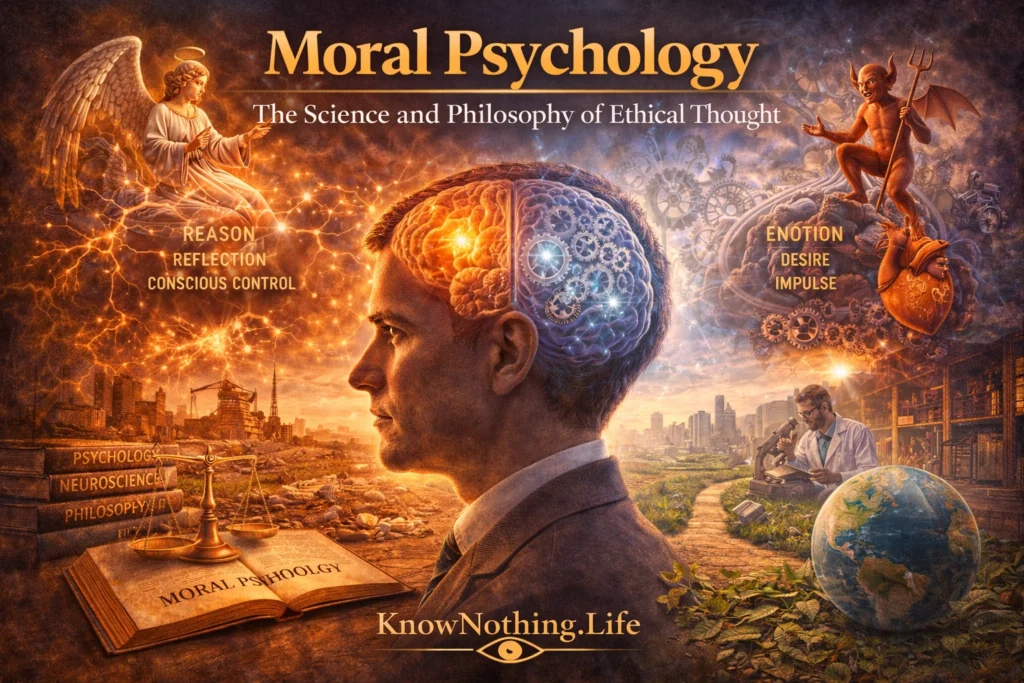
Moral psychology is an interdisciplinary field that explores how humans think, feel, and act in relation to moral issues. It sits at the intersection of philosophy and psychology, investigating the cognitive, emotional, and social processes that shape moral judgment and behavior. While ethics traditionally asks what people ought to do, moral psychology asks how people actually form moral beliefs and why they act in accordance—or in conflict—with those beliefs.
This field challenges the assumption that moral reasoning is purely rational. Instead, it reveals a complex interplay between intuition, emotion, and deliberation. Moral decisions are often made quickly and automatically, influenced by deeply ingrained patterns of thought and feeling. Only afterward do individuals construct reasons to justify their judgments. This insight has profound implications for understanding ethical behavior, suggesting that morality is not solely the product of conscious reasoning but also of subconscious processes.
The study of moral psychology has gained increasing importance in a world where ethical decisions are shaped by diverse cultural, social, and technological influences. By examining how moral judgments are formed, moral psychology provides valuable insights into issues such as cooperation, conflict, justice, and social cohesion. It offers a bridge between abstract ethical theory and the realities of human behavior.
Historical Foundations and Philosophical Origins
The roots of moral psychology can be traced to early philosophical debates about the role of reason and emotion in ethical judgment. David Hume famously argued that moral distinctions are derived from sentiment rather than reason. In A Treatise of Human Nature, he wrote that “reason is, and ought only to be the slave of the passions,” suggesting that emotions play a central role in shaping moral judgments. This perspective challenged rationalist views that placed reason at the core of morality.
In contrast, Immanuel Kant emphasized the primacy of reason in ethical decision-making. In Groundwork of the Metaphysics of Morals, Kant argued that moral principles must be derived from rational consistency and universalizability. For Kant, emotions were unreliable and potentially misleading, and true moral action required adherence to duty guided by reason. This tension between rationalism and sentimentalism remains a central theme in moral psychology.
Later philosophers and psychologists expanded on these ideas, exploring the development of moral reasoning across the lifespan. Jean Piaget studied how children’s moral understanding evolves, while Lawrence Kohlberg proposed a stage theory of moral development in works such as Essays on Moral Development. Kohlberg argued that individuals progress through stages of increasingly sophisticated moral reasoning, from obedience and punishment to principled ethical thinking. These theories laid the groundwork for empirical research in moral psychology.
Intuition, Emotion, and Moral Judgment
One of the most influential developments in moral psychology is the recognition of the role of intuition and emotion in moral judgment. Contrary to the traditional view that moral decisions are the result of deliberate reasoning, research suggests that many judgments are made rapidly and automatically, guided by intuitive responses.
Jonathan Haidt has been a leading proponent of this view. In his social intuitionist model, outlined in works such as The Righteous Mind, Haidt argues that moral judgments are primarily driven by intuitive processes, with reasoning serving a secondary role in justifying these judgments. He famously described moral reasoning as “the tail wagged by the intuitive dog,” highlighting the dominance of intuition in ethical decision-making.
Emotions such as empathy, guilt, and anger play a crucial role in shaping moral responses. Empathy, for example, allows individuals to understand and share the feelings of others, promoting prosocial behavior and cooperation. At the same time, emotions can also lead to bias and partiality, influencing judgments in ways that may conflict with principles of fairness or justice. Understanding this dual role of emotion is essential for developing a nuanced account of moral psychology.
Moral Development and Socialization
Moral psychology also examines how individuals acquire moral beliefs and values through processes of development and socialization. From early childhood, individuals are exposed to norms, rules, and expectations that shape their understanding of right and wrong. These influences come from family, education, culture, and broader social institutions.
Lawrence Kohlberg’s stage theory of moral development remains one of the most influential frameworks in this area. He identified a progression from pre-conventional morality, where behavior is guided by self-interest and punishment avoidance, to conventional morality, where individuals conform to social norms, and finally to post-conventional morality, where ethical principles are based on universal values. This model emphasizes the role of cognitive development in shaping moral reasoning.
However, later research has challenged the universality and linearity of Kohlberg’s stages. Carol Gilligan, in In a Different Voice, argued that Kohlberg’s model overlooked the importance of care and relationships in moral reasoning, particularly among women. She proposed an alternative framework that emphasizes empathy, responsibility, and the ethics of care. This perspective highlights the diversity of moral experiences and the influence of social context on ethical development.
Bias, Rationalization, and Moral Behavior
A key insight of moral psychology is that individuals are not always consistent or rational in their moral behavior. Cognitive biases, social pressures, and situational factors can lead to discrepancies between moral beliefs and actions. People may justify unethical behavior, overlook moral considerations, or act in ways that conflict with their stated values.
Research by psychologists such as Daniel Kahneman has shown that human decision-making is influenced by heuristics and biases that operate outside conscious awareness. In Thinking, Fast and Slow, Kahneman distinguishes between fast, intuitive thinking and slow, deliberate reasoning, illustrating how these systems interact in moral judgment. This framework helps explain why individuals may make snap judgments that are later rationalized through reasoning.
Moral disengagement is another important concept, explored by Albert Bandura. It refers to the ways in which individuals justify harmful behavior by reframing it as acceptable or necessary. This process can occur in various contexts, from everyday interactions to large-scale social phenomena. Understanding these mechanisms is crucial for addressing ethical failures and promoting accountability.
Contemporary Applications and Interdisciplinary Insights
Moral psychology has significant implications for a wide range of contemporary issues, including politics, education, and technology. In political contexts, differences in moral values and intuitions can lead to polarization and conflict. Understanding these differences can help foster dialogue and mutual understanding, even in deeply divided societies.
In education, insights from moral psychology inform efforts to cultivate ethical reasoning and character development. Programs that emphasize empathy, critical thinking, and social responsibility aim to prepare individuals to navigate complex moral challenges. These approaches recognize that moral development involves both cognitive and emotional dimensions.
Technological advancements also raise new questions for moral psychology. The design of artificial intelligence, for example, requires an understanding of how moral decisions are made and how they can be modeled in machines. Similarly, the influence of social media on moral discourse highlights the role of communication and social dynamics in shaping ethical behavior. These developments underscore the relevance of moral psychology in an increasingly interconnected and technologically mediated world.
Conclusion
Moral psychology provides a comprehensive framework for understanding how humans think, feel, and act in relation to ethical issues. By integrating insights from philosophy and psychology, it reveals the complex interplay between intuition, emotion, reasoning, and social context in shaping moral judgment.
The contributions of thinkers such as David Hume, Immanuel Kant, Jonathan Haidt, and Lawrence Kohlberg highlight the diversity of perspectives within the field. Each offers valuable insights into different aspects of moral experience, from the role of emotion to the structure of reasoning.
Ultimately, moral psychology reminds us that ethics is not only about abstract principles but also about human behavior. By understanding the psychological processes that underlie moral judgment, we can better navigate ethical challenges, promote cooperation, and foster a more just and compassionate society.