Charles Duhigg’s The Power of Habit: Why We Do What We Do in Life and Business is an exploration of one of the most powerful forces shaping human behavior: the tendency to repeat actions until they become automatic. Published in 2012, the book combines neuroscience, psychology, organizational research, and narrative journalism to explain why habits form, how they influence individuals and institutions, and how they can sometimes be deliberately changed. Duhigg’s central argument is that much of everyday life is not governed by conscious decision-making but by behavioral routines that operate largely outside awareness. What feels like a deliberate choice may actually be the execution of a pattern established through repeated associations between situations, actions, and rewards.
This idea places Duhigg within a much older philosophical discussion about freedom and automatic behavior. Aristotle argued in the Nicomachean Ethics that character is shaped through repeated action: people become courageous by practicing courageous acts and just by performing just actions. William James later made a similar observation in The Principles of Psychology (1890), describing habit as an essential mechanism that allows the nervous system to make frequently repeated actions easier and more automatic. Duhigg modernizes these insights through contemporary behavioral science. Rather than treating habit merely as a moral strength or weakness, he presents it as a neurological process that can be studied, understood, and sometimes redesigned.
The Habit Loop: Cue, Routine, and Reward
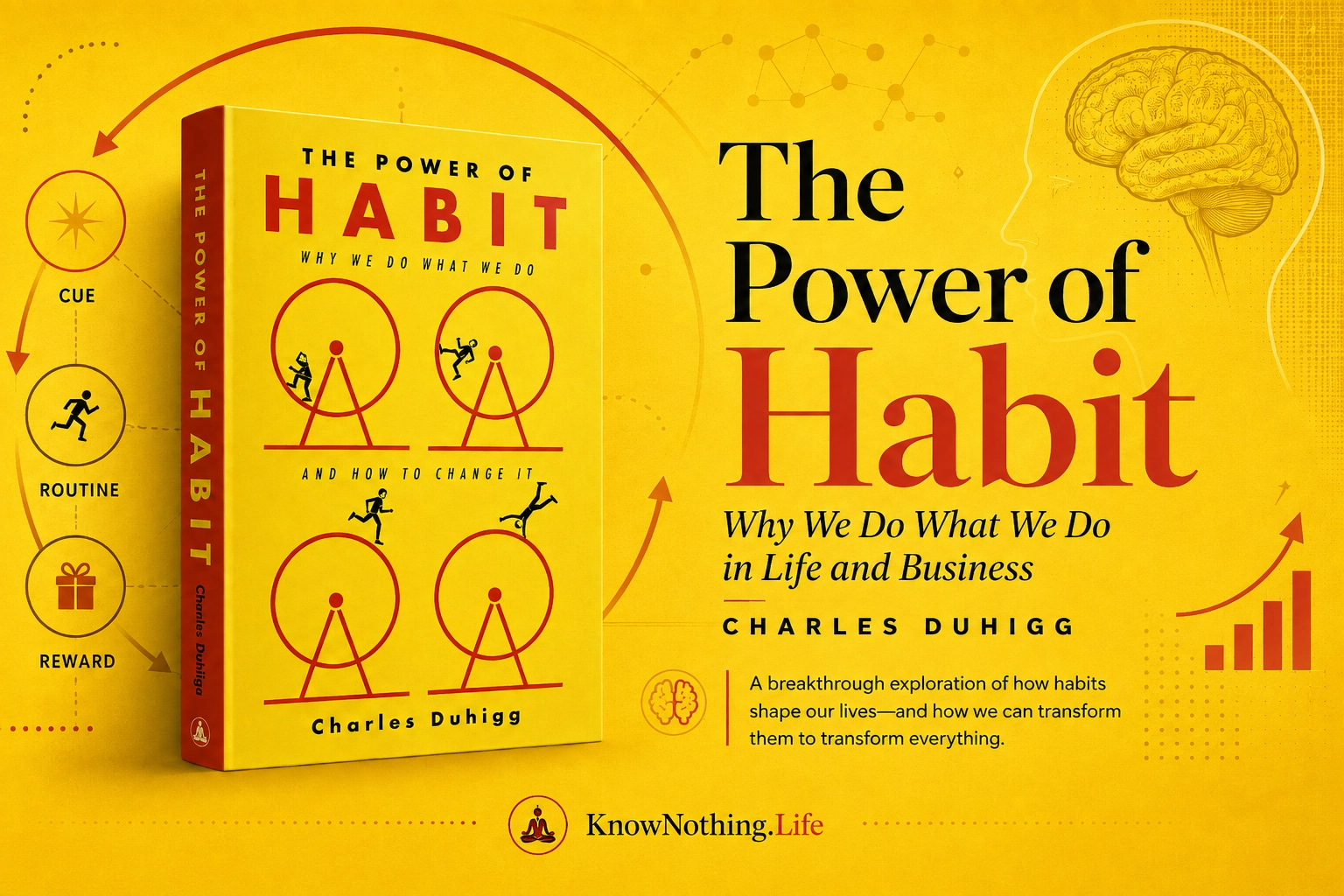
The foundational concept of The Power of Habit is what Duhigg calls the “habit loop.” A habit consists of three basic components: a cue, which signals the brain to initiate a behavior; a routine, which is the behavior itself; and a reward, which reinforces the pattern. Repeated often enough, this sequence becomes increasingly automatic. Someone who habitually checks a phone after hearing a notification, eats something sweet during an afternoon slump, or exercises immediately after arriving home may eventually perform the behavior with very little conscious deliberation.
Duhigg illustrates the neurological foundation of this process through research involving the basal ganglia, brain structures strongly associated with procedural learning, action selection, and habitual behavior. Classic experiments by neuroscientist Ann Graybiel and colleagues at MIT showed that neural activity changes as animals learn repeated behavioral sequences. Early in learning, brain activity remains elevated throughout the task, but once the behavior becomes familiar, much of the neural activity becomes concentrated near the beginning and end of the behavioral sequence. This phenomenon has sometimes been described as behavioral “chunking,” in which complicated sequences are compressed into more efficient automatic routines.
The concept also resembles principles established by behaviorists such as Edward Thorndike and B. F. Skinner. Thorndike’s “law of effect” proposed that behaviors followed by satisfying consequences become more likely to recur, while Skinner developed this idea into the theory of operant conditioning. Duhigg differs from classical behaviorism by emphasizing the subjective anticipation of reward. Habits are not simply responses mechanically reinforced by external consequences; people often develop cravings for the experience associated with the reward. The cue gradually becomes connected not only with behavior but with expectation.
Craving and the Psychology of Reinforcement
One of Duhigg’s most important additions to the habit-loop model is the role of craving. A cue becomes powerful when the brain learns to anticipate the reward that normally follows it. The smell of coffee can produce an expectation of stimulation, a notification sound can produce anticipation of social information, and the sight of running shoes may eventually evoke an expectation of the mood improvement associated with exercise. In this sense, the reward begins influencing behavior before it is actually received.
This mechanism is consistent with later developments in the neuroscience of reinforcement learning. Research associated with Wolfram Schultz and colleagues demonstrated that dopamine activity often reflects differences between expected and received rewards—a process known as reward prediction error. Once an organism learns that a particular signal predicts a reward, dopaminergic responses can begin occurring in connection with the predictive cue rather than only when the reward itself appears. This helps explain why environmental triggers can exert such strong motivational power.
The psychological implications extend far beyond trivial routines. Similar learning processes contribute to compulsive gambling, overeating, substance use, repetitive internet behavior, and other difficult-to-control activities. Yet Duhigg avoids arguing that habits eliminate personal responsibility. Instead, he suggests that understanding the machinery of behavior creates opportunities for intervention. Awareness alone may not eliminate a habit, but identifying what triggers a routine and what reward the behavior provides can make change more systematic.
The Golden Rule of Habit Change
Duhigg argues that deeply established habits are rarely erased completely. Instead, the most effective strategy is often to preserve the cue and reward while replacing the routine. He calls this the “Golden Rule of Habit Change.” Someone who habitually snacks during an afternoon break, for example, might discover that the actual reward being sought is not food but social stimulation or temporary relief from boredom. Once the underlying reward becomes clearer, a different routine can potentially satisfy the same psychological need.
This framework has parallels with cognitive behavioral therapy, where individuals learn to identify triggers, automatic responses, and consequences before developing alternative behavioral strategies. Research on implementation intentions by psychologist Peter Gollwitzer is also relevant. Implementation intentions take the form of “if-then” plans—if situation X occurs, then I will perform behavior Y. Studies have found that clearly connecting environmental cues with intended actions can substantially improve follow-through on goals. Instead of relying entirely on willpower at the moment of temptation, people establish alternative responses in advance.
Duhigg nevertheless emphasizes that behavioral substitution is not always sufficient. In his discussion of addiction recovery and Alcoholics Anonymous, he argues that belief can become particularly important during periods of extreme stress. Although the mechanisms behind successful recovery are complex and no single approach works universally, Duhigg’s broader point is psychologically significant: people often change more successfully when they believe change is possible and when supportive social structures reinforce new identities and routines.
Keystone Habits and the Ripple Effect of Change
Not every habit has equal influence. Duhigg introduces the concept of “keystone habits”—behaviors that appear to trigger broader changes across multiple areas of life. Exercise is a common example. Someone who begins exercising consistently may eventually eat differently, sleep more regularly, experience improved mood, or develop stronger perceptions of self-discipline. The original behavior creates secondary changes that extend beyond its immediate purpose.
The concept resembles Albert Bandura’s theory of self-efficacy. Bandura argued that successful experiences can strengthen a person’s belief in their ability to influence future outcomes. Completing one difficult behavior can therefore alter expectations about what is possible elsewhere. A small accomplishment may produce psychological momentum. Duhigg’s notion of “small wins,” influenced by organizational theorist Karl Weick, operates according to a similar logic. Breaking large problems into achievable victories can transform ambiguous challenges into manageable sequences of action.
There is also a philosophical dimension. Aristotle’s account of virtue assumed that repeated behavior gradually shapes character. Modern habit research suggests something similar without requiring the language of classical virtue ethics: repeated action can reshape preferences, expectations, and identity. People do not always act according to a fully formed character; character itself may partly emerge from repeated behavior. The practical implication is powerful. Large personal transformations may sometimes begin with apparently modest routines.
Willpower as a Habit
One of the book’s most influential sections examines willpower. Duhigg discusses research suggesting that self-control can function somewhat like a skill that becomes strengthened through practice. He draws particularly on work associated with Roy Baumeister and colleagues, whose experiments popularized the theory of “ego depletion”—the idea that exerting self-control temporarily reduces the capacity for further self-control.
Subsequent psychological research has complicated the original ego-depletion model. Large replication projects and meta-analyses have questioned whether willpower behaves as consistently like a limited resource as early studies suggested. Nevertheless, other aspects of Duhigg’s discussion remain useful. Planning responses to predictable challenges can reduce the need for spontaneous self-control. People who decide beforehand what they will do when faced with temptation, stress, or uncertainty often perform better than those who rely exclusively on motivation in the moment.
This distinction highlights an important theme running through the book: successful behavior change often depends less on heroic willpower than on designing environments and routines that reduce unnecessary decisions. This idea echoes psychologist Kurt Lewin’s famous formulation that behavior is a function of both the person and the environment. Instead of asking only how people can become more disciplined, Duhigg encourages readers to examine the cues, structures, expectations, and rewards surrounding behavior.
Organizational Habits and Corporate Culture
Duhigg expands the idea of habit beyond individuals by examining organizations. Companies, hospitals, government agencies, and other institutions develop routines for responding to recurring situations. These procedures may not formally be called habits, but they function similarly by reducing uncertainty and allowing complicated organizations to operate without renegotiating every decision.
One prominent case involves Paul O’Neill’s leadership of Alcoa. Rather than beginning his tenure by announcing conventional financial targets, O’Neill focused intensely on worker safety. Duhigg presents this emphasis as a keystone organizational habit because improving safety required better communication, faster reporting, stronger accountability, and closer attention to operational processes. Changes designed around one priority ultimately influenced broader organizational behavior.
The lesson parallels research on organizational culture by scholars such as Edgar Schein, who argued that organizations develop shared assumptions that gradually become taken for granted. Once institutional routines become normal, employees may stop consciously examining why they exist. This can create efficiency, but it can also perpetuate dysfunction. Organizational change therefore often requires identifying routines so deeply embedded that participants no longer perceive them as choices.
Habits, Consumer Behavior, and Predictive Data
Another major section examines how companies analyze consumer habits. Duhigg famously discusses Target’s attempts to identify purchasing patterns associated with pregnancy and major life transitions. The broader issue is not simply advertising but the predictability of repeated human behavior. When individuals establish shopping routines, digital traces can reveal patterns that marketers use to anticipate future purchases.
Psychologically, major life transitions are particularly interesting because existing habits can become temporarily unstable. Moving to a new city, beginning a new job, getting married, becoming a parent, or undergoing other major changes disrupts familiar environmental cues. Research on habit discontinuity has found that behavior change may become easier when contexts shift because old cues no longer automatically trigger established routines.
The ethical implications have only grown more significant in the era of large-scale digital tracking and algorithmic prediction. Duhigg’s analysis implicitly raises questions about autonomy: if companies can identify behavioral tendencies that individuals themselves barely recognize, who controls the resulting choices? Philosophers concerned with autonomy have long distinguished between merely acting according to desire and critically reflecting upon the forces shaping those desires. Habit science complicates this distinction by showing how preferences themselves can be influenced by environmental repetition.
Social Habits and the Power of Movements
Duhigg eventually moves from individual and corporate behavior to social movements. His discussion of the Montgomery Bus Boycott examines how personal relationships, community expectations, and social networks helped transform Rosa Parks’ arrest into sustained collective action. Strong personal ties initially mobilized participants, while broader social norms encouraged people with weaker connections to join and remain involved.
This argument draws on sociological research into network effects and collective behavior. Mark Granovetter’s influential work on “the strength of weak ties” demonstrated that loose social connections can carry information across networks in ways that close relationships sometimes cannot. Social movements often require both strong ties, which create loyalty and commitment, and weak ties, which allow ideas to spread beyond immediate circles.
At this level, habit becomes culture. Groups develop expectations about what people like “us” are supposed to do. Eventually participation may no longer depend entirely on individual motivation because social identity itself reinforces behavior. Duhigg therefore moves from neurons to societies without abandoning his central theme: repeated patterns acquire power when cues, expectations, rewards, and identity reinforce one another.
What The Power of Habit Ultimately Teaches
The lasting value of The Power of Habit lies less in presenting a single universal formula than in changing how readers interpret behavior. Habits transform repetition into automaticity. They reduce cognitive effort, stabilize routines, and make complicated lives manageable. Yet the same efficiency can preserve destructive behaviors long after the reasons for establishing them have disappeared.
Duhigg’s central message is ultimately optimistic without implying that change is effortless. Once people recognize the cue, routine, and reward underlying a behavior, they gain a framework for experimentation. They can alter routines, redesign environments, establish implementation plans, create supportive communities, and strengthen alternative patterns through repetition. Habit change becomes less a matter of mysterious motivation and more a process of behavioral engineering.
In this respect, Duhigg reconnects contemporary neuroscience with an ancient philosophical insight. Human beings are partly shaped by what they repeatedly do. Aristotle approached repetition as the foundation of virtue; William James saw habit as a mechanism for conserving mental energy; behaviorists studied reinforcement; cognitive psychologists examined automaticity; neuroscientists traced learning through brain circuits. The Power of Habit gathers these traditions into an accessible argument: much of life runs on patterns, but patterns are not necessarily destiny. Understanding how they operate is one of the first steps toward changing them.