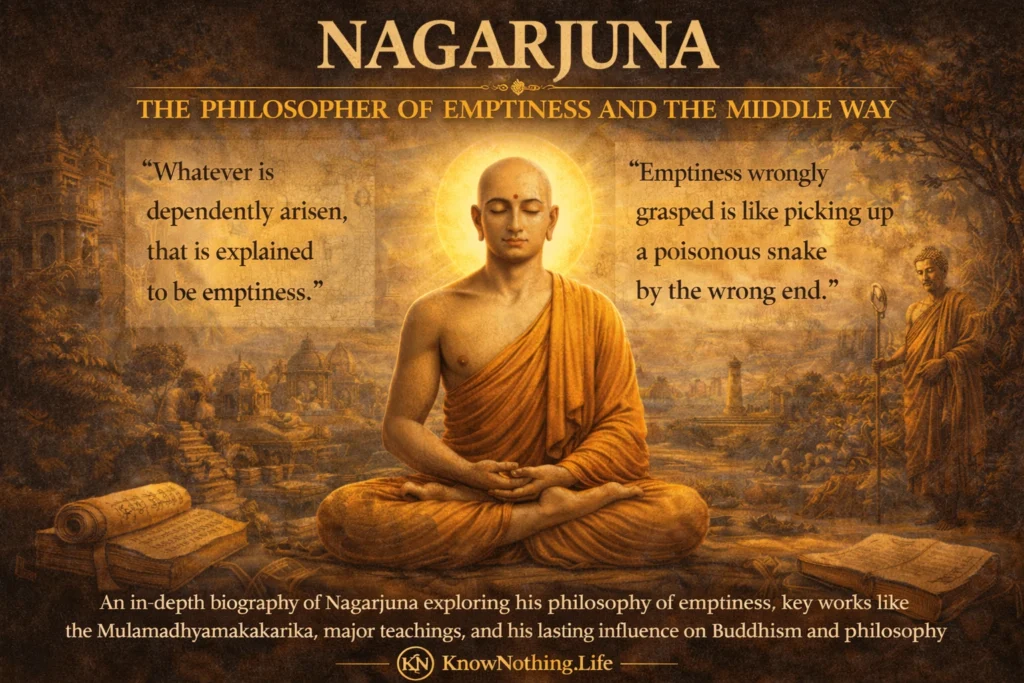
Few thinkers in the history of philosophy have challenged the foundations of reality as profoundly as Nagarjuna. Revered as one of the most influential figures in Buddhism, Nagarjuna stands at the center of the Madhyamaka school, a tradition that redefined how existence, knowledge, and perception are understood. His work does not merely refine earlier teachings—it destabilizes assumptions about reality itself, pushing philosophical inquiry into radical territory.
What distinguishes Nagarjuna is his method. Rather than constructing a system of beliefs, he dismantled conceptual frameworks, exposing contradictions and revealing the limits of language and thought. His philosophy centers on the concept of emptiness (śūnyatā), a principle that challenges the notion of inherent existence. Through this approach, Nagarjuna offered not only a reinterpretation of Buddhist teachings but a profound critique of metaphysics that continues to influence philosophy, logic, and epistemology today.
Historical Background and Life
The historical details of Nagarjuna’s life remain partly obscured by legend, but he is generally believed to have lived between the 2nd and 3rd centuries CE in southern India during the era of the Kushan Empire. Tradition holds that he was born into a Brahmin family, receiving an education steeped in classical Indian philosophy and religious thought. This intellectual foundation would later enable him to engage deeply with competing schools of thought.
Accounts of his life often portray a figure who moved between worlds—both intellectually and spiritually. Some traditions describe him as a monk who studied the teachings of the Buddha in depth, while others suggest he had connections to royal courts and political figures. These narratives, though varied, consistently emphasize his exceptional intellect and his role as a teacher.
Despite the uncertainty surrounding his biography, his influence is unmistakable. Nagarjuna’s works were widely transmitted and studied across India and later in Tibet, China, and Japan. His ideas became foundational to the development of Mahayana Buddhism, shaping philosophical discourse across cultures and centuries.
Philosophical Context and the Rise of Madhyamaka
Nagarjuna emerged at a time when Buddhist thought was undergoing significant development and diversification. Various schools had begun to interpret the teachings of the Buddha in different ways, often introducing complex metaphysical systems. In this environment, Nagarjuna’s work can be seen as both a continuation and a correction of earlier traditions.
Central to his contribution is the development of the Madhyamaka, or “Middle Way,” philosophy. While the term itself originates from the teachings of Siddhartha Gautama, Nagarjuna redefined it with unprecedented philosophical rigor. For him, the Middle Way was not simply a rejection of extremes in behavior, but a rejection of extreme views about existence itself—specifically, the belief in inherent existence and the belief in complete non-existence.
Nagarjuna argued that all phenomena arise dependently, a concept known as dependent origination (pratītyasamutpāda). This means that nothing exists independently or permanently; everything is conditioned by causes and circumstances. By extending this principle to its logical conclusion, he demonstrated that all concepts of fixed identity or essence are ultimately untenable.
The Mulamadhyamakakarika and Core Works
Nagarjuna’s most important work is the Mulamadhyamakakarika, often translated as the “Fundamental Verses on the Middle Way.” This text is a systematic exploration of emptiness, presented through a series of arguments that challenge conventional assumptions about reality. Rather than offering definitive answers, Nagarjuna employs a dialectical method, using logical analysis to reveal contradictions in commonly held views.
The Mulamadhyamakakarika examines a wide range of topics, including causation, motion, time, and selfhood. In each case, Nagarjuna demonstrates that attempts to define these phenomena in absolute terms lead to paradox. His conclusion is not that nothing exists, but that existence cannot be understood in terms of fixed, independent entities.
In addition to this central text, Nagarjuna is traditionally credited with several other works, including the Vigrahavyavartani and the Ratnavali. These writings further elaborate his philosophical positions and address criticisms from other schools. Together, they form a body of work that continues to be studied and debated in both religious and academic contexts.
The Doctrine of Emptiness
The concept of emptiness (śūnyatā) is the cornerstone of Nagarjuna’s philosophy, yet it is often misunderstood. Emptiness does not mean that things do not exist; rather, it means that they do not possess inherent, independent existence. All phenomena are empty of a fixed essence because they arise through interdependent conditions.
Nagarjuna expressed this idea succinctly: “Whatever is dependently arisen, that is explained to be emptiness.” This statement encapsulates his central insight, linking the concept of emptiness directly to the Buddha’s teaching of dependent origination. By recognizing this relationship, one can avoid the extremes of nihilism and eternalism.
Another important teaching is: “There is not the slightest difference between samsara and nirvana.” This provocative statement challenges the assumption that liberation involves escaping from the world. Instead, Nagarjuna suggests that the distinction between bondage and freedom arises from misunderstanding. When reality is seen clearly—free from conceptual distortions—samsara itself is recognized as nirvana.
Method and Philosophical Approach
Nagarjuna’s approach to philosophy is distinctive in its reliance on negation and paradox. Rather than constructing positive theories, he uses a method known as reductio ad absurdum, demonstrating that opposing positions lead to contradictions. This method allows him to dismantle assumptions without replacing them with new dogmas.
One of his most famous formulations is the “tetralemma,” which examines four possible positions regarding existence: that something exists, does not exist, both exists and does not exist, or neither exists nor does not exist. Nagarjuna shows that each of these positions is logically untenable, thereby freeing the mind from attachment to rigid categories.
This approach reflects a broader philosophical goal: to loosen the grip of conceptual thinking. According to Nagarjuna, suffering arises in part from the tendency to reify concepts—to treat them as if they correspond to fixed realities. By exposing the limitations of these concepts, he opens the possibility for a more direct and unmediated understanding of experience.
Key Teachings and Quotes
Nagarjuna’s teachings are often expressed in concise, paradoxical statements that invite reflection rather than immediate comprehension. One of his most cited lines is: “Emptiness wrongly grasped is like picking up a poisonous snake by the wrong end.” This warning highlights the potential for misunderstanding his philosophy. If emptiness is interpreted as nihilism, it can lead to confusion rather than insight.
Another notable teaching is: “For whom emptiness is possible, everything is possible.” This statement emphasizes the liberating potential of his philosophy. By recognizing the fluid and interdependent nature of reality, one becomes less constrained by rigid beliefs and more open to transformation.
He also observed: “When the notion of emptiness is relinquished, all views are relinquished.” This reflects his ultimate aim: not to replace one set of beliefs with another, but to transcend the need for fixed views altogether. In doing so, he aligns philosophical inquiry with the broader Buddhist goal of liberation.
Influence and Legacy
The influence of Nagarjuna extends across multiple traditions and disciplines. Within Buddhism, his work became foundational to Mahayana thought, shaping schools such as Zen and Tibetan Buddhism. His ideas were transmitted along trade routes and translated into multiple languages, ensuring their preservation and dissemination.
In Tibetan Buddhism, Nagarjuna is regarded as a second Buddha, a figure whose insights clarified and expanded the original teachings. His works are central to monastic education, forming the basis for rigorous debate and study. In East Asia, his philosophy influenced the development of schools such as Chan (Zen), where the emphasis on direct experience resonates with his critique of conceptual thinking.
Beyond religious contexts, Nagarjuna’s ideas have attracted the attention of modern philosophers and scholars. His analysis of language, logic, and metaphysics has been compared to developments in Western philosophy, including existentialism and post-structuralism. While these comparisons are not exact, they highlight the enduring relevance of his thought.
Conclusion
Nagarjuna’s philosophy represents a profound exploration of the nature of reality, one that challenges assumptions at the deepest level. Through his analysis of emptiness and dependent origination, he offers a framework for understanding existence that transcends conventional categories. His work does not provide simple answers, but rather invites a transformation in the way questions are approached.
By dismantling rigid concepts, Nagarjuna opens the possibility for a more flexible and responsive engagement with the world. His teachings encourage a shift from certainty to inquiry, from attachment to openness. In this sense, his philosophy is not merely theoretical but practical, offering a path toward greater clarity and freedom.
Ultimately, Nagarjuna reminds us that the search for truth is not about constructing perfect systems, but about recognizing the limits of our own understanding. In that recognition lies the potential for insight—a quiet, transformative awareness that reshapes how reality is seen and experienced.