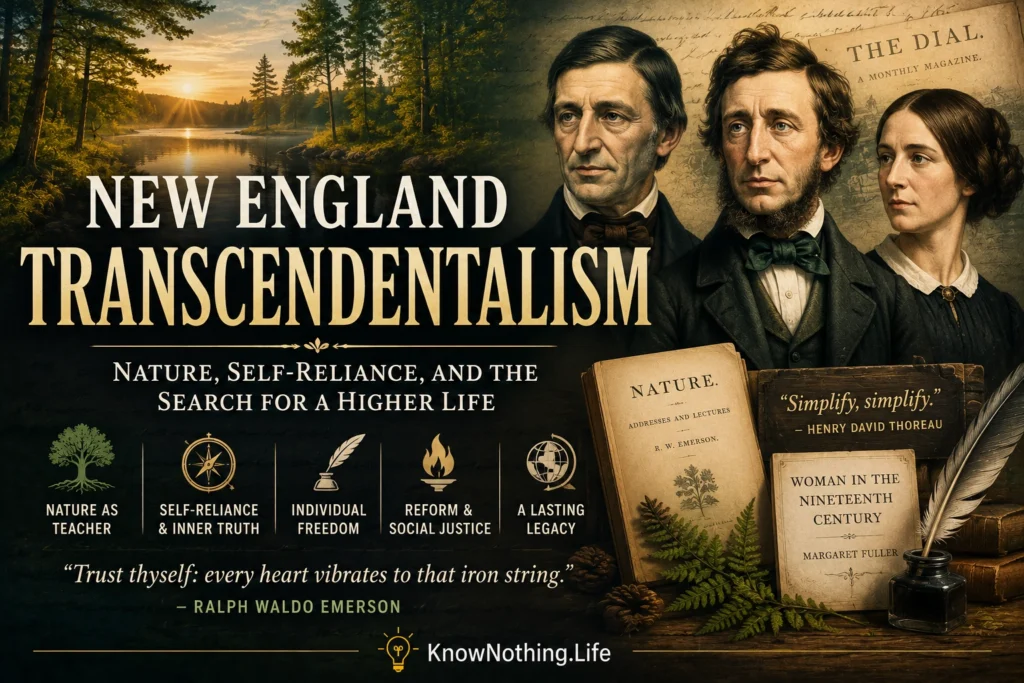
New England Transcendentalism emerged during the 1830s among writers, ministers, teachers, and reformers centered largely in Boston and Concord, Massachusetts. It was not a church with a fixed creed but a loose intellectual movement united by dissatisfaction with inherited authority, conventional religion, materialism, and social conformity. Its members believed that people possessed an intuitive capacity to recognize moral and spiritual truth directly, without depending entirely on institutions or established doctrines. In Ralph Waldo Emerson’s phrase, each person should seek “an original relation to the universe.”
The movement developed from New England Unitarianism while challenging its rational restraint. Its thinkers drew upon English and German Romanticism, biblical criticism, Neoplatonism, Samuel Taylor Coleridge, and European idealist philosophy. They did not simply reproduce Immanuel Kant’s technical system; they transformed “transcendence” into an American language of intuition, nature, conscience, and personal renewal. Discussions among the writers and ministers associated with the Transcendental Club helped turn these scattered influences into a recognizable movement. Emerson became its best-known voice, but Margaret Fuller, Henry David Thoreau, Theodore Parker, Amos Bronson Alcott, Elizabeth Palmer Peabody, George Ripley, and Lydia Maria Child made it intellectually and politically diverse.
Emerson and the Authority of the Inner Self
Emerson supplied Transcendentalism with its most influential philosophical vocabulary. His short book Nature, published in 1836, argued that the natural world could restore wonder and reveal a spiritual unity beneath ordinary experience. Nature was not merely scenery or material for human use. It was a symbolic language through which the individual might encounter universal truth. Emerson’s image of becoming a “transparent eyeball” describes a temporary loosening of the isolated ego, allowing the observer to feel connected to a larger spiritual life. Revelation, he suggested, remained available in the present rather than belonging only to scripture, religious authorities, or the distant past.
In “Self-Reliance,” “The Over-Soul,” and “The American Scholar,” Emerson turned self-trust into a moral and intellectual principle. Self-reliance did not merely mean economic independence, selfishness, or isolation from other people. It meant resisting conformity long enough to hear one’s own conscience and creative insight. His 1838 “Divinity School Address” extended this argument into religion by criticizing a Christianity that treated spiritual truth as completed in the life of Jesus rather than continuously accessible to the individual soul. The controversy surrounding the address clarified the Transcendentalist belief that institutions become lifeless when inherited forms replace personal experience and active moral perception.
Thoreau and Philosophy as a Way of Living
Henry David Thoreau converted Emerson’s principles into experiments in daily conduct. At Walden Pond, where he lived from 1845 to 1847 on land owned by Emerson, he tested whether a simpler life could free attention from unnecessary labor and consumption. Walden, published in 1854, was not a literal account of total wilderness isolation; Thoreau remained close to Concord and regularly interacted with family and neighbors. His purpose was philosophical: to ask which needs were genuine, how possessions shaped consciousness, and whether deliberate living could recover possibilities hidden by routine. His criticism of people living “lives of quiet desperation” targeted a society in which property, debt, work, and social expectations could control their supposed owners.
Thoreau also carried the authority of conscience into politics. In “Resistance to Civil Government,” published in 1849 and later known as “Civil Disobedience,” he argued that citizens should not permit law or majority rule to make them agents of injustice. His refusal to pay a poll tax was connected to his opposition to slavery and the Mexican-American War. During the 1850s, he condemned the Fugitive Slave Law and defended John Brown following the raid on Harpers Ferry. Transcendentalist individualism, in Thoreau’s work, therefore became a basis for resistance when government violated a higher moral law. Conscience demanded more than holding correct private opinions; it required refusing meaningful cooperation with injustice.
Margaret Fuller and the Expansion of Freedom
Margaret Fuller exposed a central problem within Transcendentalism: who was actually permitted to become a free and complete individual? As the first editor of The Dial, the movement’s principal journal, she created a forum for essays, poetry, criticism, translations, and comparative religion. Published from 1840 to 1844, the magazine featured work by Emerson, Thoreau, Alcott, Fuller, and less familiar writers who struggled to enter conventional publications. Fuller edited its first two years before Emerson assumed the position. Although its circulation and finances were limited, The Dial gave the movement a public identity and preserved its internal variety.
Fuller’s essay “The Great Lawsuit,” first published in The Dial, became the foundation of Woman in the Nineteenth Century in 1845. She argued that women should have unrestricted intellectual, spiritual, and vocational development rather than identities prescribed by men. Scholar David M. Robinson emphasizes that her feminist philosophy arose both from Transcendentalist principles and from her experience of the restrictions placed on nineteenth-century women. Fuller’s Boston “Conversations” also gave women a setting for serious intellectual exchange. Through them, self-culture became a shared educational practice rather than a privilege exercised only by formally educated men. Her work made the movement confront the social barriers that prevented its language of universal freedom from being universally applied.
Reform, Global Sources, and Historical Limits
The movement was more socially engaged than its reputation for solitude suggests. George and Sophia Ripley founded Brook Farm in 1841 to combine shared labor, intellectual cultivation, and a less competitive social order. Members received equal compensation regardless of gender, but the community eventually collapsed financially. Other Transcendentalists pursued educational reform, women’s rights, religious liberalization, and abolitionism. Theodore Parker, Lydia Maria Child, Thoreau, and later Emerson challenged slavery, while the concept of a “higher law” offered language for judging government against conscience. This conflict became especially urgent after the Fugitive Slave Law required citizens and officials to cooperate with the capture of people who had escaped slavery.
Transcendentalists also read Hindu, Buddhist, Confucian, Persian, and other religious traditions, sometimes publishing selections in The Dial under the heading “Ethnical Scriptures.” Studies by Arthur Versluis and other scholars show that Asian religions significantly influenced their thinking about nature, selfhood, spiritual discipline, and universal religion. Yet these texts often reached New England through translations shaped by missionary and colonial perspectives. The movement’s universalism contained other serious blind spots. Leading figures were largely silent about Native American sovereignty and territorial rights, while ideals of retreat, leisure, and self-culture were far less accessible to enslaved people, factory workers, domestic laborers, and poor families. Its philosophical promise was expansive, but the social circle producing it remained comparatively privileged.
The Continuing Legacy
New England Transcendentalism reshaped American literature by making encounters with nature, conscience, and spiritual experience sources of cultural authority. Emerson encouraged writers to imagine an American literature that was not dependent on European approval. Thoreau united close natural observation with criticism of consumption, slavery, war, and government. Fuller extended the movement’s promise of self-development into a foundational argument for women’s equality. Its influence can be traced through Walt Whitman, American pragmatism, religious liberalism, nature writing, environmental thought, feminist criticism, and traditions of principled civil disobedience. Modern scholarship now treats Transcendentalism not merely as a literary school but as a cultural formation encompassing religion, politics, science, education, journalism, and reform.
Its enduring power lies in a tension the Transcendentalists never fully resolved. They defended individual authority without wanting to abandon social responsibility. They sought truth in solitude but repeatedly returned to education, journalism, reform, and political controversy. Their finest works ask whether people can live according to conscience rather than convention, value nature without reducing it to property, and create institutions that enlarge rather than diminish human possibility. New England Transcendentalism was never a finished philosophical system. It was an argument that inherited forms of life could be examined, resisted, and remade—and that personal awakening carried obligations extending far beyond the self.