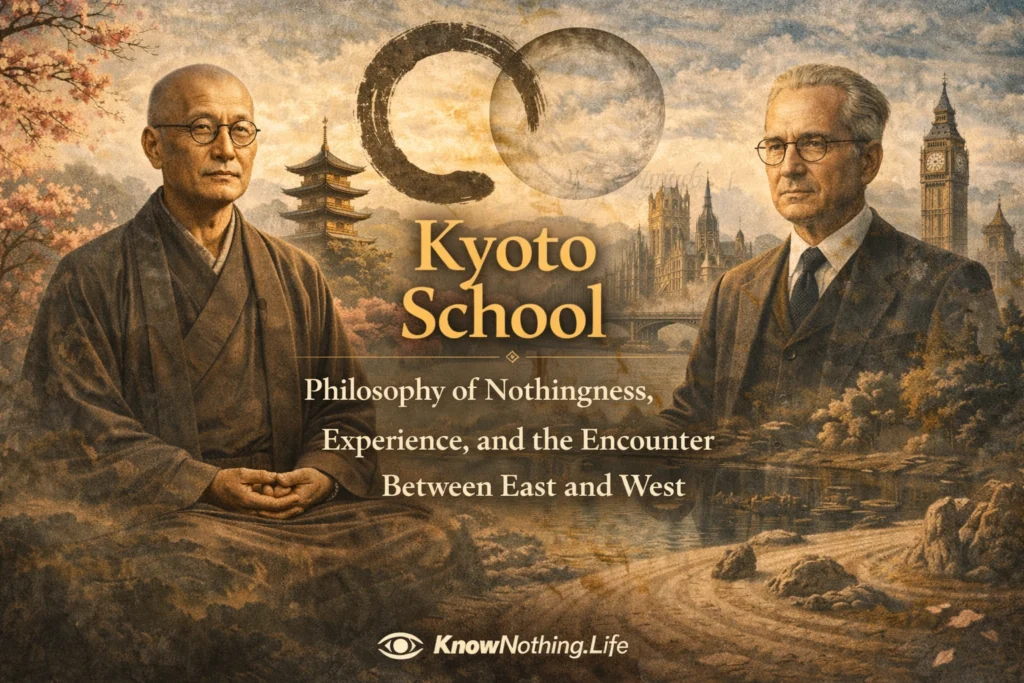
The Kyoto School represents one of the most significant philosophical movements to emerge from modern Japan, distinguished by its ambitious attempt to synthesize Eastern and Western traditions into a coherent and original framework. Centered at Kyoto Imperial University in the early twentieth century, the movement began with the work of Nishida Kitarō and continued through thinkers such as Tanabe Hajime and Nishitani Keiji. These philosophers sought to engage deeply with Western philosophy—particularly figures like Kant, Hegel, and Heidegger—while remaining rooted in the spiritual and intellectual heritage of Zen Buddhism.
At its core, the Kyoto School is defined by its exploration of nothingness (mu), not as mere absence but as a fundamental ground of being that transcends dualistic distinctions. This concept serves as a bridge between Buddhist thought and modern philosophy, offering a way to rethink the nature of self, reality, and knowledge. Rather than adopting Western ideas uncritically or retreating into tradition, Kyoto School philosophers engaged in a creative dialogue, producing a body of work that is both deeply original and globally relevant. Their efforts reflect a broader philosophical question: how can different intellectual traditions meet without dissolving into one another?
Nishida Kitarō and the Concept of Pure Experience
The foundation of the Kyoto School lies in the philosophy of Nishida Kitarō, whose groundbreaking work An Inquiry into the Good introduced the concept of “pure experience.” Nishida sought to overcome the dualism between subject and object that characterizes much of Western philosophy, proposing instead that experience in its most immediate form precedes such distinctions. In pure experience, there is no separation between the perceiver and the perceived; reality is encountered directly, without the mediation of conceptual thought.
Nishida describes pure experience as the starting point of all knowledge, a state in which consciousness is unified and undivided. “To experience is to know facts exactly as they are,” he writes, emphasizing the immediacy and authenticity of this mode of awareness. This idea draws heavily on Zen Buddhist insights, particularly the emphasis on direct realization, while also engaging with Western epistemology. By grounding knowledge in experience rather than abstraction, Nishida offers a radically different approach to understanding reality.
As his thought developed, Nishida introduced the concept of the “place of nothingness” (basho), a metaphysical field in which all things exist and relate to one another. This notion extends his earlier work, suggesting that reality is not composed of discrete entities but arises within a dynamic, relational context. The idea of basho challenges conventional metaphysics, replacing substance-based models with a more fluid and interconnected vision of being. Through these innovations, Nishida laid the intellectual groundwork for the Kyoto School’s ongoing exploration of nothingness and experience.
Tanabe Hajime and the Philosophy of Metanoetics
While Nishida focused on the structure of experience, Tanabe Hajime developed a philosophy centered on ethical transformation and self-negation. His work, particularly in Philosophy as Metanoetics, introduces the concept of metanoia—a radical conversion or turning of the self. For Tanabe, philosophy is not merely an intellectual exercise but a process of existential transformation, requiring individuals to confront their limitations and undergo a profound change in perspective.
Tanabe critiques the notion of autonomous reason, arguing that human beings cannot achieve truth through rationality alone. Instead, he emphasizes the importance of recognizing one’s own inadequacy and opening oneself to a deeper ground of being. “Through the negation of the self, the self is restored,” he writes, capturing the paradoxical nature of his philosophy. This process of self-negation is not destructive but transformative, leading to a renewed sense of identity grounded in humility and openness.
His thought is deeply influenced by both Buddhism and Western existentialism, particularly the work of Kierkegaard and Heidegger. By integrating these influences, Tanabe develops a philosophy that addresses the ethical and spiritual crises of modernity. His emphasis on repentance, responsibility, and transformation offers a powerful response to the challenges of a fragmented and uncertain world, highlighting the role of philosophy as a guide for living rather than merely thinking.
Nishitani Keiji and the Problem of Nihilism
The third major figure of the Kyoto School, Nishitani Keiji, confronts the problem of nihilism in the modern world. In his influential work Religion and Nothingness, Nishitani explores the sense of meaninglessness that arises when traditional frameworks of belief collapse. Drawing on both Western philosophy and Buddhist thought, he seeks to move beyond nihilism by reinterpreting nothingness as a source of possibility rather than despair.
Nishitani distinguishes between “relative nothingness,” associated with the loss of meaning, and “absolute nothingness,” which represents a deeper ground of existence. While the former leads to alienation and emptiness, the latter opens the possibility of a more authentic relationship with reality. “To overcome nihilism,” he writes, “we must pass through it,” suggesting that the experience of emptiness is not an endpoint but a necessary stage in the search for meaning.
His philosophy emphasizes the dissolution of the ego and the realization of interdependence. By letting go of the illusion of a separate self, individuals can experience a deeper connection with the world. This insight resonates with Zen teachings while addressing the existential concerns of modern philosophy. Nishitani’s work thus represents a culmination of the Kyoto School’s engagement with nothingness, offering a vision that is both critical and constructive.
Dialogue with Western Philosophy
A defining feature of the Kyoto School is its sustained engagement with Western philosophical traditions. Rather than rejecting Western thought, Kyoto School philosophers sought to enter into dialogue with it, drawing on its insights while challenging its assumptions. Nishida engaged with Kant’s epistemology and Hegel’s dialectics, Tanabe with existentialism, and Nishitani with Nietzsche and Heidegger. This engagement was not merely academic but aimed at addressing fundamental questions about existence, knowledge, and meaning.
Through this dialogue, the Kyoto School developed a unique philosophical language that bridges cultural and intellectual divides. Concepts such as nothingness, self-negation, and pure experience provide alternatives to Western frameworks, offering new ways of thinking about familiar problems. At the same time, the engagement with Western philosophy allowed Kyoto School thinkers to articulate their ideas in a global context, making their work accessible to a wider audience.
This cross-cultural exchange reflects a broader philosophical project: the search for a universal language of thought that transcends cultural boundaries while respecting their differences. The Kyoto School’s success in this endeavor lies in its ability to remain rooted in its own tradition while engaging openly with others, demonstrating that philosophical dialogue can be both critical and creative.
Legacy and Contemporary Relevance
The influence of the Kyoto School extends far beyond its historical context, shaping contemporary discussions in philosophy, theology, and cultural studies. Its exploration of nothingness, experience, and the limits of reason continues to resonate in a world grappling with questions of identity, meaning, and globalization. By addressing the tensions between tradition and modernity, the Kyoto School offers valuable insights into the challenges of living in a rapidly changing world.
In recent decades, scholars have revisited Kyoto School philosophy in light of global concerns such as environmental ethics, interreligious dialogue, and the search for sustainable ways of living. The emphasis on interdependence and the critique of individualism provide a framework for rethinking human relationships with each other and with the natural world. At the same time, the School’s engagement with nihilism and existential anxiety speaks to the psychological and cultural challenges of modern life.
Despite its achievements, the Kyoto School has also faced criticism, particularly regarding its relationship to Japanese nationalism during the early twentieth century. These debates highlight the complexity of its legacy, reminding us that philosophical ideas are always situated within historical contexts. Nonetheless, the enduring significance of the Kyoto School lies in its ability to provoke thought, inspire dialogue, and offer new perspectives on enduring philosophical questions.
Final Reflections on the Kyoto School
The Kyoto School stands as a remarkable example of philosophical creativity, demonstrating how diverse traditions can be brought into meaningful dialogue. Through its exploration of nothingness, pure experience, and the limits of reason, it challenges conventional assumptions and opens new possibilities for understanding reality. Its thinkers do not provide easy answers but invite a deeper engagement with the questions that define human existence.
In a world increasingly shaped by cultural exchange and intellectual diversity, the Kyoto School offers a model for how philosophy can bridge differences without erasing them. By remaining rooted in its own tradition while engaging openly with others, it embodies a spirit of inquiry that is both rigorous and inclusive. Its legacy continues to inspire those seeking to navigate the complexities of modern life, offering a vision of philosophy as a living, evolving practice grounded in both thought and experience.