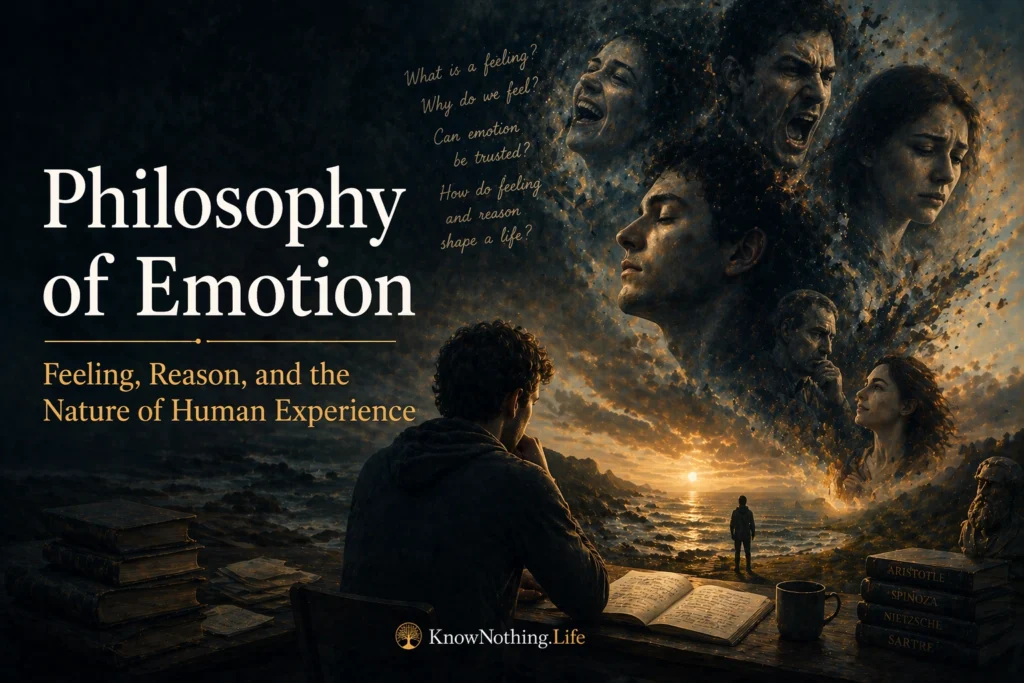
Emotion is one of the most immediate and powerful aspects of human life, shaping perception, guiding action, and giving meaning to experience. From joy and love to fear and anger, emotions influence not only how individuals feel but how they think, decide, and relate to others. Yet despite their familiarity, emotions remain philosophically complex. Are they irrational impulses that disrupt reason, or are they essential components of rational thought? Do emotions reveal truths about the world, or do they distort reality through subjective bias?
The philosophy of emotion seeks to answer these questions by examining the nature, function, and value of emotional experience. It explores how emotions arise, what they represent, and how they interact with cognition and behavior. Across history, philosophers have offered competing accounts—some viewing emotions as obstacles to knowledge, others recognizing them as integral to understanding and moral judgment. By analyzing emotion through philosophical inquiry, we gain insight into the deeper structure of human experience and the role feeling plays in shaping the self.
Historical Perspectives on Emotion
Early philosophical accounts often treated emotions with suspicion, associating them with disorder and loss of control. In ancient Greek thought, Plato described the soul as divided into rational and non-rational parts, with emotions belonging to the latter. For Plato, the ideal life required reason to govern the passions, ensuring harmony within the individual. Aristotle offered a more balanced view, acknowledging that emotions can be appropriate and even virtuous when properly regulated. In his ethical framework, emotions are not inherently problematic; rather, their value depends on how they are expressed and moderated.
The Stoics took a more critical stance, viewing emotions as disturbances that arise from false judgments. For thinkers like Epictetus, emotional suffering results from misinterpreting external events as inherently good or bad. By correcting these judgments, individuals can achieve emotional tranquility. This approach emphasizes the cognitive dimension of emotion, suggesting that feelings are closely tied to beliefs and evaluations.
In contrast, later philosophers challenged the idea that emotion is subordinate to reason. David Hume famously argued that reason is “the slave of the passions,” asserting that emotions are the primary drivers of action. According to Hume, rational thought alone cannot motivate behavior; it is emotion that gives direction and purpose. This shift marked a significant departure from earlier views, highlighting the central role of emotion in human life.
What Are Emotions?
Defining emotion is a central challenge in philosophy. Emotions are often described as complex states involving feelings, physiological responses, and cognitive evaluations. They are not merely internal sensations but responses to perceived situations, shaped by both bodily reactions and mental interpretation. This dual nature has led to diverse theories about what emotions fundamentally are.
Some philosophers and psychologists have proposed that emotions are primarily physiological. According to this view, associated with thinkers like William James, emotions arise from bodily changes. For example, we do not tremble because we are afraid; we feel fear because we tremble. This perspective emphasizes the role of the body in shaping emotional experience, suggesting that feelings are closely tied to physical states.
Other theories focus on the cognitive aspects of emotion. Emotions, in this view, involve judgments or appraisals about the world. Fear, for instance, is not just a feeling but an evaluation that something is dangerous. This cognitive approach aligns with the idea that emotions can be rational or irrational depending on the accuracy of the underlying judgment. The interplay between bodily response and cognitive evaluation continues to be a central topic in the philosophy of emotion.
Emotion and Reason
The relationship between emotion and reason has long been a focal point of philosophical debate. Traditional views often placed reason above emotion, treating the latter as a source of error and distraction. However, contemporary perspectives increasingly recognize that emotion and reason are deeply interconnected. Rather than opposing forces, they work together to shape human thought and behavior.
Philosophers such as Immanuel Kant emphasized the importance of reason in moral decision-making, arguing that ethical principles must be grounded in rationality. Yet even within this framework, emotions play a role in motivating action and reinforcing moral commitments. Without emotional engagement, rational principles may lack the force needed to guide behavior.
Modern research supports the idea that emotion is essential for effective reasoning. Emotional responses provide information about value and significance, helping individuals prioritize and make decisions. Without emotion, reasoning can become detached and ineffective, as individuals struggle to assign importance to different options. The integration of emotion and reason highlights the complexity of human cognition, suggesting that both are necessary for a better understanding of experience.
The Intentionality of Emotion
One of the defining features of emotion is its intentionality—the fact that emotions are about something. Fear is directed at a perceived threat, love toward a person, anger toward an injustice. This directedness distinguishes emotions from mere sensations, linking them to the external world and giving them meaning.
Philosophers like Franz Brentano emphasized intentionality as a key characteristic of mental states, including emotions. This perspective suggests that emotions involve representations of the world, shaped by perception and interpretation. The object of an emotion may be real or imagined, but it is always central to the experience itself.
Intentionality also raises questions about the accuracy of emotions. If emotions are based on interpretations, they can be mistaken or misleading. Fear may arise in situations that are not truly dangerous, or anger may be directed at the wrong target. At the same time, emotions can reveal important truths, highlighting aspects of experience that might otherwise be overlooked. Understanding the intentional nature of emotion allows for a more nuanced view, recognizing both its strengths and limitations.
Emotion and Moral Life
Emotions play a crucial role in moral judgment and ethical behavior. Feelings such as empathy, guilt, and compassion shape how individuals respond to others and evaluate actions. Without these emotional capacities, moral reasoning would lack depth and motivation. The philosophy of emotion thus intersects with ethics, exploring how feelings contribute to moral understanding.
Adam Smith argued that sympathy is the foundation of moral judgment, allowing individuals to understand and share the feelings of others. This capacity for empathy enables moral evaluation by connecting personal experience with the experiences of others. Similarly, contemporary philosophers emphasize the importance of emotional engagement in fostering ethical awareness.
However, emotions can also complicate moral decision-making. Biases and prejudices may influence emotional responses, leading to unjust or irrational judgments. The challenge lies in cultivating emotions that align with ethical principles while remaining open to reflection and revision. This balance highlights the importance of integrating emotion with critical reasoning in moral life.
Emotion in Contemporary Thought
In modern philosophy and science, the study of emotion has expanded significantly, incorporating insights from neuroscience, psychology, and cognitive science. Research has revealed the complex neural mechanisms underlying emotional experience, showing how different brain regions interact to produce feelings and responses. These findings support the view that emotions are not isolated phenomena but integral components of cognitive processes.
Contemporary philosophers continue to debate the nature of emotion, exploring questions about its relationship to consciousness, language, and culture. Some argue that emotions are shaped by social and linguistic frameworks, suggesting that different cultures may experience and interpret emotions in distinct ways. This perspective emphasizes the role of context in shaping emotional life.
At the same time, advances in artificial intelligence and technology raise new questions about emotion. Can machines experience emotions, or are they uniquely human? What role do emotions play in defining consciousness and identity? These emerging issues ensure that the philosophy of emotion remains a vibrant and evolving field, continually adapting to new challenges and discoveries.
Conclusion
The philosophy of emotion reveals that feelings are not merely fleeting experiences but fundamental aspects of human life. They shape perception, guide action, and influence moral judgment, playing a central role in both personal and social existence. From ancient debates about the relationship between emotion and reason to modern explorations of cognitive and neural processes, emotions have been understood in diverse and evolving ways.
What emerges from this exploration is a recognition of the complexity and significance of emotion. Far from being opposed to reason, emotions are deeply intertwined with it, contributing to understanding and decision-making. They are both sources of insight and potential error, requiring careful reflection and balance.
Ultimately, the study of emotion invites a deeper appreciation of what it means to be human. It highlights the richness of experience, the interplay between feeling and thought, and the ways in which emotions shape the world we inhabit. In understanding emotion, we gain insight not only into the mind but into the very nature of human existence.