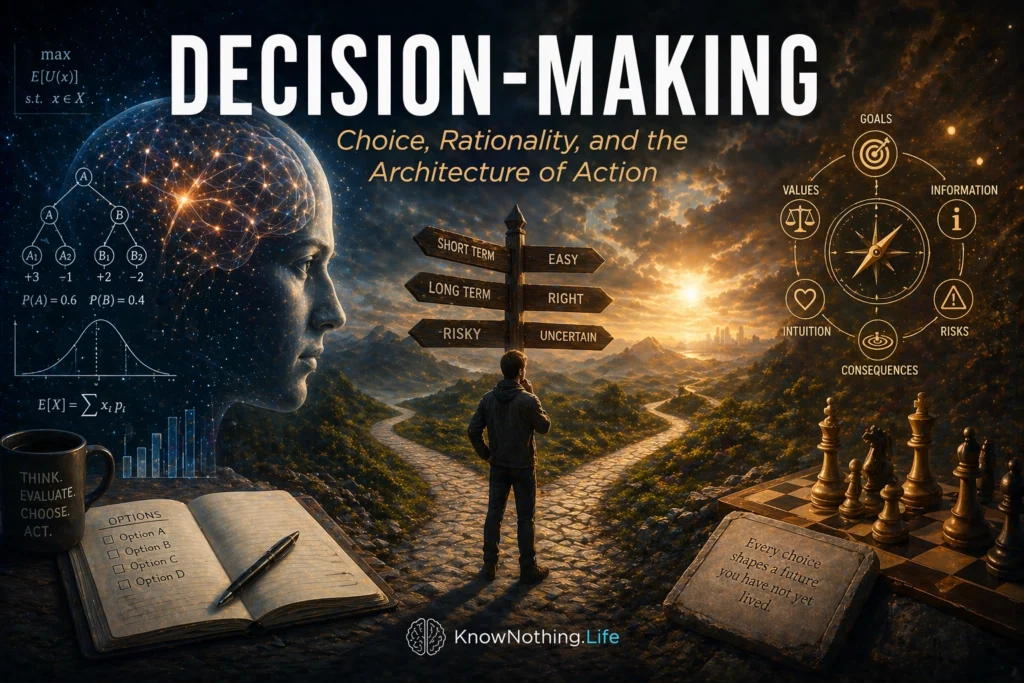
Decision-making is one of the most fundamental aspects of human life. From everyday choices to life-defining commitments, individuals are constantly evaluating options, weighing outcomes, and acting under uncertainty. These decisions shape not only external circumstances but also identity, relationships, and moral responsibility. Yet the process of choosing is far from straightforward. It involves a complex interplay of reasoning, emotion, habit, and context, often unfolding beneath conscious awareness.
Philosophically, decision-making raises deep questions about rationality, freedom, and value. What does it mean to make a rational choice? Are decisions guided by logic, emotion, or both? To what extent are individuals truly free in their choices, given the influence of psychological and social factors? By examining these questions, the philosophy of decision-making seeks to understand how individuals navigate the possibilities before them and what it means to choose well.
Historical Foundations of Choice
Philosophical reflection on decision-making can be traced back to ancient inquiries into reason and action. In classical Greek thought, Aristotle analyzed choice within his broader framework of ethics. For Aristotle, decision-making involves deliberation, a process of reasoning about means to achieve desired ends. Rational choice is not merely about selecting options but about aligning actions with virtuous character and practical wisdom.
In contrast, early modern philosophy placed greater emphasis on the role of individual autonomy. René Descartes highlighted the importance of clear and distinct reasoning in guiding decisions, suggesting that rational clarity is the foundation of reliable judgment. Meanwhile, David Hume challenged this view by arguing that reason alone cannot motivate action. According to Hume, decisions are ultimately driven by desires and passions, with reason serving as a tool for achieving emotional goals.
These contrasting perspectives illustrate a central tension in the philosophy of decision-making: whether choice is primarily a rational process or one fundamentally shaped by emotion. This tension continues to influence contemporary debates, reflecting the complexity of human cognition and action.
Rationality and Decision Theory
Modern philosophy has developed formal frameworks for understanding decision-making, particularly through decision theory. This approach seeks to model rational choice by analyzing how individuals evaluate options under conditions of uncertainty. It often involves concepts such as probability, utility, and expected outcomes, providing a structured way of thinking about decisions.
Philosophers and economists such as John von Neumann and Oskar Morgenstern contributed to the development of expected utility theory, which suggests that rational decisions maximize expected value based on probabilities and preferences. This framework has been highly influential, offering a mathematical model of rational choice.
However, the application of decision theory raises important philosophical questions. Real-world decisions often involve incomplete information, conflicting values, and emotional influences that cannot be easily quantified. This has led to critiques of purely formal models, emphasizing the need for a more nuanced understanding of rationality. Decision-making, in practice, may require balancing formal reasoning with practical judgment and contextual awareness.
Emotion and Decision-Making
While traditional accounts often emphasized rationality, contemporary perspectives recognize the essential role of emotion in decision-making. Emotions provide information about value and significance, guiding attention and shaping preferences. Fear, for example, highlights potential risks, while desire motivates pursuit of goals. Without these emotional inputs, decision-making would lack direction and meaning.
Philosophers such as David Hume anticipated this view, arguing that reason alone cannot produce action. Modern research supports this insight, showing that individuals with impaired emotional processing often struggle to make decisions, even when their cognitive abilities remain intact. This suggests that emotion is not an obstacle to rationality but a necessary component of it.
At the same time, emotions can introduce bias and error. Decisions influenced by fear or anger may be impulsive or disproportionate, leading to outcomes that do not align with long-term goals. The challenge lies in integrating emotion with reason, allowing feelings to inform decisions without overwhelming rational judgment. This integration is central to understanding how individuals make choices in complex and uncertain environments.
Freedom, Agency, and Responsibility
Decision-making is closely tied to the concept of freedom. To make a decision is to exercise agency, choosing between alternatives based on one’s values and intentions. This capacity for choice is often seen as a defining feature of human beings, distinguishing them from purely deterministic systems.
Philosophers have long debated the nature of this freedom. Immanuel Kant argued that true freedom involves acting according to rational principles rather than external influences. In this view, autonomy is achieved when individuals make decisions based on reason and moral law. In contrast, determinist perspectives suggest that decisions are shaped by prior causes, including biological, psychological, and social factors, raising questions about the extent of genuine freedom.
The relationship between freedom and responsibility is also central to the philosophy of decision-making. If individuals are free to choose, they can be held accountable for their actions. However, if decisions are heavily influenced by factors beyond their control, the basis for responsibility becomes less clear. These questions highlight the ethical dimensions of decision-making, connecting individual choice to broader issues of justice and accountability.
Bias, Heuristics, and Limits of Rationality
Contemporary research in psychology has revealed that human decision-making is often influenced by biases and heuristics—mental shortcuts that simplify complex problems. While these shortcuts can be efficient, they can also lead to systematic errors. For example, individuals may overestimate the likelihood of dramatic events or rely on initial impressions when making judgments.
Philosophers and cognitive scientists have explored the implications of these findings for understanding rationality. Rather than viewing humans as perfectly rational agents, many now recognize that decision-making is bounded by cognitive limitations. This concept of “bounded rationality” suggests that individuals make the best decisions they can within the constraints of their knowledge and processing capacity.
These insights challenge traditional models of rational choice, emphasizing the need for a more realistic account of decision-making. By understanding the limits of rationality, individuals can develop strategies to mitigate bias and improve decision-making. This approach reflects a shift toward a more practical and context-sensitive understanding of choice.
Decision-Making in Social Context
Decisions are rarely made in isolation. Social factors, including cultural norms, relationships, and institutional structures, play a significant role in shaping choices. Individuals often consider the expectations and preferences of others, as well as the potential social consequences of their actions.
Philosophers such as Jean-Paul Sartre emphasized the role of social context in shaping freedom and responsibility. For Sartre, individuals are free but also situated within a world that influences their choices. This perspective highlights the interplay between individual agency and social structure, suggesting that decision-making is both personal and relational.
The social dimension of decision-making also raises ethical questions about influence and manipulation. Advertising, social pressure, and institutional power can shape choices in ways that may not align with individual interests. Understanding these influences is essential for preserving autonomy and ensuring that decisions reflect genuine preferences.
Decision-Making in Contemporary Life
In the modern world, decision-making has become increasingly complex due to the abundance of options and the rapid flow of information. Individuals are often faced with a vast array of choices, from consumer decisions to career paths, each with uncertain outcomes. This complexity can lead to decision fatigue, reducing the ability to make thoughtful choices.
Technological advancements have also transformed decision-making processes. Algorithms and artificial intelligence play a growing role in guiding choices, from recommending products to influencing political opinions. While these tools can enhance efficiency, they also raise concerns about autonomy and control, as decisions may be shaped by systems that are not fully understood.
These developments highlight the need for critical reflection on decision-making in contemporary life. Philosophical inquiry provides tools for navigating this complexity, emphasizing the importance of clarity, reflection, and balance. By understanding the factors that influence decisions, individuals can make more informed and intentional choices.
Conclusion
Decision-making is a complex and multifaceted process that lies at the heart of human action. It involves the integration of reason, emotion, and context, shaping how individuals navigate the possibilities before them. Philosophical analysis reveals that decision-making is not simply a matter of choosing between options but a dynamic process that reflects values, goals, and constraints.
The study of decision-making highlights both the potential and the limitations of human rationality. While individuals have the capacity for thoughtful and deliberate choice, they are also influenced by biases, emotions, and external factors. Understanding these influences is essential for improving decision-making and achieving better outcomes.
Ultimately, decision-making is central to the human condition. It defines how individuals act, how they shape their lives, and how they relate to others. By examining the nature of choice, philosophy offers insight into the structure of action and the meaning of agency, providing a deeper understanding of what it means to decide and to live.