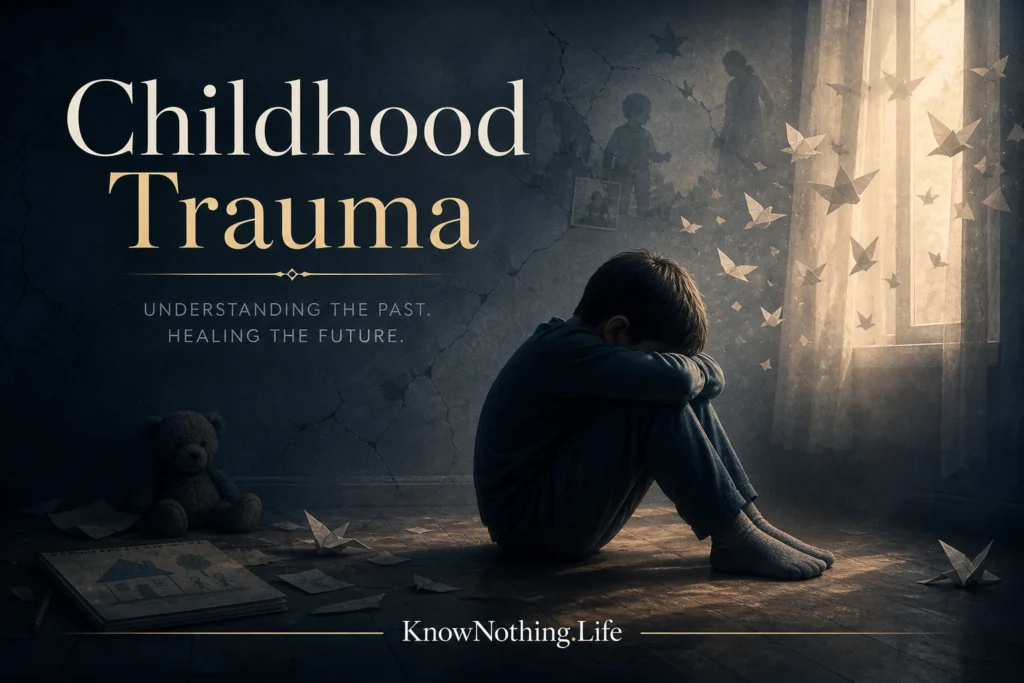
Childhood trauma refers to overwhelming experiences that occur during the early stages of development and disrupt a child’s sense of safety, attachment, identity, or bodily security. It may involve physical abuse, sexual abuse, emotional abuse, neglect, domestic violence, parental substance use, severe bullying, community violence, medical trauma, sudden loss, displacement, or chronic instability. Childhood trauma is especially powerful because children are still developing the emotional, cognitive, and nervous system capacities needed to understand danger, regulate distress, and make sense of experience. What an adult might recognize as a crisis, a child may experience as the collapse of the world itself.
The study of childhood trauma draws from developmental psychology, attachment theory, neuroscience, psychiatry, social work, and trauma studies. John Bowlby’s attachment theory, Mary Ainsworth’s research on caregiver responsiveness, Judith Herman’s Trauma and Recovery, Bessel van der Kolk’s The Body Keeps the Score, Bruce Perry’s developmental trauma work, and Vincent Felitti and Robert Anda’s Adverse Childhood Experiences research have all shaped modern understanding. Childhood trauma is not merely a painful memory from the past. It can become a developmental force, influencing how the child learns to trust, feel, remember, cope, and relate to others.
What Makes Childhood Trauma Different
Childhood trauma differs from adult trauma because it occurs while the self is still forming. A child does not yet have a mature understanding of danger, responsibility, morality, or identity. When trauma happens early, the child may not simply think, “Something bad happened.” They may conclude, “I am bad,” “I am unsafe,” “I cannot trust anyone,” or “My needs do not matter.” Trauma becomes woven into the child’s developing assumptions about the world and the self. This is why childhood trauma often produces shame, confusion, and relational fear as much as ordinary anxiety.
Judith Herman wrote in Trauma and Recovery that trauma “overwhelms the ordinary systems of care that give people a sense of control, connection, and meaning.” In childhood, those systems are still being built. A child depends on adults not only for food and shelter, but for emotional regulation, protection, interpretation, and reassurance. When caregivers are absent, frightening, abusive, or emotionally unavailable, the child may be left alone with experiences they cannot metabolize. The result is not only fear of what happened, but a damaged foundation for understanding safety itself.
Attachment and the Need for Safety
Attachment theory is central to understanding childhood trauma. John Bowlby argued that children are biologically prepared to seek closeness to caregivers because attachment promotes survival. A responsive caregiver becomes a secure base, allowing the child to explore the world while knowing comfort is available when distress arises. Mary Ainsworth’s “Strange Situation” research further showed how patterns of caregiver responsiveness shape secure, anxious, avoidant, and disorganized attachment behaviors. These early patterns influence how children learn to seek help, manage emotion, and trust relationships.
When trauma occurs within the caregiving relationship, the child faces a profound contradiction. The person who should provide safety may also be the source of terror, neglect, humiliation, or unpredictability. This can produce disorganized attachment, in which the child has no stable strategy for obtaining comfort. They may approach and avoid the caregiver at the same time, freeze, become controlling, dissociate, or show contradictory behavior. In adulthood, this early conflict may appear as fear of intimacy, emotional volatility, chronic distrust, people-pleasing, avoidance, or intense fear of abandonment.
The Developing Brain and Nervous System
Childhood trauma affects the developing brain because the nervous system is shaped by repeated experience. When a child grows up in a safe and responsive environment, the brain can devote energy to learning, play, social exploration, and emotional development. When a child grows up in chronic threat, the brain adapts for survival. It becomes tuned toward danger detection, rapid reaction, and self-protection. These adaptations may help the child endure the environment, but later they can interfere with learning, relationships, sleep, attention, and emotional regulation.
Bruce Perry’s work emphasizes that development is sequential: lower brain systems involved in arousal and survival develop before higher systems involved in reflection and self-control. If early life is dominated by fear, chaos, or neglect, the child’s stress-response systems may become overactive or poorly regulated. Bessel van der Kolk’s phrase “the body keeps the score” captures how trauma can remain present through bodily states: startle responses, muscle tension, stomach pain, headaches, shutdown, panic, numbness, or chronic alertness. The child’s body learns the world before the child can explain it.
Adverse Childhood Experiences
The Adverse Childhood Experiences study, often called the ACEs study, was led by Vincent Felitti and Robert Anda and became one of the most influential public health investigations into childhood trauma. It examined categories such as abuse, neglect, and household dysfunction, showing that early adversity is associated with increased risk for later physical health problems, mental illness, substance use, and social difficulties. The importance of the ACEs framework is that it connected childhood trauma to lifelong health, demonstrating that early suffering can become biologically and socially consequential across decades.
However, ACE scores should be used carefully. They are screening tools, not destiny. A high ACE score indicates increased risk, not inevitable damage. It also does not capture every form of trauma, such as racism, community violence, bullying, poverty, medical trauma, war, or cultural displacement. The ACEs framework is most useful when it encourages prevention, early intervention, and trauma-informed care. It reminds us that childhood conditions are not private background details; they are major determinants of health and development.
Memory, Dissociation, and Emotional Fragmentation
Children often remember trauma differently from adults because their language, time sense, and autobiographical memory are still developing. Some traumatic memories may be vivid and intrusive, while others may be fragmented, sensory, or difficult to narrate. A child may not be able to explain what happened, yet may show it through nightmares, play, aggression, regression, withdrawal, stomachaches, panic, or sudden changes in behavior. Trauma may appear as action before it becomes story.
Pierre Janet’s early work on dissociation remains relevant here. Janet argued that overwhelming experiences can fail to integrate into ordinary consciousness. For children, dissociation can be a survival strategy when escape is impossible. A child may mentally disconnect from the body, emotions, or environment in order to endure what cannot be stopped. Later, dissociation may appear as numbness, spacing out, memory gaps, emotional detachment, or feeling unreal. These symptoms are not meaningless. They are traces of a mind that learned to survive by separating from unbearable experience.
Emotional Regulation and Behavior
Childhood trauma often affects emotional regulation. A child exposed to chronic threat may swing between hyperarousal and shutdown. Hyperarousal can look like anger, impulsivity, panic, defiance, restlessness, or constant alertness. Shutdown can look like numbness, passivity, depression, exhaustion, or withdrawal. Adults may misread these behaviors as laziness, disrespect, manipulation, or lack of discipline. Trauma psychology asks a different question: what survival response is this behavior expressing?
This shift is central to trauma-informed care. A child who explodes in anger may be responding to perceived threat. A child who cannot concentrate may be scanning for danger. A child who lies may be trying to avoid punishment or abandonment. A child who acts overly mature may have learned that needs are unsafe. These behaviors still need guidance and boundaries, but punishment alone often fails because it does not address the nervous system beneath the behavior. Children heal through structure, predictability, safety, and relationships that teach the body a new expectation: distress can be survived without danger.
Shame, Identity, and Self-Worth
Shame is one of the most damaging effects of childhood trauma. Because children are naturally self-centered in their interpretation of events, they often assume that bad things happen because of something wrong with them. If a caregiver is abusive, neglectful, addicted, or emotionally unavailable, the child may believe they are unlovable rather than recognizing the adult’s failure. This is psychologically tragic but developmentally understandable. It may feel safer for a child to believe “I am bad” than “the person I depend on is dangerous.”
Over time, shame can become an identity. The child may grow into an adult who feels defective, burdensome, invisible, or undeserving of care. Brené Brown’s work on shame is useful here because it distinguishes guilt from shame: guilt concerns behavior, while shame attacks the self. Childhood trauma often creates shame before the child has the tools to question it. Recovery involves helping survivors understand that the trauma was something that happened to them, not proof of who they are.
Relationships After Childhood Trauma
Because childhood trauma often occurs in relational contexts, its effects commonly appear in later relationships. Survivors may fear abandonment, expect betrayal, struggle with boundaries, avoid intimacy, choose unsafe partners, become overly responsible for others, or feel overwhelmed by ordinary conflict. Some may become hyper-independent, believing they can rely only on themselves. Others may become highly dependent, searching for the safety they never received. These patterns are not character flaws; they are adaptations to early relational danger.
Attachment-based therapies and trauma-informed relationships can help repair these patterns. Healing often requires repeated experiences of safe connection: someone listens without humiliation, sets boundaries without abandonment, stays present during distress, and responds consistently over time. The nervous system learns through experience, not advice alone. A survivor may intellectually know that not everyone is dangerous, but relational healing occurs when the body gradually experiences that truth.
Treatment and Healing
Treatment for childhood trauma must be paced with care. Many survivors need stabilization before deep trauma processing. This can include grounding skills, emotional regulation, safety planning, sleep support, body awareness, and help building stable routines. Judith Herman’s three-stage model—safety, remembrance and mourning, and reconnection—remains one of the clearest frameworks. The first task is not forcing memory open; it is creating enough safety for memory to be approached without overwhelming the person again.
Different therapies may be helpful depending on the individual. Trauma-focused cognitive behavioral therapy is often used with children and adolescents. EMDR, developed by Francine Shapiro, can help process traumatic memories. Play therapy may help younger children express experiences they cannot verbalize directly. Somatic therapies address bodily survival responses. Family therapy may be important when caregivers are safe and willing to participate. For adults with childhood trauma histories, therapy often involves grief, boundary work, attachment repair, shame reduction, and learning emotional skills that were not available in childhood.
Resilience and Protective Factors
Childhood trauma increases risk, but it does not erase resilience. Protective factors can buffer the effects of adversity. These include at least one stable and caring adult, emotional validation, safe housing, community support, school connection, cultural belonging, therapy, spirituality, creative expression, and opportunities for mastery. Development is shaped by risk and protection together. Even when early life was painful, later relationships and environments can support healing.
Ann Masten famously described resilience as “ordinary magic,” emphasizing that resilience often grows from ordinary human systems of care rather than extraordinary toughness. This is an important corrective to the myth that traumatized children must simply become stronger alone. Resilience is relational. Children recover best when adults provide safety, predictability, compassion, and repair. Adults who survived childhood trauma also benefit from building lives that include stable connection, meaningful work, bodily care, and communities where they no longer have to hide.
Conclusion
Childhood trauma is one of the most powerful forces in psychological development because it occurs while the brain, body, identity, and attachment systems are still forming. It can shape how a child learns to feel safe, trust others, regulate emotion, remember experience, and understand self-worth. Its effects may appear as anxiety, depression, dissociation, anger, perfectionism, people-pleasing, avoidance, addiction, relationship difficulty, or chronic shame. These symptoms are often survival adaptations that made sense in an unsafe world.
Yet childhood trauma does not have the final word. The developing brain is vulnerable, but it is also capable of change. Healing happens through safety, relationship, emotional regulation, memory integration, and the gradual rebuilding of identity. Childhood trauma teaches the nervous system that the world is dangerous; recovery teaches, slowly and repeatedly, that safety can be real. Understanding childhood trauma matters because it replaces blame with context, punishment with care, and hopelessness with the possibility of repair.