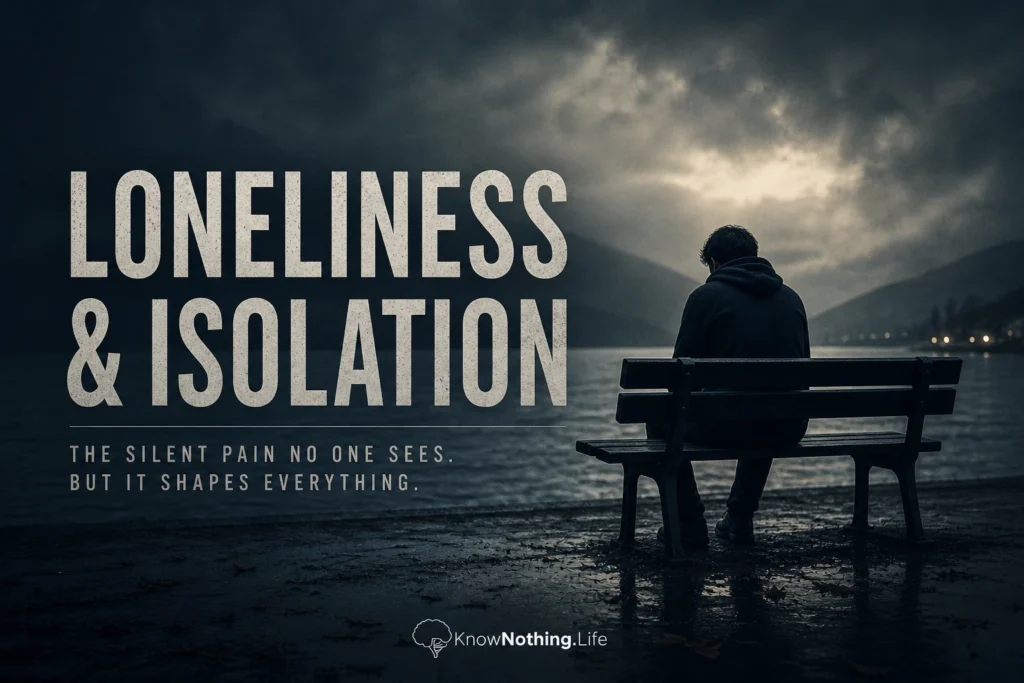
Loneliness and isolation are often spoken of as the same condition, but psychology draws an important distinction between them. Isolation refers to the objective state of being physically or socially separated from others. A person may live alone, work remotely, lack regular social contact, or be cut off from family and community. Loneliness, by contrast, is the subjective feeling that one’s social needs are unmet. A person can be surrounded by people and still feel profoundly lonely if those relationships lack intimacy, recognition, trust, or emotional meaning. Loneliness is not simply the absence of company; it is the pain of feeling unseen, unwanted, disconnected, or unable to share one’s inner world.
The topic has become one of the central concerns of modern psychology because human beings are deeply social creatures. Aristotle wrote in Politics that man is “by nature a political animal,” meaning that human flourishing depends on shared life, speech, friendship, and moral community. John Bowlby’s attachment theory later showed that emotional bonds are not luxuries but developmental necessities. In Attachment and Loss, Bowlby argued that human beings are biologically prepared to seek proximity to caregivers and loved ones, especially under stress. Loneliness and isolation therefore strike at something fundamental. They are not merely unpleasant moods; they reveal a broken or threatened connection between the person and the social world.
The Difference Between Solitude, Isolation, and Loneliness
Solitude can be healthy. Many philosophers, artists, writers, and spiritual traditions have valued being alone as a source of reflection, creativity, self-knowledge, and freedom from social noise. Henry David Thoreau, in Walden, wrote, “I never found the companion that was so companionable as solitude.” This kind of aloneness is chosen, meaningful, and inwardly rich. It allows the mind to recover from overstimulation, examine its own motives, and listen to thoughts that are often drowned out by constant interaction. Solitude becomes psychologically beneficial when it is voluntary and balanced by the possibility of connection.
Isolation is different when it is unwanted, prolonged, or imposed. It can arise from illness, disability, grief, relocation, poverty, aging, stigma, unemployment, trauma, digital substitution for real community, or social rejection. Loneliness appears when the person experiences this separation as a wound. Hannah Arendt, in The Origins of Totalitarianism, made an important distinction between isolation and loneliness, warning that loneliness involves being deserted not only by others but also, in some sense, from the shared world itself. Isolation may prevent action with others; loneliness can corrode one’s sense of belonging to reality. It is the difference between being alone and feeling abandoned.
The Psychology of Belonging
Belonging is one of the most powerful motives in human life. Abraham Maslow placed love and belonging near the center of his hierarchy of needs, below esteem and self-actualization but above basic safety. Although Maslow’s model has been debated, its psychological insight remains strong: people need more than food, shelter, and survival. They need affection, friendship, membership, and recognition. Roy Baumeister and Mark Leary later developed the “belongingness hypothesis,” arguing that human beings possess a fundamental need to form and maintain strong, stable interpersonal relationships. Their influential paper “The Need to Belong” described belonging not as a preference but as a basic human motivation.
This need is visible across development. Infants seek caregivers; children seek playmates and approval; adolescents seek peer belonging and identity; adults seek friendship, partnership, family, community, and social meaning. Loneliness hurts because it signals that an essential human need is frustrated. Just as hunger alerts the body to the need for food, loneliness alerts the person to the need for connection. The problem is that loneliness can become self-reinforcing. When people feel rejected or unworthy, they may withdraw, become hypervigilant for signs of exclusion, or interpret ambiguous social cues negatively. The signal meant to restore connection can begin to deepen disconnection.
Attachment, Early Bonds, and Emotional Security
Attachment theory provides one of the strongest frameworks for understanding loneliness. Bowlby argued that early relationships with caregivers create internal working models of the self and others. If caregivers are responsive and reliable, the child is more likely to develop a sense that others can be trusted and that the self is worthy of care. If caregiving is inconsistent, frightening, neglectful, or emotionally unavailable, the person may develop anxious, avoidant, or disorganized patterns of connection. These patterns can shape adult loneliness by influencing how people seek closeness, tolerate distance, and respond to vulnerability.
Mary Ainsworth’s “Strange Situation” studies gave empirical form to Bowlby’s theory by identifying different attachment patterns in infants. Later researchers extended attachment theory into adult relationships. A person with anxious attachment may fear abandonment and feel lonely even within relationships because reassurance never feels secure for long. A person with avoidant attachment may protect themselves from loneliness by denying need, keeping emotional distance, or valuing independence to the point of isolation. These patterns show that loneliness is not only about how many people are present. It is also about whether the nervous system feels safe enough to receive connection.
The Body and Brain of Loneliness
Loneliness is psychological, but it is also bodily. Chronic loneliness has been linked in research to stress, sleep disruption, inflammation, cardiovascular strain, and changes in immune functioning. John Cacioppo, one of the most important scientific researchers on loneliness, argued in Loneliness: Human Nature and the Need for Social Connection that loneliness evolved as a biological warning signal. Just as physical pain alerts us to bodily injury, social pain alerts us to threatened social bonds. Cacioppo’s work helped establish loneliness as a serious public health concern rather than a sentimental issue.
The body may treat social disconnection as danger because, for most of human evolution, isolation increased vulnerability. A lone human was more exposed to predators, starvation, injury, and exclusion from shared resources. This evolutionary background helps explain why loneliness can produce heightened threat detection. The lonely person may become more sensitive to rejection, more defensive in conversation, and more likely to perceive others as untrustworthy. Unfortunately, this defensive posture can make connection harder. Loneliness tells the person to reconnect, but it may also alter perception in ways that make reconnection feel risky.
Modern Life and the Loneliness Paradox
Modern societies are more connected technologically than any previous societies, yet many people feel emotionally disconnected. The paradox is not difficult to understand. Communication has become faster, but not always deeper. Social media can provide contact without intimacy, visibility without recognition, and comparison without belonging. A person may receive messages, likes, and notifications while lacking anyone they can call in crisis. Digital life can widen weak ties while weakening the rhythms of embodied community: shared meals, neighborhood familiarity, religious gatherings, clubs, extended family networks, and unplanned conversation.
Sociologist Robert Putnam’s Bowling Alone famously argued that civic participation and social capital declined in many areas of American life during the late twentieth century. Whether one accepts every part of Putnam’s diagnosis or not, the larger concern remains powerful: people suffer when the institutions of ordinary belonging weaken. Émile Durkheim’s concept of anomie, developed in Suicide, is also relevant. Anomie describes a condition in which social norms and bonds weaken, leaving individuals less anchored by shared meaning. Loneliness is not only a private emotional problem. It can be a symptom of social fragmentation.
Loneliness, Shame, and Self-Perception
Loneliness often carries shame because people interpret it as evidence that something is wrong with them. They may think, “If I were more attractive, successful, interesting, or lovable, I would not feel this way.” This self-blame intensifies the pain. Carl Rogers, in On Becoming a Person, argued that psychological health requires congruence and unconditional positive regard. When people feel they must hide their real selves to be accepted, relationships become performances. They may appear socially functional while remaining inwardly alone, because no one knows the self they are protecting.
Shame also makes loneliness difficult to confess. People may admit stress, busyness, or fatigue more easily than loneliness. To say “I am lonely” can feel like admitting failure, rejection, neediness, or social defeat. Brené Brown, in Daring Greatly, describes shame as the fear of disconnection, writing that shame tells us we are “not good enough.” This is why loneliness and shame are so closely linked: loneliness is the experience of disconnection, and shame is the fear that disconnection is deserved. Healing loneliness often requires challenging not only social absence but the belief that one is unworthy of connection.
Isolation, Trauma, and Defensive Withdrawal
Some isolation is chosen because connection has become associated with danger. People who have experienced betrayal, abuse, neglect, bullying, discrimination, or repeated rejection may withdraw to protect themselves. From the outside, this can look like indifference or antisocial behavior. From the inside, it may be a survival strategy. Judith Herman, in Trauma and Recovery, emphasized that trauma damages the basic sense of safety and trust in relationships. After trauma, solitude may feel safer than intimacy because intimacy requires openness, and openness once led to harm.
The challenge is that protective isolation can become a prison. Avoiding people reduces immediate anxiety, but it also prevents corrective experiences of trust, kindness, and belonging. The person may become increasingly convinced that others are unsafe, while the lack of connection deepens despair. Trauma-informed approaches do not force connection too quickly. They recognize that rebuilding social life requires safety, choice, boundaries, and gradual trust. For people whose loneliness is rooted in trauma, the goal is not simply “be more social.” The goal is to make connection feel survivable again.
Existential Loneliness and the Human Condition
There is also a deeper form of loneliness that belongs to the human condition itself. Existential thinkers argued that each person must face certain experiences alone: death, responsibility, freedom, guilt, and the search for meaning. Søren Kierkegaard saw the individual as standing before choices that no crowd can make on their behalf. Martin Heidegger, in Being and Time, described human existence as being-toward-death, a condition that individualizes us because no one can die our death for us. This kind of loneliness cannot be solved simply by company, because it arises from the structure of being a self.
Yet existential loneliness is not only tragic. It can also deepen authenticity. To recognize one’s separateness may make love more meaningful, because connection becomes a chosen bridge across real difference rather than a fantasy of complete fusion. Martin Buber, in I and Thou, offered one of the most profound responses to isolation. He distinguished between relationships in which we treat others as objects and relationships in which we encounter them as whole beings. The “I-Thou” relation does not erase loneliness permanently, but it creates moments of genuine presence. In such moments, the person is not merely seen; they are met.
Healing Loneliness Through Meaningful Connection
Reducing loneliness is not the same as increasing social quantity. A calendar full of shallow obligations may leave a person emptier than before. What matters is meaningful connection: relationships in which there is trust, reciprocity, emotional honesty, shared attention, and the possibility of being known. This may involve friendship, family repair, romantic partnership, community service, group activities, therapy, spiritual life, creative collaboration, or even small repeated interactions that restore a sense of social presence. The lonely person often needs not a crowd, but a bridge.
Viktor Frankl’s Man’s Search for Meaning offers an important insight here. Frankl argued that human beings can endure great suffering when they find meaning through love, work, courage, or responsibility. Loneliness becomes more bearable when life contains purpose and contribution. Helping others, creating something, caring for animals, joining a cause, mentoring, volunteering, or participating in a community can reduce loneliness not only by increasing contact but by restoring significance. People need to feel not only that others are available to them, but that they matter to others.
Final Thoughts on Loneliness & Isolation
Loneliness and isolation reveal the social depth of human nature. People are not built to live as sealed-off individuals. They need attachment, recognition, shared meaning, touch, conversation, belonging, and emotional safety. At the same time, not all aloneness is harmful. Solitude can renew the self, deepen thought, and protect inner freedom. The crucial difference is whether aloneness is chosen and meaningful or unwanted and painful. Loneliness begins where the need for connection meets the absence of felt belonging.
The major thinkers on loneliness show that it cannot be reduced to one cause. Aristotle teaches that human beings flourish in shared life; Bowlby shows that attachment bonds shape emotional security; Maslow and Baumeister reveal belonging as a basic need; Cacioppo explains loneliness as a biological warning signal; Durkheim and Putnam show the social conditions that can intensify disconnection; Rogers and Brown reveal the role of shame and authenticity; Herman shows how trauma can make isolation protective; Buber shows that genuine encounter can heal the distance between self and other. Loneliness is painful because connection matters. To understand loneliness is to understand that human beings do not merely want company. They want to be known, valued, needed, and met.