The philosophy of Albert Camus occupies a unique place in modern thought, standing at the crossroads of literature, ethics, and existential inquiry. Often associated with existentialism, though he rejected the label, Camus developed a distinct philosophical perspective centered on the concept of the absurd—the tension between humanity’s search for meaning and the silent, indifferent universe. His work does not offer comforting answers; instead, it confronts the human condition with clarity, honesty, and a quiet insistence on dignity.
Born in 1913 in Mondovi Algeria (now Dréan), Camus grew up in poverty under French colonial rule. His early life was marked by hardship, yet also by the luminous landscapes of the Mediterranean, which would later infuse his writing with a sense of physical immediacy and beauty. Unlike philosophers who build abstract systems, Camus grounded his ideas in lived experience, weaving philosophical reflection into novels, essays, and plays that continue to resonate across generations.
Early Life and Intellectual Formation
Camus’ upbringing profoundly shaped his worldview. His father died in World War I when Camus was an infant, leaving his mother—a partially deaf and illiterate woman—to raise him in difficult circumstances. Despite these challenges, Camus excelled academically, aided by a teacher who recognized his potential and encouraged him to pursue higher education. He eventually attended the University of Algiers, where he studied philosophy.
During his university years, Camus became deeply engaged with both literature and political thought. He was briefly associated with the Communist Party, though he later distanced himself due to ideological disagreements. His early writings reveal a concern with justice, inequality, and the human struggle for meaning in a world marked by suffering. At the same time, he developed a deep appreciation for classical philosophy and the natural beauty of Algeria, elements that would remain central to his work.
A diagnosis of tuberculosis interrupted his academic and professional trajectory, forcing him to abandon plans for a traditional academic career. This limitation, however, pushed him toward writing and journalism, where he found a medium for exploring philosophical ideas in a more immediate and accessible form. His experiences as a reporter and editor sharpened his awareness of social injustice and political complexity.
The Philosophy of the Absurd
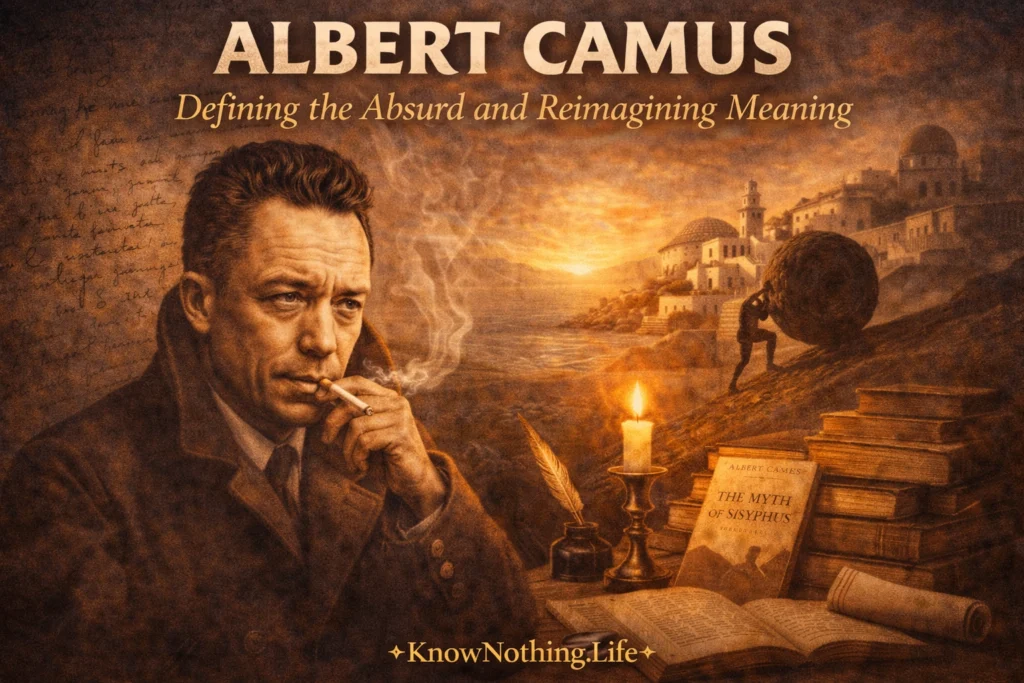
At the core of Camus’ thought lies the concept of the absurd, most fully articulated in The Myth of Sisyphus. The absurd arises from the confrontation between human beings’ desire for meaning, order, and clarity, and the universe’s apparent indifference. This clash does not resolve into harmony; it persists as a fundamental condition of existence.
Rather than responding to the absurd with despair or resignation, Camus proposes a stance of defiance. He rejects both religious faith, which he sees as an escape into illusion, and nihilism, which denies the value of life altogether. Instead, he advocates for a conscious acceptance of the absurd, coupled with a commitment to live fully and authentically within its limits. The figure of Sisyphus, condemned to roll a boulder uphill for eternity, becomes a symbol of this attitude. Camus famously concludes, “One must imagine Sisyphus happy.”
This philosophy emphasizes clarity, rebellion, and freedom. By recognizing the absence of ultimate meaning, individuals are liberated to create their own values and experiences. The absurd does not negate life; it intensifies it, stripping away false hopes and revealing the raw immediacy of existence.
Major Works and Literary Philosophy
Camus’ philosophical ideas are inseparable from his literary work, which serves as both expression and exploration of his thought. His novel The Stranger presents a protagonist, Meursault, who embodies the absurd through his emotional detachment and refusal to conform to social expectations. The novel’s stark style and unsettling narrative challenge readers to confront their assumptions about morality and meaning.
In The Plague, Camus uses the metaphor of a deadly epidemic to explore themes of suffering, solidarity, and resistance. Set in the Algerian city of Oran, the novel depicts individuals responding to crisis with varying degrees of courage and compassion. It reflects Camus’ belief that, even in an absurd world, human beings can find meaning through collective action and ethical commitment.
Another significant work, The Rebel, examines the nature of rebellion and its role in human history. Camus distinguishes between rebellion that affirms life and dignity, and revolutionary movements that justify violence in the name of ideology. His critique of totalitarianism and ideological extremism underscores his commitment to moderation and humanistic values.
Ethics, Rebellion, and Humanism
Camus’ philosophy is often described as a form of ethical humanism grounded in rebellion. For him, rebellion is not merely a political act, but a fundamental assertion of human dignity. To rebel is to say “no” to injustice and suffering, while simultaneously affirming the value of life. This dual movement reflects his belief that ethics must arise from lived experience rather than abstract principles.
Unlike philosophers who base morality on universal laws or divine commands, Camus emphasizes the importance of limits. He warns against the dangers of absolute ideologies, which can justify oppression in the pursuit of utopian goals. Instead, he advocates for a measured approach that respects individual freedom and acknowledges the complexity of human existence.
His ethical vision is deeply influenced by his experiences during World War II, when he was involved in the French Resistance. As a journalist for the underground newspaper Combat, Camus wrote passionately about justice, freedom, and the responsibility of individuals to oppose tyranny. These experiences reinforced his belief that moral action must be grounded in both courage and restraint.
Quotes and Key Ideas
Camus’ writings are rich with memorable statements that capture the essence of his philosophy. Among his most notable quotes:
- “In the depth of winter, I finally learned that within me there lay an invincible summer.”
- “The struggle itself toward the heights is enough to fill a man’s heart.”
- “Man is the only creature who refuses to be what he is.”
- “Freedom is nothing but a chance to be better.”
These quotes reflect central themes in his work: resilience, struggle, self-definition, and ethical responsibility. They reveal a philosophy that, while rooted in the recognition of absurdity, remains deeply committed to the possibility of meaning through human action.
Camus’ key ideas—the absurd, rebellion, and the rejection of nihilism—have influenced a wide range of disciplines, from literature and philosophy to political theory. His work continues to inspire those seeking to navigate the complexities of modern life without resorting to simplistic answers.
Later Life and Recognition
Camus’ literary and philosophical achievements earned him widespread recognition during his lifetime. In 1957, he was awarded the Nobel Prize in Literature, becoming one of the youngest recipients in history. The award acknowledged his contributions to literature and his exploration of moral questions in a rapidly changing world.
Despite his success, Camus remained a deeply reflective and sometimes conflicted figure. His views on political issues, particularly the Algerian War, placed him in a difficult position, as he sought to balance his commitment to justice with his personal ties to Algeria. This tension reflects the complexity of his ethical stance, which resisted simple categorization.
His life was cut short in 1960 when he died in a car accident at the age of 46. The suddenness of his death added a poignant dimension to his work, which had already grappled with the unpredictability and fragility of existence.
Legacy and Influence
The influence of Camus extends across literature, philosophy, and cultural thought. Although often associated with Jean-Paul Sartre and existentialism, his philosophical outlook remains distinct, emphasizing clarity and moderation over radical freedom or despair. His disagreements with Sartre highlight his commitment to independence and intellectual integrity.
Camus’ exploration of the absurd has resonated with readers confronting the uncertainties of modern life. His insistence on living fully without illusions offers a powerful alternative to both nihilism and blind faith. In literature, his works continue to be studied and adapted, reflecting their enduring relevance.
In contemporary discussions of ethics and politics, Camus’ emphasis on limits and human dignity provides a valuable framework for addressing complex issues. His philosophy encourages individuals to engage with the world thoughtfully and responsibly, recognizing both its challenges and its possibilities.
Conclusion
Albert Camus stands as one of the most compelling voices of the 20th century, offering a philosophy that confronts the human condition with honesty and courage. His concept of the absurd challenges the search for ultimate meaning, while his emphasis on rebellion affirms the value of human action and dignity. Through his novels, essays, and plays, Camus created a body of work that is both intellectually rigorous and deeply human.
His ideas continue to resonate because they address fundamental questions that remain unresolved: how to live in a world without clear answers, how to find meaning in the face of uncertainty, and how to act ethically amid complexity. To read Camus is to engage with a philosophy that refuses to simplify the human experience. It invites reflection, demands honesty, and ultimately affirms the possibility of living with purpose—even in an indifferent universe.