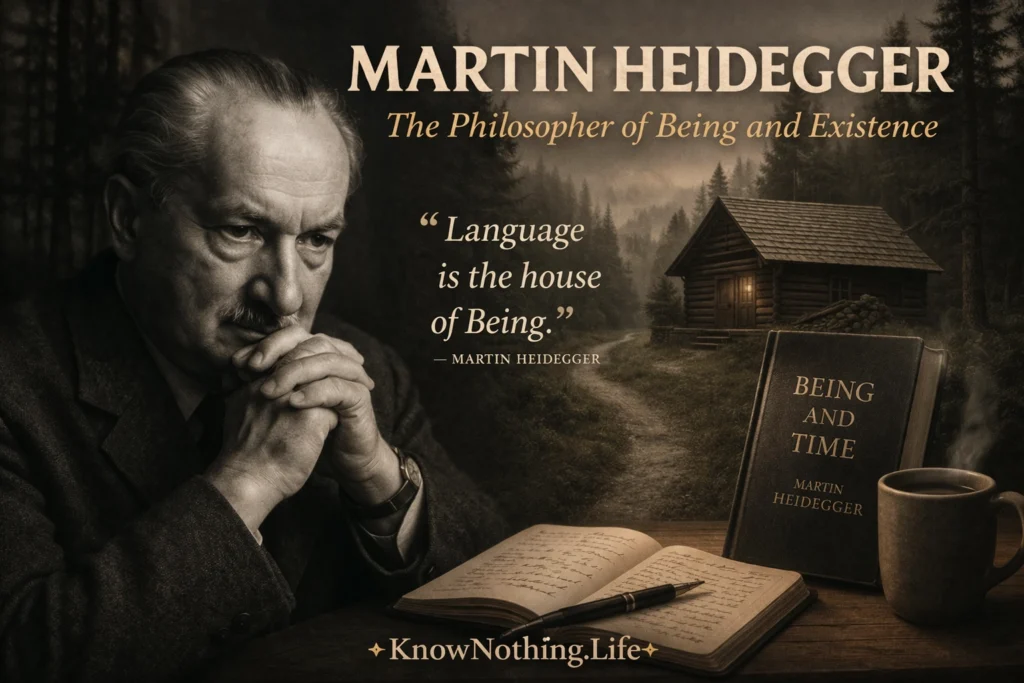
The philosophy of Martin Heidegger represents one of the most profound and controversial developments in 20th-century thought. His work centers on a deceptively simple yet deeply complex question: what does it mean to be? While earlier philosophers had explored existence, Heidegger sought to uncover the underlying structure of Being itself, arguing that Western philosophy had largely forgotten this fundamental inquiry.
Born in 1889 in Messkirch, Heidegger emerged during a time of intellectual upheaval marked by rapid scientific advancement and existential uncertainty. His work stands at the intersection of phenomenology, existentialism, and ontology, offering a radical rethinking of human existence. Through dense and often challenging prose, he reshaped philosophical language, introducing concepts that continue to influence contemporary thought.
Early Life and Intellectual Formation
Heidegger was raised in a Catholic family, and his early education was oriented toward theology. He initially intended to enter the priesthood, but his interests gradually shifted toward philosophy. He studied at the University of Freiburg, where he was influenced by Edmund Husserl, the founder of phenomenology. Under Husserl’s guidance, Heidegger developed an interest in examining the structures of experience.
Despite this influence, Heidegger eventually moved beyond Husserl’s framework. While Husserl focused on consciousness and intentionality, Heidegger turned his attention to the question of Being itself. He believed that understanding human existence required a more fundamental analysis—one that addressed not just how we experience the world, but how we exist within it.
His early academic career was marked by rapid advancement. He became a professor at Freiburg and later at Marburg, gaining recognition for his innovative lectures. During this period, he began developing the ideas that would culminate in his most famous work.
Being and Time
Heidegger’s magnum opus, Being and Time (1927), stands as one of the most influential texts in modern philosophy. In this work, Heidegger introduces the concept of Dasein, a German term often translated as “being-there,” which refers to human existence as fundamentally situated in the world.
Rather than treating humans as detached observers, Heidegger argues that we are always already embedded in a context of relationships, meanings, and practices. Dasein is characterized by its awareness of its own existence and its capacity to question Being. This self-awareness distinguishes human beings from other entities and forms the basis of philosophical inquiry.
A central theme of Being and Time is the concept of authenticity. Heidegger suggests that individuals often live in a state of inauthenticity, conforming to social norms and avoiding the deeper questions of existence. Authenticity, by contrast, involves confronting one’s own finitude and taking responsibility for one’s life. This confrontation is closely tied to the concept of being-toward-death, which emphasizes the inevitability of mortality as a defining aspect of human existence.
The Question of Being
Heidegger’s philosophy revolves around the question of Being—what it means for something to exist. He argues that traditional philosophy has focused too much on specific beings (objects, entities) and not enough on Being itself as a fundamental condition. This oversight, he claims, has led to a distorted understanding of reality.
To address this issue, Heidegger distinguishes between “Being” (the condition that allows entities to exist) and “beings” (the entities themselves). This distinction is central to his project, as it shifts the focus from individual objects to the broader context in which they appear. By examining Being, Heidegger seeks to uncover the structures that make experience possible.
His approach is deeply phenomenological, emphasizing direct engagement with experience rather than abstract theorizing. However, he extends phenomenology beyond consciousness to encompass the entirety of existence. This expansion marks a significant departure from earlier philosophical traditions and establishes Heidegger as a transformative figure in modern thought.
Language, Truth, and Poetry
In his later work, Heidegger turned increasingly toward language and its role in revealing Being. He famously declared that “language is the house of Being,” suggesting that our understanding of existence is shaped by the way we speak and think. This perspective highlights the importance of interpretation and meaning in human experience.
Heidegger also explored the relationship between truth and unconcealment. Rather than viewing truth as correspondence between statements and facts, he describes it as a process of revealing—bringing something into the open. This idea reflects his broader emphasis on disclosure and the dynamic nature of understanding.
His engagement with poetry, particularly the work of Friedrich Hölderlin, further illustrates his belief that language can reveal deeper truths. Poetry, in Heidegger’s view, has the power to disclose aspects of Being that are inaccessible through ordinary discourse. This shift toward poetic thinking represents a significant evolution in his philosophy.
Quotes and Key Ideas
Heidegger’s writings are dense but filled with striking insights that capture the essence of his thought. Among his most notable quotes:
- “Being is the transcendens pure and simple.”
- “Language is the house of Being.”
- “The nothing nothings.”
- “Man is not the lord of beings. Man is the shepherd of Being.”
These statements reflect his unique approach to philosophy, emphasizing the primacy of Being and the role of human existence in its revelation. They also illustrate his willingness to challenge conventional language and thought.
Key concepts such as Dasein, authenticity, being-toward-death, and the distinction between Being and beings have become central to contemporary philosophy. They continue to influence discussions in existentialism, hermeneutics, and phenomenology.
Controversy and Political Involvement
Heidegger’s legacy is complicated by his involvement with National Socialism. In 1933, he joined the Nazi Party and served as rector of the University of Freiburg, a decision that has been widely criticized. Although his active political engagement was relatively brief, it has cast a long shadow over his philosophical work.
Scholars continue to debate the relationship between Heidegger’s philosophy and his political actions. Some argue that his ideas are independent of his political affiliations, while others see connections between his thought and the ideological context of his time. This controversy remains a significant aspect of his legacy.
Despite these challenges, Heidegger’s philosophical contributions have continued to be studied and debated. His work raises important questions about the relationship between intellectual inquiry and ethical responsibility.
Legacy and Influence
Heidegger’s influence on modern philosophy is immense. His ideas shaped existentialism, particularly in the work of Jean-Paul Sartre, as well as hermeneutics through thinkers like Hans-Georg Gadamer. His emphasis on interpretation and context has also influenced fields such as literary theory and psychology.
In addition to philosophy, Heidegger’s work has impacted architecture, theology, and environmental thought. His critique of technology, for example, highlights the ways in which modern society reduces the world to a resource for exploitation. This perspective has become increasingly relevant in discussions of sustainability and ecological responsibility.
Heidegger’s legacy is both profound and contested. His contributions to philosophy are undeniable, yet they must be considered alongside the ethical complexities of his life. This duality reflects the broader challenges of engaging with influential but controversial figures.
Conclusion
Martin Heidegger stands as one of the most challenging and influential philosophers of the modern era. His exploration of Being, existence, and language offers a framework for understanding the human condition that is both radical and enduring. Through concepts such as Dasein and authenticity, he invites individuals to confront the fundamental questions of existence.
At the same time, his life and work raise important questions about the relationship between philosophy and ethics. Engaging with Heidegger requires both intellectual openness and critical reflection, recognizing the depth of his insights while acknowledging the complexities of his legacy.
Ultimately, Heidegger’s philosophy is not about providing definitive answers, but about opening new ways of thinking. It challenges us to reconsider our assumptions, to engage more deeply with the world, and to reflect on what it means to be.