Addiction neuroscience examines how repeated exposure to drugs or highly reinforcing behaviors changes the neural systems responsible for motivation, learning, decision-making, stress regulation, and self-control. Addiction is not defined simply by enjoying a substance, using it regularly, or developing physical dependence. It is marked by persistent drug seeking or consumption despite serious consequences, difficulty controlling use, and a narrowing of motivation around the addictive reward. Physical dependence can occur during appropriate medical treatment and may produce withdrawal when a drug is stopped, but it does not necessarily include craving, compulsive seeking, or continued use despite harm.
The field rejects both the idea that addiction is merely a moral failure and the equally simplistic claim that one brain chemical removes all personal agency. Addictive behavior develops through interactions among neural plasticity, drug pharmacology, genetics, stress, development, environment, learning history, and access to alternative rewards. Alan Leshner’s influential 1997 article described addiction as a chronic, relapsing brain disorder, helping move public discussion away from punishment and toward treatment. Modern neuroscience adds an important qualification: brain changes influence behavior without making recovery impossible. Neural systems remain responsive to medication, experience, relationships, changing environments, and sustained learning.
Dopamine, Reward, and Reinforcement Learning
Dopamine is frequently called the brain’s pleasure chemical, but this description is inaccurate. Dopamine helps the nervous system learn which events deserve attention, predict valuable outcomes, and energize actions that may obtain them. In a landmark 1997 paper, Wolfram Schultz, Peter Dayan, and Read Montague showed that dopamine-neuron activity resembles a reward-prediction error. An unexpected reward produces a burst of activity; once a cue reliably predicts the reward, the response shifts toward that cue; and an expected reward that fails to appear produces a reduction in activity. This mechanism helps organisms update their expectations and repeat actions that have produced beneficial outcomes.
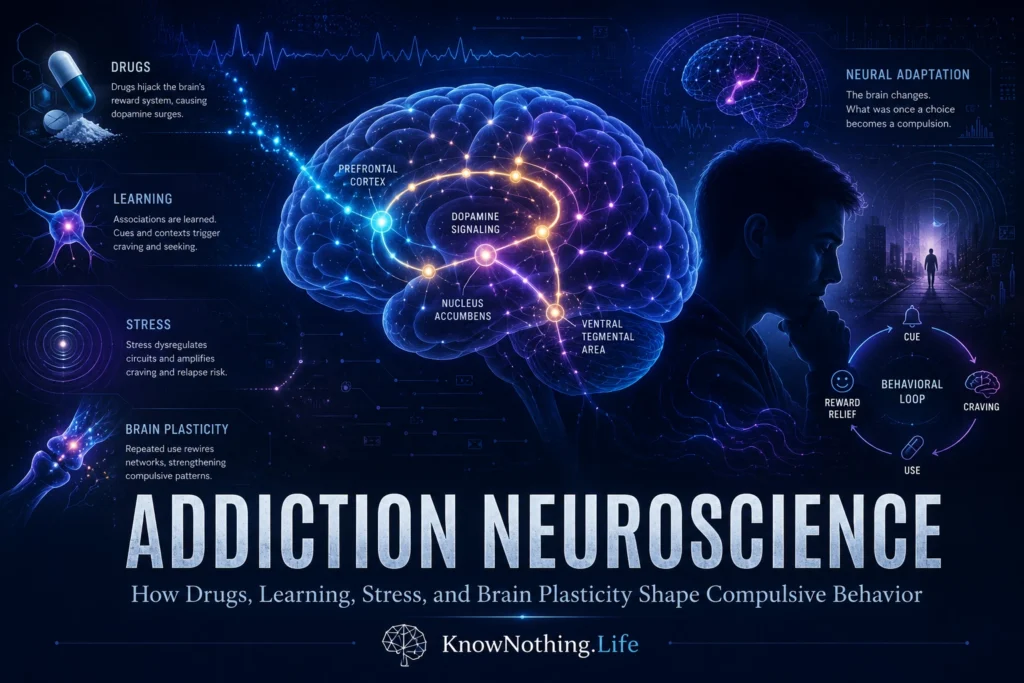
Many addictive drugs influence this learning system more directly or intensely than ordinary rewards. In 1988, Gaetano Di Chiara and Assunta Imperato reported that several drugs abused by humans increased extracellular dopamine preferentially within the mesolimbic system of freely moving rats, particularly in the nucleus accumbens. Different substances achieve this through different molecular routes: stimulants interfere with dopamine transport, opioids disinhibit dopamine neurons through opioid receptors, nicotine activates nicotinic acetylcholine receptors, and alcohol affects several transmitter systems. The shared result is not identical pleasure but unusually strong reinforcement, allowing drug-related actions, places, objects, and social settings to acquire motivational importance.
Wanting Is Not the Same as Liking
The distinction between “wanting” and “liking” is central to addiction neuroscience. Liking refers to the pleasurable impact of consuming a reward, whereas wanting describes the motivation to obtain it. Terry Robinson and Kent Berridge proposed the incentive-sensitization theory in 1993, arguing that repeated drug exposure can make mesolimbic systems increasingly responsive to drugs and drug-associated cues. As a result, a person may experience intense craving even when the substance provides less pleasure than it once did. The theory helps explain why someone can sincerely report that drug use is no longer enjoyable while still feeling powerfully compelled to continue.
Incentive sensitization also explains why craving can be highly situational. A person may feel relatively stable in a new environment but experience a sudden surge of desire after encountering a familiar street, smell, person, song, or piece of paraphernalia. These cues have acquired incentive salience through repeated association with the drug. They do not merely remind the individual of past use; they can activate motivational systems that direct attention and prepare action. Sensitization may persist long after tolerance to some drug effects has developed, creating the paradox of increasing desire alongside decreasing enjoyment.
From Goal-Directed Action to Habit and Compulsion
Early drug use is usually goal-directed. A person takes a substance expecting a particular outcome, such as euphoria, stimulation, relief from anxiety, social confidence, or escape from distress. With repetition, control over behavior may gradually shift from flexible decision-making toward stimulus-driven habits. Barry Everitt and Trevor Robbins proposed that this transition involves changing interactions between the ventral striatum, which contributes to reward and motivation, and dorsal striatal systems involved in learned routines. Drug-related behavior may then be triggered with less deliberate evaluation of its consequences.
Habit alone does not fully explain addiction, because many habits remain sensitive to changing circumstances and can be interrupted. Compulsion emerges when drug seeking becomes unusually persistent despite punishment, reduced reward value, or opportunities to choose safer alternatives. In a 2008 animal study, David Belin and colleagues found that high impulsivity predicted the later development of compulsive cocaine taking, even though impulsivity did not necessarily predict initial drug use. This distinction illustrates that the factors encouraging experimentation may differ from those promoting the loss of control. Addiction develops through stages rather than appearing automatically after exposure.
Withdrawal, Stress, and the Negative Side of Addiction
Addiction is not driven only by pursuit of a positive effect. With repeated drug use, the nervous system adapts in ways that can reduce ordinary reward sensitivity and recruit brain stress systems. George Koob and Michel Le Moal described this process as hedonic homeostatic dysregulation. Initially, drug use may be motivated largely by positive reinforcement—the desire to experience a rewarding effect. As dependence develops, negative reinforcement becomes increasingly important: the substance is taken to escape irritability, anxiety, dysphoria, physical withdrawal, or an inability to feel normal.
Koob and Le Moal used the concept of allostasis to describe a persistent shift in the brain’s regulatory set point. Reward function becomes weaker, while systems involving stress-related signals such as corticotropin-releasing factor become more active. The person may require the drug not to become unusually euphoric but to approach a temporary state of relief. This helps explain escalation, repeated relapse during distress, and the emotionally difficult period that may follow cessation. Withdrawal varies greatly among substances: alcohol and sedative withdrawal can be medically dangerous, opioid withdrawal is intensely distressing, and stimulant withdrawal may produce profound fatigue, low motivation, and depressed mood.
Cues, Memory, and Craving
Addiction-related memories are distributed across circuits involving the amygdala, hippocampus, striatum, prefrontal cortex, and sensory systems. The hippocampus contributes information about places and contexts, while the amygdala helps assign emotional and motivational importance to cues. In a 1999 imaging study, Anna Rose Childress and colleagues found limbic activation when people with cocaine dependence viewed drug-related cues outside conscious awareness. Other imaging experiments have shown that consciously presented cocaine cues can activate regions associated with craving, attention, memory, and action preparation.
These learned associations help account for relapse after long periods without drug use. Abstinence weakens some patterns but does not automatically erase every cue–reward memory. Stress, re-exposure to the drug, or return to a familiar environment can retrieve those associations. Craving should therefore be understood as a fluctuating state rather than proof that treatment has failed. Effective recovery often includes changing routines, reducing exposure to high-risk cues, practicing alternative responses, strengthening social support, and learning to tolerate urges without acting on them.
Executive Control and the Narrowing of Motivation
Addiction alters not only reward systems but also the neural processes used to evaluate consequences and inhibit actions. Rita Goldstein and Nora Volkow developed the impaired response inhibition and salience attribution model, often abbreviated as I-RISA. They proposed that addiction involves the overvaluation of drug-related rewards, the undervaluation of competing rewards, and reduced control over strongly prepared responses. Imaging evidence has repeatedly implicated the orbitofrontal cortex, anterior cingulate cortex, and other prefrontal regions involved in valuation, error monitoring, planning, and inhibition.
Dopamine changes may interact with these cortical systems. Nora Volkow and colleagues reported in 1993 that people with cocaine dependence had reduced availability of striatal dopamine D2 receptors that persisted for several months after detoxification. Related work found low D2-receptor availability in people who used methamphetamine and linked it with reduced metabolism in the orbitofrontal cortex. These results are group-level associations rather than diagnostic brain scans, and they cannot determine whether every difference preceded drug use or resulted from it. They nevertheless support the view that addiction involves disrupted communication between motivational and regulatory networks.
Recovery, Treatment, and Neuroplasticity
The same plasticity that contributes to addiction also makes recovery possible. Brain systems can change when drug exposure stops, health improves, stress decreases, and new patterns are repeatedly practiced. Volkow and colleagues found that reduced dopamine-transporter availability in people who had used methamphetamine showed substantial recovery after prolonged abstinence, although improvement in the biological measure did not correspond perfectly with every cognitive outcome. Recovery is therefore not a simple return to a previous brain state, but it can involve meaningful restoration and adaptation.
Medication can stabilize specific neurotransmitter systems while behavioral treatment reshapes learning and daily choices. Methadone and buprenorphine act on opioid receptors in controlled ways that suppress withdrawal and reduce the reinforcing effects of illicit opioids. In a controlled trial, Richard Johnson and colleagues found that buprenorphine and an adequate dose of methadone were effective maintenance treatments for opioid dependence. Extended-release naltrexone takes a different approach by blocking opioid receptors after detoxification; a randomized trial led by Evgeny Krupitsky found that monthly injections improved opioid abstinence and treatment retention compared with placebo.
Behavioral approaches also work through principles identified by neuroscience. Contingency management supplies immediate, reliable rewards for treatment attendance or verified abstinence, helping non-drug outcomes compete with the delayed and uncertain benefits of recovery. Stephen Higgins and colleagues demonstrated in 1994 that incentive-based treatment improved cocaine abstinence and retention. Cognitive-behavioral therapy helps people identify cues, examine expectations, plan responses, and practice alternative actions. Treatment is most effective when it also addresses housing, trauma, pain, psychiatric illness, relationships, employment, and social connection—the real environments in which motivation and choice occur.
Addiction neuroscience shows why telling someone simply to exercise willpower is inadequate. Repeated drug use can alter learning, motivation, stress, habits, and inhibitory control, making drug-related actions unusually powerful and alternative rewards less compelling. Yet neuroscience does not imply hopelessness or erase responsibility. It shows where control has become impaired, why support and treatment are necessary, and how new patterns can gradually become stronger. Addiction is neither a defect of character nor an irreversible takeover of the brain. It is a complex, learned, biologically embedded condition that can be treated through sustained changes in chemistry, behavior, relationships, and environment.