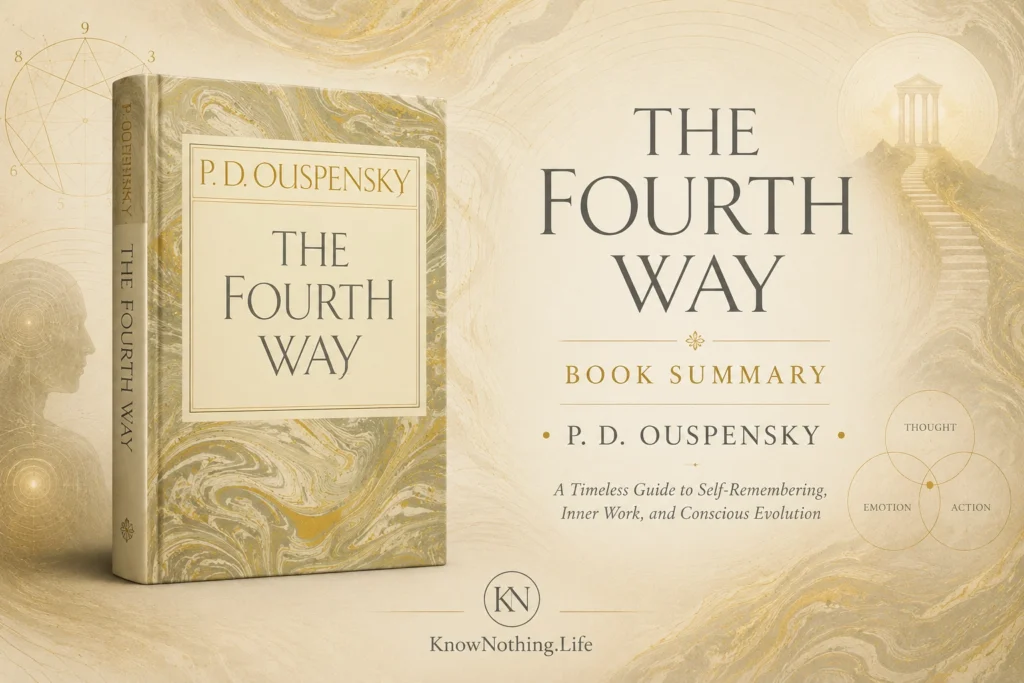
P. D. Ouspensky’s The Fourth Way presents the psychological system he developed from the teachings of G. I. Gurdjieff. Published posthumously in 1957, it collects talks and question-and-answer meetings held between 1921 and 1946. Unlike In Search of the Miraculous, which narrates Ouspensky’s encounter with Gurdjieff, this book arranges the ideas by subject. Its questions show students testing ideas about attention, habit, emotion, identity, and freedom.
The title names a path distinguished from the traditional ways of the fakir, monk, and yogi. Those paths emphasize the body, emotions, or intellect and often require withdrawal. The Fourth Way seeks development of all three while a person continues working, maintaining relationships, and confronting daily pressures. Ordinary life becomes the laboratory of awakening because it exposes mechanical reactions in real time. The system resembles philosophy as practiced transformation, including Stoic exercises and Aristotle’s claim in Nicomachean Ethics that character is formed through action.
Human Beings Live in “Waking Sleep”
Ouspensky begins with an unsettling claim: people generally live below the level of consciousness they imagine they possess. Ordinary waking life is “waking sleep.” A person can plan, converse, work, and solve problems without maintaining continuous awareness of being present. People assume they possess stable will, but behavior is shaped by mood, habit, and external pressure. The statement that “man is a machine” means that most reactions occur automatically. Freedom is not an inborn possession but a capacity that must be cultivated through conscious effort.
Modern psychology does not confirm Ouspensky’s theory, yet research on automaticity gives his diagnosis a recognizable counterpart. John Bargh examines how judgments, goals, and behavior can be influenced outside deliberate awareness. Keith Stanovich and Richard West likewise showed that people differ in their ability to override intuitive biases, even when intellectually capable. These theories are not versions of the Fourth Way, but they support its warning that explaining a decision does not prove that one consciously produced it.
The Many “I’s” and the Divided Personality
A central idea is that the ordinary personality is not one unified self but a collection of competing “I’s.” One part makes a promise, another breaks it; one seeks discipline, another wants comfort. Each impulse speaks as “I,” creating the illusion of a continuous agent. Ouspensky argues that a more permanent center can develop only through sustained observation and organization. Until then, the self remains a shifting coalition of habits, roles, and emotional states.
This model resembles several influential accounts of the mind. William James emphasized habit in The Principles of Psychology, while Freud’s The Ego and the Id portrayed psychological life as internally conflicted. Ouspensky treats this plurality as incomplete development, while evidence also suggests people often misunderstand their motives. Richard Nisbett and Timothy Wilson concluded that individuals frequently lack direct access to the processes producing their judgments and instead construct explanations that seem plausible afterward.
Centers and the Wrong Work of Functions
Ouspensky divides ordinary functioning into intellectual, emotional, moving, and instinctive centers. The intellectual center compares and formulates; the emotional center experiences attraction, aversion, sympathy, and anger; the moving center governs learned movement; and the instinctive center regulates bodily processes and sensation. Difficulties arise when one center attempts another’s work. People may intellectualize grief or allow anxious thought to disrupt skilled action. Self-study requires recognizing not only what is happening but which function is operating.
These centers are not scientifically established brain modules, and treating them as literal anatomy would be misleading. Their value is phenomenological: they encourage readers to distinguish thought from feeling, sensation from interpretation, and automatic movement from deliberate action. Modern mindfulness theory makes comparable distinctions using testable constructs. Britta Hölzel and colleagues proposed that mindfulness involves attention regulation, body awareness, emotion regulation, and changes in perspective on the self. That framework does not validate Ouspensky’s psychology, but it supports observing several dimensions of experience.
Self-Observation and Self-Remembering
Self-observation is the book’s first practical discipline. The student watches thoughts, gestures, postures, speech, emotional reactions, and shifts of attention without immediately trying to correct them. Premature improvement can merely replace one automatic habit with another. Observation must reveal what provokes irritation, when attention disappears, and how energy is consumed by fantasy, resentment, or worry. The method recalls Socratic self-examination, although Ouspensky focuses on direct observation of mental events as they unfold.
Self-remembering goes further. It means remaining aware of oneself while simultaneously attending to another person, object, or task. Ouspensky admits that the state is difficult to define because ordinary language assumes the continuity of awareness that the exercise questions. Research on mind wandering and meta-awareness offers a useful parallel. Jonathan Schooler distinguishes having an experience from knowing that one is having it, while Killingsworth and Gilbert found that attention frequently leaves the present activity. These findings do not prove higher consciousness, but they make intermittent awareness psychologically plausible.
Identification, Negative Emotions, and Buffers
“Identification” describes complete absorption in a thought, emotion, role, or grievance. When identified, a person loses distance and temporarily becomes the reaction: anger seems unquestionably justified, anxiety becomes reality, and criticism feels like an assault on the whole self. Ouspensky also examines “considering,” the preoccupation with how others value, ignore, or mistreat us. In contemporary terms, these patterns resemble cognitive fusion, rumination, and emotionally driven reasoning. The aim is not indifference but the ability to experience emotion without surrendering all attention and judgment to it.
“Buffers” prevent people from seeing contradictions in their behavior. Someone can consider themselves generous while acting selfishly because excuses and selective memory keep evidence apart. Buffers protect comfort but weaken conscience, which requires seeing incompatible motives together. Ouspensky’s advice to resist expressing negative emotions needs care. Contemporary psychology distinguishes mindful observation and reappraisal from chronic suppression. The strongest interpretation is not that grief, fear, or anger should be denied, but that their repetitive performance should cease to govern identity and conduct.
Knowledge, Being, and Understanding
One of Ouspensky’s strongest distinctions is between knowledge and being. A person may accumulate sophisticated theories while remaining vain, reactive, inattentive, and unreliable. Knowledge determines what one can describe; being determines what one can perceive, endure, and embody. Understanding arises only when the two develop together. This resembles Aristotle’s distinction between theoretical knowledge and practical wisdom, as well as Pierre Hadot’s account of ancient philosophy as spiritual exercise. Truth has not been fully understood until it changes attention, behavior, and character.
The book therefore emphasizes concrete aims rather than vague wishes for improvement. An aim might be noticing a recurring reaction or remembering oneself during conflict. Such practices can be evaluated without accepting the system’s cosmology. A review led by Madhav Goyal found that meditation programs produced modest improvements in anxiety, depression, and pain while noting limited evidence for broader claims. Disciplined attention may be beneficial, but psychological benefit does not establish every spiritual explanation attached to it.
Essence, Personality, and the Possibility of Change
Another important distinction is between essence and personality. Essence refers to what is considered innate or genuinely one’s own, while personality consists of acquired beliefs, social roles, imitations, habits, and expectations. Personality is necessary for living in society, but it can grow so dominant that the undeveloped essence remains hidden beneath layers of performance. People then mistake their education, reputation, preferences, and defensive roles for their deepest identity. Ouspensky does not advocate destroying personality; he argues that it should become an instrument rather than an unconscious ruler.
This idea resembles philosophical concerns about authenticity, especially the distinction between a life guided from within and one organized entirely around social approval. It also has similarities to Carl Jung’s concept of the persona, the socially adapted mask that may conceal neglected aspects of the psyche. Ouspensky’s model is more rigid than most contemporary personality theories, but it raises a useful question: how much of what people call themselves consists of deliberate commitments, and how much has been absorbed through imitation, fear, reward, and habit?
The Meaning and Limits of The Fourth Way
The book argues that meaningful human development is possible but not automatic. Nature produces a functioning organism and society produces an adapted personality; conscious unity, stable will, and deeper understanding require intentional work. Ouspensky’s repetition is methodological. Students return to the same problems because intellectual agreement does not change habit. Each question reveals another way the personality converts a practical demand into speculation, self-justification, or a search for reassurance.
The Fourth Way is most valuable as an experiment in attention and self-knowledge, not as established science. Its observations about divided motivation, rationalization, emotional absorption, and lapses of awareness remain penetrating. Its cosmic laws, hierarchy of human types, and claims concerning higher states are esoteric propositions rather than demonstrated facts. Even so, its challenge endures: people should not assume they possess freedom merely because they can imagine it. Ouspensky asks how often readers are truly present, how consistently they act on intentions, and whether the self they defend is as unified as it appears.