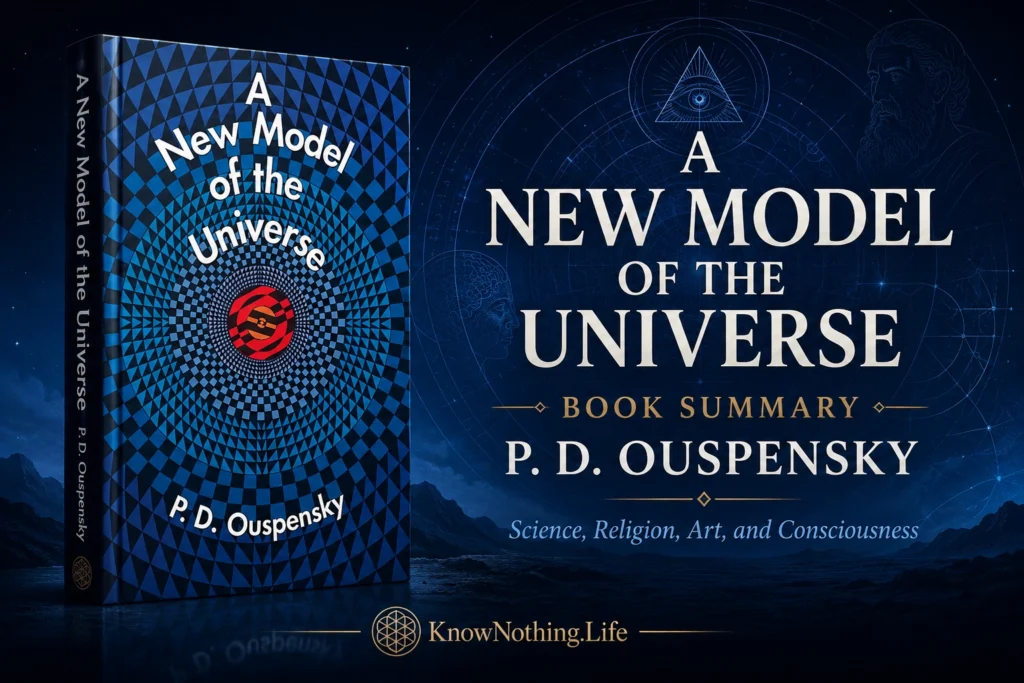
P. D. Ouspensky’s A New Model of the Universe: Principles of the Psychological Method in Its Application to Problems of Science, Religion and Art is his broadest attempt to assemble a unified philosophy of reality. Published in English in 1931 and translated with R. R. Merton, the book gathers twelve extended essays, several of which began as independent Russian works. Its subjects include esotericism, higher dimensions, Christianity, Tarot symbolism, yoga, dreams, hypnosis, mystical experience, cosmology, sex, and eternal recurrence. Rather than presenting one continuous argument, it offers related investigations organized around a persistent question: how would the universe appear to a consciousness less restricted than ordinary human awareness?
The “new model” is not a rival astronomical model in the modern scientific sense. Ouspensky is concerned with the relationship between the knower and what is known. His central premise is that human thought operates at different levels and that observations change with the capacities of the “perceiving apparatus.” Science, religion, and art appear divided because they examine different portions of reality through different methods. Ouspensky hopes that a psychological method—one that studies the limits and possible development of consciousness—can reveal connections among them.
The Psychological Method
Ouspensky distinguishes the practical logical mind from what he calls the psychological mind. Logical reasoning is effective within defined problems, but it becomes unreliable when it assumes that familiar categories must apply universally. The psychological mind recognizes its limitations and asks how perception is shaped by the observer. This resembles Immanuel Kant’s argument in Critique of Pure Reason that space and time are forms through which human sensibility organizes appearances, although Ouspensky moves beyond Kant by proposing that higher consciousness may disclose realities unavailable to ordinary cognition.
Modern research supports the narrower proposition that perception is constructed rather than passively received. Experiments show that expectations can accelerate a stimulus’s entry into awareness when sensory information is ambiguous, while neuroimaging suggests that expectations can sharpen representations in early visual cortex. These findings do not validate Ouspensky’s hierarchy of minds, but they strengthen his warning: experience is partly determined by the structure, history, and expectations of the mind doing the experiencing.
Esotericism and Possible Human Evolution
The book opens with Ouspensky’s theory of esotericism, the belief that knowledge of human transformation has been preserved by an “inner circle” and expressed indirectly through scriptures, myths, monuments, and symbols. He interprets the Gospels, Eastern scriptures, the Sphinx, and initiatory traditions as products or traces of a higher intelligence. This is the book’s least verifiable premise. Ouspensky admits that higher minds cannot be proved in an ordinary way, yet treats recurring transformative symbols as evidence of an enduring hidden tradition.
His image of the “superman” should not be confused with a biological master race or merely powerful individual. For Ouspensky, the higher human being represents greater consciousness, unity, knowledge, and responsibility. Comparison with Friedrich Nietzsche is unavoidable because Nietzsche connected the Übermensch with self-overcoming and eternal recurrence. Ouspensky, however, emphasizes disciplined psychological development and the transmission of esoteric knowledge. In both thinkers, humanity is transitional rather than complete, but Ouspensky believes transformation requires methods ordinary culture does not possess.
Higher Dimensions, Time, and Recurrence
The chapters on the fourth dimension expand arguments first developed in Tertium Organum. Ouspensky uses dimensional analogy to suggest that a being restricted to three-dimensional perception might encounter only sections of a larger reality. What appears as change through time could be the successive perception of a complete higher-dimensional form. An entire human life might therefore be imagined as one extended structure, while ordinary consciousness experiences only the cross-section called the present.
This speculation should be separated from the four-dimensional spacetime of relativity. Ouspensky uses higher dimensions metaphysically, linking them to consciousness, immortality, and recurrence rather than constructing a testable physical theory. Shepard and Metzler’s classic mental-rotation experiment later showed that people can transform internal spatial representations systematically, but that result demonstrates flexible imagery, not perception of a fourth spatial direction. Ouspensky’s geometry is most useful as an exercise in intellectual humility.
Christianity, Tarot, and Symbolic Knowledge
Ouspensky reads Christianity as an esoteric psychology hidden beneath literal doctrine. The Kingdom of Heaven becomes a higher condition of being, repentance signifies transformation of mind, and initiation is an inner birth rather than membership in an institution. He treats the Tarot’s Major Arcana as a symbolic system connecting nature, consciousness, ethics, and spiritual development. Art matters because a symbol can preserve several meanings at once and affect thought, feeling, and imagination simultaneously.
This resembles later depth-psychological approaches to myth and image, especially Carl Jung’s account of archetypes and symbols as expressions of material not fully available to conscious thought. Yet symbols also invite projection: a reader may discover genuine patterns or impose expectations on ambiguous material. Ouspensky’s interpretations are strongest as philosophical provocations rather than historically proven secret codes. Their value lies in reorganizing perception, not in guaranteeing that every association is objectively true.
Dreams, Hypnosis, and Experimental Mysticism
Ouspensky’s chapters on dreams and hypnosis are among the book’s most recognizably psychological. He observes that dream images are assembled through associations of impressions, emotions, reading, entertainment, and recent experience. Contemporary research broadly supports a continuity hypothesis in which waking concerns appear in dream content, although dreams recombine rather than literally reproduce them. His skepticism toward extravagant claims of hypnotic clairvoyance is also notable, even though parts of his account reflect early twentieth-century limitations.
In “Experimental Mysticism,” Ouspensky describes attempts to alter consciousness while preserving an observing point within himself. He reports intensified meaning, altered time, diminished separateness, and difficulty translating experience into language. William James had catalogued similar qualities in The Varieties of Religious Experience. Controlled studies now show that psilocybin can occasion experiences rated as mystical and personally meaningful, sometimes with enduring significance. Such findings establish the psychological reality of these experiences, not the metaphysical truth of their interpretations.
Yoga, Energy, and Transformation
The discussions of yoga extend the book’s principle from knowledge to practice. Ouspensky sees yoga not as exercise but as specialized methods for changing attention, bodily control, emotion, and identity. He warns that practices taken from books may be misunderstood or used without the preparation required to interpret their effects. Altered states alone do not produce reliable development; method, guidance, and integration are equally important.
Some later claims, especially those concerning sex, biological “types,” social hierarchy, and the transformation of sexual energy, are speculative or plainly dated. They should not be treated as modern psychology or biology. Their role is to express Ouspensky’s belief that human energies can be mechanically discharged or consciously redirected. The defensible philosophical point is that attention, desire, and emotion can be organized around long-term aims rather than obeyed automatically.
Meaning and Limits of the New Model
A New Model of the Universe is most compelling when Ouspensky exposes assumptions behind ordinary knowledge. He asks whether perception reveals reality itself, whether linear time is the only possible temporal structure, whether symbols communicate more than propositions, and whether altered states disclose neglected features of mind. His range moves from geometry and astronomy to scripture, dream reports, Tarot, yoga, and personal experiments.
The book is not established science, and many historical, biological, and cosmological claims are unsupported. Ouspensky often moves too quickly from evocative analogy or subjective experience to universal conclusion. Yet his central challenge survives: a complete model of reality cannot ignore the consciousness constructing it. By placing psychology between science, religion, and art, Ouspensky asks readers to examine not only what they believe about the universe, but what kind of mind is doing the believing.