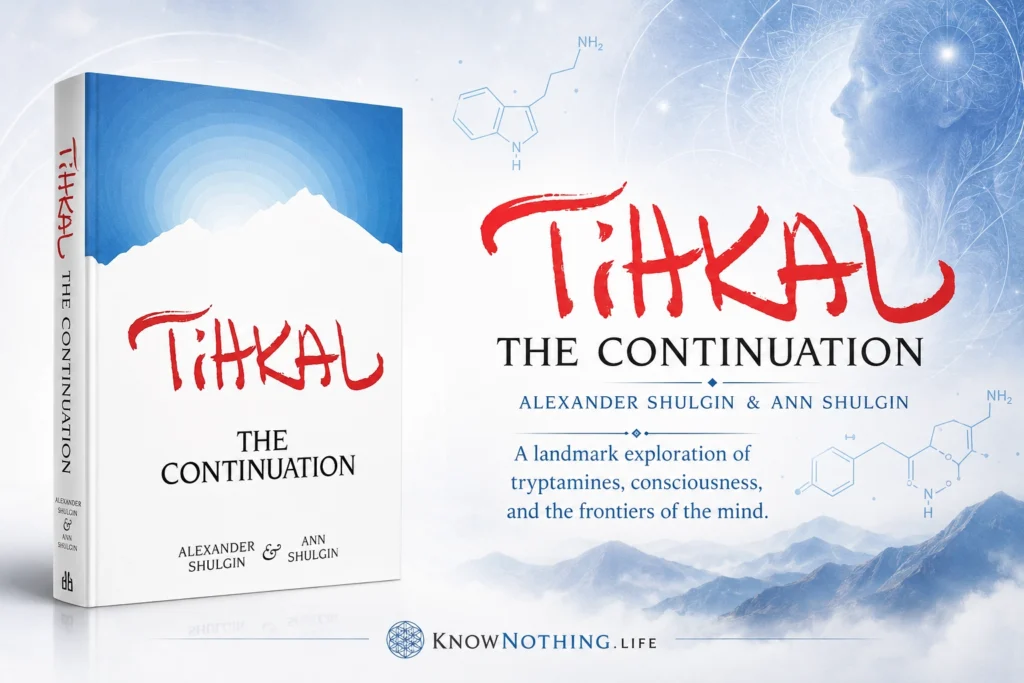
Published in 1997, TiHKAL: The Continuation is Alexander “Sasha” Shulgin and Ann Shulgin’s sequel to their 1991 book PiHKAL: A Chemical Love Story. The title abbreviates “Tryptamines I Have Known and Loved,” signaling the major shift between the books: where PiHKAL concentrates primarily on phenethylamines, TiHKAL explores the chemically and psychologically diverse world of tryptamines. Yet describing it simply as a pharmacology book misses its unusual character. Transform Press describes TiHKAL as a combination of autobiography, travel, botanical observations, scientific speculation, psychological reflection, and political commentary. Like its predecessor, it is divided into two broad parts: the continuation of the Shulgins’ fictionalized autobiographical story and a technical section devoted to tryptamine chemistry and pharmacology.
The result is simultaneously scientific record, cultural history, personal memoir, and philosophical argument about consciousness. The Shulgins are fascinated by a striking fact: relatively small molecular differences can correspond with dramatically different forms of subjective experience. Some tryptamines alter perception, others produce unusual emotional or cognitive effects, and naturally occurring members of this chemical family occupy important positions in both neurobiology and the history of psychedelic experience. TiHKAL uses this molecular diversity as a gateway into a much larger question—how chemistry participates in creating the states of consciousness humans ordinarily experience as reality.
Tryptamines and the Chemical Foundations of Experience
Tryptamines are especially significant because their basic chemical architecture relates to naturally occurring biological molecules, including serotonin. This relationship makes them unusually interesting to anyone attempting to understand the connection between brain chemistry and consciousness. Modern research has since established that the psychedelic effects of several classic tryptamine compounds are strongly associated with stimulation of serotonin 5-HT2A receptors. Human PET research with psilocybin, for example, has demonstrated a close relationship among circulating psilocin levels, 5-HT2A receptor occupancy, and the reported intensity of psychedelic experience.
That finding gives scientific depth to one of Shulgin’s recurring fascinations: chemistry can be manipulated at the molecular level while its consequences appear at the level of perception, emotion, imagination, identity, and meaning. Yet contemporary pharmacology also shows why simplistic explanations are inadequate. The 5-HT2A receptor is crucial to classic psychedelic effects, but newer research indicates that psychedelic action involves multiple signaling pathways and broader neural processes rather than a single neurological switch. TiHKAL therefore anticipates a question that remains central to neuroscience: how does an interaction measured at the receptor level become an experience as complex as altered selfhood, visual transformation, emotional insight, or mystical unity?
The Scientist as a Maker of Tools
Alexander Shulgin repeatedly portrayed himself less as someone searching for recreational intoxicants than as a maker of tools for investigating the mind. Transform Press preserves a 1996 statement in which he explained that his primary interest was creating tools that other people could eventually use to investigate mental processes and their relationship to the brain. That attitude helps explain the extraordinary breadth of TiHKAL. The book’s technical half records a large range of tryptamine compounds and places them within a wider chemical, botanical, and pharmacological landscape. Its appendices also address topics including naturally occurring beta-carbolines, cactus alkaloids, drug law, and known tryptamines discussed in scientific literature.
The philosophical parallel is Francis Bacon’s conception of experimental knowledge: understanding nature requires active investigation rather than passive speculation. Shulgin’s laboratory philosophy follows this experimental tradition into the controversial territory of consciousness. But his project also resembles William James’s psychological pluralism. In The Varieties of Religious Experience, James resisted assuming that ordinary waking consciousness exhausts the legitimate possibilities of human awareness. Shulgin similarly treats altered states as phenomena worth investigating rather than dismissing them simply because they are unusual. The difference is methodological: James gathered and analyzed reports of extraordinary experience, while Shulgin explored how chemical modifications could reliably alter the conditions under which extraordinary experiences appeared.
Subjective Experience as Psychological Data
A defining feature of TiHKAL is the seriousness with which the Shulgins treat subjective reports. An experience is observed for qualities such as emotional tone, changes in perception, alterations of thought, interpersonal effects, bodily sensations, and shifts in self-awareness. Such reporting is very different from the methods of a randomized controlled trial, yet it reflects a recognizable intellectual tradition. Phenomenology, particularly in the work of Edmund Husserl and Maurice Merleau-Ponty, begins from the premise that conscious experience deserves disciplined description in its own right. Understanding a brain state and understanding what that state feels like are related but not interchangeable tasks.
Modern psychedelic science has partly vindicated the value of carefully measuring subjective experience while placing it inside much stronger experimental designs. Roland Griffiths and colleagues reported in 2006 that psilocybin administered under supportive laboratory conditions could occasion experiences participants rated as having substantial personal and spiritual significance. Follow-up research found that such experiences could be associated with persistent changes in attitudes and behavior. This does not establish that subjective impressions are automatically accurate or therapeutically valuable. Expectations, context, personality, selection effects, and suggestion can influence psychedelic experiences. What it does demonstrate is that first-person experience can be investigated scientifically rather than discarded as irrelevant.
Ann Shulgin, Jung, and the Psychology of the Inner World
Ann Shulgin provides an important counterweight to Sasha’s chemical orientation. Her interest was much more explicitly psychological, and her approach drew significantly from Jungian thought. Transform Press describes her work as emphasizing Jungian concepts, particularly exploration and integration of the “shadow”—parts of the personality that remain rejected, unrecognized, or insufficiently incorporated into conscious identity. Within TiHKAL, altered states therefore become psychologically important not merely because they are unusual but because they may confront individuals with emotional material, relationships, fears, desires, and assumptions normally kept at a distance.
Carl Jung’s conception of individuation provides a useful framework for understanding this part of the book. Psychological growth, in Jung’s view, requires developing a more inclusive relationship with previously disowned aspects of the psyche rather than maintaining a rigidly idealized identity. Psychedelic experience does not guarantee such integration. Indeed, an intense experience can just as easily confuse, frighten, or destabilize. The distinction between experience and integration is consequently crucial. TiHKAL repeatedly implies that unusual states become meaningful only insofar as people can bring something from them back into ordinary life. This is one of the book’s strongest psychological ideas: revelation and transformation are not synonymous.
Mystical Experience, Personality, and the Boundaries of the Self
Tryptamine psychedelics are particularly associated with profound alterations in the ordinary sense of self, time, space, and interpersonal boundaries. Experiences of unity or transcendence have often been interpreted religiously, yet TiHKAL approaches them from a perspective in which chemistry and spirituality do not necessarily exclude one another. A molecular trigger can have identifiable pharmacology while the resulting subjective state remains existentially meaningful to the person experiencing it. The book therefore challenges a common assumption that biological explanation automatically invalidates subjective significance.
Later research has made this question even more interesting. Katherine MacLean and colleagues found that participants who underwent strong psilocybin-associated mystical experiences showed increases in the personality trait of openness, with changes persisting beyond the immediate experience in some participants. Such studies require cautious interpretation and do not mean psychedelics reliably improve personality. They do, however, challenge the assumption that acute altered states are necessarily psychologically trivial once the drug effect ends. William James confronted a similar problem more than a century earlier: an experience may have a physiological cause and still have consequences for a person’s beliefs, relationships, values, or conception of reality.
Freedom of Consciousness and the Politics of Drug Control
The Shulgins’ scientific interests cannot be separated from their views about personal liberty. TiHKAL emerged in an era when psychedelic research had been heavily constrained by prohibition, and its autobiographical material reflects the increasing conflict between Shulgin’s chemical investigations and law enforcement. Transform Press notes that TiHKAL opens by recounting the disruption that followed the publication of PiHKAL, including official scrutiny of Shulgin’s laboratory. Consequently, questions about drug policy and intellectual freedom occupy a larger place in TiHKAL than they might in a conventional pharmacology text.
John Stuart Mill’s On Liberty provides an obvious philosophical comparison. Mill argued that mature individuals should possess wide freedom over their own thought and conduct unless their actions cause harm to others. Psychedelics complicate this principle because autonomy exists alongside real questions about health risks, impaired judgment, uncertain pharmacology, social consequences, and public safety. TiHKAL generally favors broad freedom of inquiry, but contemporary psychedelic research illustrates why liberty and scientific safeguards need not be opposites. Modern studies rely upon ethical review, informed consent, medical screening, standardized preparation, controlled environments, and systematic follow-up. The renewed scientific investigation of psychedelics therefore continues part of Shulgin’s project while subjecting it to more rigorous standards.
From TiHKAL to Modern Psychedelic Neuroscience
When TiHKAL appeared in 1997, contemporary psychedelic neuroscience was still largely dormant. The contrast with the present research environment is remarkable. Scientists have now used neuroimaging, receptor pharmacology, controlled clinical trials, and molecular biology to investigate psilocybin, DMT, LSD, and related serotonergic psychedelics. Evidence strongly implicates 5-HT2A signaling in their characteristic subjective effects, while research increasingly examines changes in neural connectivity and plasticity that may help explain why relatively brief pharmacological interventions can sometimes be followed by longer-lasting psychological changes.
Yet modern findings also complicate the Shulgin-era tendency to move readily from compelling subjective reports to broad conclusions. Psychedelic effects vary greatly between individuals, and profound experiences are not inherently truthful simply because they feel convincing. Researchers continue debating how much potential therapeutic benefit comes from receptor-level biological effects, neuroplasticity, subjective experience, psychotherapy, expectation, environmental context, or interactions among them. Recent reviews emphasize that 5-HT2A activation is only one component of a much more complicated pharmacological and psychological system. In this sense, contemporary science is answering some of Shulgin’s questions while revealing how much harder those questions are than they initially appeared.
The Limits of Self-Experimentation
The Shulgins’ willingness to combine personal experience with chemical research makes TiHKAL fascinating, but it also creates obvious scientific limitations. Self-experimentation and observations from small groups cannot establish clinical efficacy, population-level safety, or reliable causal relationships. Participants know what they expect to happen, environmental conditions vary, reporting is subjective, and rare adverse effects may remain invisible. The book therefore occupies a space closer to exploratory psychopharmacology and phenomenological field notes than contemporary evidence-based medicine.
That distinction is important because Shulgin’s observations have sometimes acquired an authority they were never methodologically equipped to possess. His great strength was exploration: identifying possibilities, documenting patterns, and asking questions neglected by mainstream science. Controlled research has a different purpose—it determines which impressions survive systematic testing. TiHKAL is consequently best appreciated not as a medical manual but as a historical record of hypothesis generation. Its enormous curiosity helped preserve questions about psychedelics during an era when institutional research was severely limited, but modern readers have access to scientific tools unavailable to the Shulgins and should use them.
What TiHKAL: The Continuation Ultimately Teaches
At its deepest level, TiHKAL is a book about the instability of the boundary between chemistry and identity. Human beings normally experience consciousness as immediate and self-evident: the world appears the way it appears, the self feels like the self, and thoughts seem to arise from a continuous personal identity. Tryptamine psychedelics dramatically expose how contingent those experiences can be. Altering neurochemistry can transform perception, emotion, selfhood, time, meaning, and the perceived relationship between the individual and the surrounding world. Modern research connecting psychedelic intensity with measurable serotonin-receptor engagement gives this philosophical observation an increasingly detailed biological foundation.
Yet TiHKAL ultimately refuses to reduce consciousness to chemistry. Sasha Shulgin supplies molecules and pharmacological curiosity; Ann Shulgin continually returns attention to relationships, psychological integration, spirituality, and the inner life. Together they create a work suspended between neuroscience and phenomenology. The chemistry matters precisely because experience matters. More than a quarter-century after its publication, psychedelic science has become more rigorous, technologically sophisticated, and clinically oriented, but it continues investigating many of the questions at the heart of the Shulgins’ project. TiHKAL remains historically important because it asks one of consciousness research’s most provocative questions: if changing a molecule can change the world we experience, what does that reveal about the mind that constructs our ordinary reality?