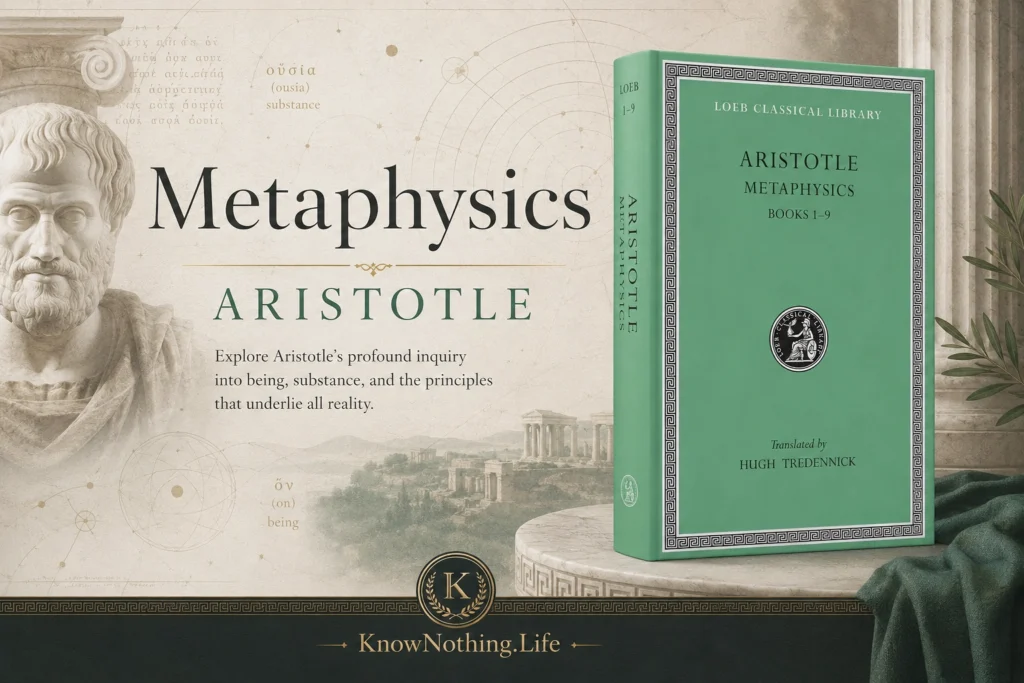
Aristotle’s Metaphysics is one of the foundational works of Western philosophy, yet its subject is more difficult to summarize than the modern word “metaphysics” might suggest. Aristotle himself did not give the collection that title. The work is composed of fourteen books traditionally identified by Greek letters, and its concerns range from the history of earlier philosophy to substance, essence, causation, possibility, actuality, mathematics, theology, and the basic principles that make rational thought possible. Aristotle describes his central project as the study of “being qua being”—being precisely insofar as something is—and as an inquiry into the highest causes and first principles of reality.
The ambition of the work becomes clearer when Metaphysics is read alongside Aristotle’s Physics, Categories, Posterior Analytics, and On the Soul. The natural sciences investigate particular kinds of beings: animals, plants, motion, matter, and change. First philosophy asks what must be true of anything that exists at all. Aristotle wants to know what it means for something to be a thing, what makes it the kind of thing it is, how change can occur without reality dissolving into contradiction, and whether explanation ultimately terminates in something fundamental. This is why Metaphysics repeatedly shifts between what may seem like abstract logical questions and very concrete examples involving houses, statues, animals, plants, craftsmen, and living development. For Aristotle, metaphysics is not an escape from the observable world. It is an attempt to uncover the deepest structure that makes that world intelligible.
Being, Substance, and the Question of What Is Most Real
One of the central problems of Metaphysics is Aristotle’s question of substance, or ousia. Many things can be said to exist: colors, sizes, relationships, locations, actions, and individual objects. But these do not all exist in the same way. A color is normally the color of something; a size is the size of something. Aristotle therefore asks whether there is a fundamental kind of being upon which these other ways of being depend. This develops ideas already present in the Categories, but Metaphysics, especially Books VII–IX, subjects the concept of substance to much deeper scrutiny. Matter has some claim to being substance because it underlies change, but Aristotle resists identifying substance simply with undifferentiated matter. He increasingly emphasizes form and essence—the organization through which a thing is the particular kind of thing it is.
The result is Aristotle’s famous doctrine commonly called hylomorphism, from the Greek terms for matter and form. Physical objects are understood as compounds of matter and form rather than as arrangements of matter alone. A bronze statue, for example, is not simply bronze; it is bronze organized according to a particular form. A living organism is an even more important example because its form is not merely external shape but the organization through which the organism lives and functions. Aristotle develops this biological dimension more fully in On the Soul, where soul is described as the form of a living body. Contemporary philosophers continue to debate hylomorphic approaches because Aristotle’s distinction addresses a problem that persists in modern metaphysics and philosophy of mind: whether understanding what something is requires more than listing the material components from which it is constructed.
Essence and the Human Desire to Find What Things Really Are
Closely connected with substance is Aristotle’s concept of essence—roughly, what it is to be a particular kind of thing. Aristotle is not satisfied by superficial description. To understand a thing scientifically, we want to identify the features that explain why it belongs to its kind and behaves as it does. This concern links Metaphysics with the Posterior Analytics, where genuine knowledge involves grasping causes and explanatory principles rather than merely observing regularities. Aristotle’s disagreement with Plato is especially important here. Plato’s theory of Forms, developed in dialogues such as the Republic and Phaedo, places intelligible Forms in a metaphysical relation distinct from ordinary sensible particulars. Aristotle retains the idea that form is essential to explanation but generally locates form within individual substances rather than treating ordinary things as dependent upon separately existing Forms.
Modern psychology provides a fascinating parallel in research on psychological essentialism. Susan Gelman has shown that children and adults often treat categories as if their members possess an underlying reality that explains their observable characteristics, even when that underlying property cannot be directly perceived. Her research describes essentialist thinking as an early-emerging cognitive tendency rather than merely a philosophical doctrine learned through formal education. The comparison must be handled carefully: Aristotle’s metaphysical theory of essence is not identical to psychological essentialism. Yet the psychological research helps explain why questions such as “What makes a tiger really a tiger?” or “What makes something the kind of thing it is?” feel so natural. Human cognition often searches beneath surface appearance for hidden structures capable of explaining identity and category membership.
Potentiality and Actuality: Aristotle’s Solution to the Problem of Change
Another of the most influential ideas in Metaphysics is Aristotle’s distinction between potentiality (dunamis) and actuality (energeia or entelecheia). Something can possess a capacity without presently exercising it. An acorn is not an oak tree, but under appropriate conditions it has the potential to become one. A person who knows how to play music retains that capacity even while sleeping. Aristotle uses this distinction to explain how genuine change can occur. Becoming does not require something to emerge simply from absolute nothingness; rather, something possessing a relevant potential becomes actual in a new way. The theory works together with the matter-form distinction developed throughout Books VII–IX.
Aristotle ultimately gives actuality a kind of explanatory priority over potentiality. The capacity to see is intelligible partly in relation to the activity of seeing; biological development is understood relative to the mature functioning toward which it characteristically proceeds. This does not mean that every possibility inevitably becomes real. Potentialities can remain unrealized. Rather, Aristotle argues that a capacity is intelligible through the actuality it is a capacity for. The concept became enormously influential, extending through medieval philosophy and into later discussions of dispositions, capacities, development, agency, and possibility. Psychologically, the distinction is also intuitively powerful. Human beings routinely distinguish what someone presently does from what that person is capable of doing—a distinction important to learning, skill acquisition, intelligence, motivation, and development.
Causes, Purposes, and What Counts as a Complete Explanation
Metaphysics also develops Aristotle’s broader theory of causation, closely connected with the account in Book II of the Physics. Aristotle famously distinguishes several senses in which we may answer the question “Why?”: material, formal, efficient, and final causes. The material cause concerns what something is made from; the formal cause concerns its organization or form; the efficient cause concerns the source of change; and the final cause concerns the end or purpose toward which something is directed. These “causes” are better understood as different kinds of explanatory factors than as four competing versions of the modern concept of mechanical causation. Aristotle believes that understanding a phenomenon often requires more than identifying the event that immediately produced it.
Modern cognitive science lends surprising support to Aristotle’s emphasis on explanation while also revealing dangers in purpose-based reasoning. Tania Lombrozo’s research has shown that generating explanations can influence learning, induction, causal judgment, and the way people organize concepts. Experiments by Cristine Legare and colleagues similarly found that prompting children to explain can improve causal learning and generalization, although explanation does not benefit every kind of learning equally. At the same time, Deborah Kelemen and collaborators have found that people exhibit a persistent tendency toward teleological explanations. Adults under time pressure become more willing to endorse inappropriate purpose-based explanations of natural phenomena, and even professional physical scientists showed increased teleological errors when required to respond quickly. Aristotle’s final causes therefore connect to a deep cognitive tendency: human beings naturally search not only for what produced something, but also for what it is for.
The Principle of Non-Contradiction and the Foundations of Thought
Book IV of Metaphysics moves from ontology into one of the deepest foundations of logic. Aristotle identifies the principle of non-contradiction as the firmest principle of all: the same attribute cannot both belong and fail to belong to the same subject at the same time and in the same respect. The qualifications matter. A person may be warm at one time and not warm at another without contradiction, or warm relative to one object while cool relative to another. What Aristotle rejects is the possibility that precisely the same proposition and its contradiction could simultaneously hold in the same respect. He regards this principle as so fundamental that it cannot be demonstrated through an ordinary proof without already presupposing the logical structure that proof requires.
Aristotle instead argues dialectically against anyone who attempts to deny it. Meaningful assertion itself requires distinctions: if words can simultaneously mean everything and its opposite, communication and argument collapse. The principle therefore operates not only as a rule in formal logic but as a condition for intelligible thought and discourse. This portion of Metaphysics demonstrates how closely Aristotle connects reality, language, and cognition. Logic is not merely a convenient game humans invented. Rational thought succeeds because it respects distinctions that Aristotle believes belong to being itself. Whatever one thinks of the metaphysical strength of that claim, the book identifies an enduring problem: rational disagreement requires enough shared structure that statements can have determinate meanings and opposing claims can genuinely conflict.
The Unmoved Mover and the Highest Form of Actuality
The culmination of Aristotle’s metaphysical system appears most famously in Book XII, or Lambda. Aristotle argues that the continuous motion of the cosmos ultimately requires an eternal principle that does not itself undergo the sort of change requiring further explanation. This is the unmoved mover, characterized as fully actual rather than as a mixture of actuality and unrealized potentiality. Aristotle associates this highest principle with intellectual activity and describes it through the extraordinary conception of thought thinking itself. The unmoved mover is not simply one more physical object at the beginning of a chain of mechanical pushes. It functions as an ultimate explanatory principle within Aristotle’s account of motion, actuality, and cosmic order.
This section profoundly influenced later Jewish, Christian, and Islamic philosophy, although those traditions frequently transformed Aristotle’s first principle into theological systems that differ considerably from his own. The important point within Metaphysics is structural: Aristotle continually pushes explanation toward what is prior. Substances invite explanations through form and matter; change invites analysis through potentiality and actuality; causal sequences raise questions about deeper causes; and the intelligibility of motion ultimately leads Aristotle toward pure actuality. Whether or not one accepts the conclusion, the method reveals the defining ambition of the book—the refusal to stop asking why merely because an explanation has worked at one level.
Why Metaphysics Still Matters
Aristotle’s Metaphysics has remained influential because it does more than propose a set of ancient answers. It identifies problems that continue to organize philosophy: What kinds of things exist? What makes an object remain the same object through change? Are properties as real as the objects possessing them? What distinguishes a capacity from its exercise? What is a cause? Does explanation eventually reach something fundamental? Contemporary metaphysics uses very different logical and scientific tools, but debates about substances, properties, dispositions, identity, grounding, causation, modality, and the relationship between parts and wholes still inhabit intellectual territory Aristotle helped define. His hylomorphic account of matter and form has even experienced renewed interest among contemporary philosophers.
Psychology adds another dimension to the book’s continuing importance. Research on essentialism suggests that humans naturally search for hidden natures behind observable categories; research on teleology shows that purpose-based explanation can remain cognitively attractive even to scientifically trained adults; and studies of explanation demonstrate that asking “why?” can actively reorganize learning and generalization. None of this proves Aristotle’s metaphysics. It reveals something different and perhaps equally interesting: many of the questions driving the Metaphysics correspond to enduring tendencies in the human mind. We search beneath appearances for what things really are, distinguish possibilities from realities, organize events around causes, and resist leaving explanation unfinished. Aristotle turned those ordinary impulses toward their most radical destination. Metaphysics asks what happens when we continue questioning until we reach not merely another fact about the world, but the principles by which anything can be a fact at all.