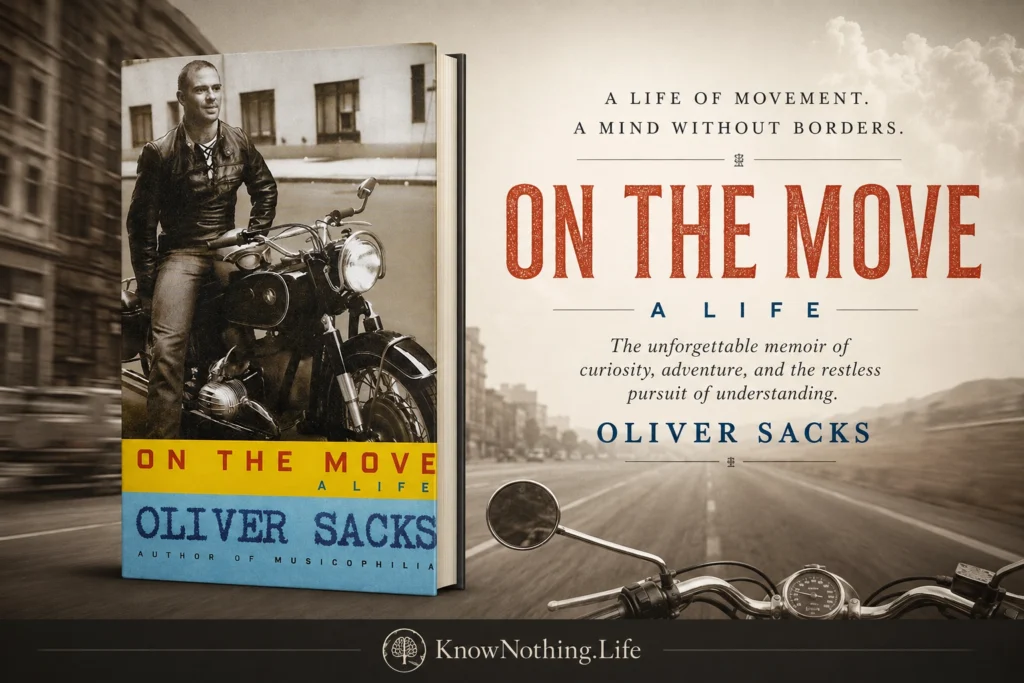
Oliver Sacks spent much of his career describing lives transformed by unusual neurological conditions. In Awakenings, The Man Who Mistook His Wife for a Hat, An Anthropologist on Mars, and Musicophilia, he explored what happened when memory, perception, movement, language, or identity ceased functioning in ordinary ways. In On the Move: A Life, published in 2015, the physician who spent decades observing other people becomes his own subject. The memoir continues roughly where the childhood recollections of Uncle Tungsten leave off, following Sacks through medical training, emigration to America, motorcycling, weightlifting, drug use, professional conflict, scientific discovery, writing, friendship, sexuality, loneliness, and eventually romantic love. The National Library of Medicine summarizes the book as the story of a restless life in which Sacks’ physical passions and his developing engagement with neurological patients gradually converge.
The title is therefore literal and metaphorical. Sacks is almost perpetually in motion. He rides motorcycles for thousands of miles, lifts extraordinary weights, swims long distances, moves from England to California and then New York, travels in search of patients and scientific questions, and repeatedly throws himself into new intellectual territories. A later JAMA Neurology memorial aptly called him “a man in motion,” noting his passions for motorcycling, swimming, weightlifting, travel, and writing. Yet the memoir also asks whether constant motion can conceal something. Sacks repeatedly seems most comfortable when traveling toward the next experience, patient, book, or idea. On the Move becomes the story of a man learning that identity is formed not only through forward momentum but also through the difficult act of turning backward and deciding what one’s past means.
Motorcycles, Muscles, and the Need for Intensity
Readers familiar only with the older Sacks—the gentle, bearded neurologist calmly discussing unusual minds—may be surprised by the young man who dominates the opening of the memoir. After leaving England for North America, Sacks becomes obsessed with powerful motorcycles. He rides enormous distances across California and the American West, sometimes taking risks that seem astonishing in retrospect. The book’s famous cover photograph shows the muscular young physician in motorcycle leathers astride his bike, an image radically different from the public persona associated with his later career. During his California period, he also becomes deeply involved in weightlifting and the culture around Muscle Beach. Contemporary reviews of the memoir noted how strongly these physical obsessions contradict expectations of the detached academic neurologist.
These pursuits are more than colorful autobiography. They reveal a temperament that helps explain Sacks’ later intellectual life. He does not engage mildly with things. Chemistry in Uncle Tungsten, motorcycles in On the Move, neurological patients in Awakenings, swimming, writing, botany, music, and correspondence all acquire an almost compulsive intensity. William James, in The Varieties of Religious Experience, was fascinated by differences in the intensity with which individuals encounter the world; Sacks represents a secular version of the same phenomenon. He repeatedly seeks states of absorption in which self-consciousness falls away into movement, sensation, work, or discovery. The motorcycle is therefore an early counterpart to the neurological case history: both allow Sacks to leave ordinary social hesitation behind and become completely occupied by an experience.
Sexuality, Family, and the Problem of Belonging
On the Move is also considerably more intimate than Sacks’ earlier writing. He describes his homosexuality, his early relationships with men, and the painful response he received from his mother after she discovered his sexuality. These episodes help explain the combination of independence and emotional reserve that shaped much of his adulthood. Leaving England allowed Sacks to create a life at a geographical and psychological distance from expectations at home. Yet freedom did not automatically produce belonging. Brief romances were followed by an extraordinarily long period without a sexual relationship, while friendships, medicine, correspondence, and writing increasingly occupied the emotional territory that romantic partnership might otherwise have filled. Reviews of the memoir emphasized how unusually candid Sacks was about these parts of his private life.
The theme is inseparable from the psychological question of identity. Dan McAdams’ influential theory of narrative identity proposes that people create an evolving internal life story that connects reconstructed memories of the past with imagined futures, giving experience some sense of coherence and purpose. Sacks himself had long argued that people construct narratives through which they understand who they are. In On the Move, he finally applies that principle to his own contradictory life: English and American, solitary and sociable, shy and physically fearless, scientifically rigorous and romantically imaginative, deeply private and internationally famous. The memoir does not resolve these contradictions so much as reveal that a coherent identity does not require a perfectly consistent personality. The story of the self may instead be the story of how seemingly incompatible tendencies came to coexist.
Drugs, Excess, and the Dangerous Side of Curiosity
The same appetite for intensity that drove Sacks toward motorcycles and weightlifting also had a destructive side. During his years in California, he experimented extensively with psychoactive drugs, including amphetamines and hallucinogens. His use eventually became dangerous, and he describes periods in which drugs threatened both his health and his professional future. The episode is important because it complicates any attempt to transform Sacks retrospectively into a uniformly wise medical humanist. The young physician could be impulsive, compulsive, reckless, and self-destructive. On the Move gains credibility by refusing to edit these qualities out of the final portrait. The memoir’s official description explicitly identifies addiction as one of the crises of his early American career.
His recovery also redirects his hunger for intense experience. Medicine gradually gives him something drugs cannot sustainably provide: entry into worlds radically different from his own. Instead of chemically altering his consciousness, he begins investigating the altered consciousness and neurological experience of his patients. This does not mean his clinical career can simply be explained as sublimated addiction, but Sacks himself repeatedly links personal temperament with scientific curiosity. The movement from self-endangering experimentation toward sustained attention to other people becomes one of the memoir’s most significant transformations. Psychological research on narrative identity is relevant here because people often create coherence by interpreting difficult experiences as turning points that changed later priorities; McAdams and Kate McLean note that narratives emphasizing agency, exploration, and constructive meaning-making after adversity are associated with psychological adaptation, although the research cannot establish simple causation.
Awakenings and the Discovery of His True Subject
Sacks’ defining professional encounter begins after he moves to New York and starts working with institutionalized patients who survived the epidemic of encephalitis lethargica. Many had developed severe postencephalitic parkinsonism and had spent years or decades in profoundly restricted states of movement. When the drug L-DOPA became available, Sacks administered it and observed extraordinary, often unstable returns of movement, speech, responsiveness, and personality. These patients became the subjects of Awakenings, published in 1973. On the Move revisits the experience not simply because it made Sacks famous but because it taught him what kind of doctor and writer he wanted to become. Conventional neurological description could document rigidity, tremor, medication dosage, and adverse effects. Sacks wanted to know what happened to a person’s world when movement returned after decades of immobility.
That approach sometimes placed him at odds with parts of the medical establishment. He was interested in phenomena that did not always fit neat diagnostic categories and wrote about patients in a style influenced by nineteenth-century case histories and especially by Soviet neuropsychologist Alexander Luria. Reviews of On the Move repeatedly identify Luria as a decisive intellectual influence because he combined rigorous neurological investigation with detailed personal narrative. What Sacks gradually developed would later resemble what physician Rita Charon called narrative competence: the ability to recognize, absorb, interpret, and respond to the stories of people who are ill. Charon argues that such competence strengthens empathy, reflection, professional practice, and trust. Sacks reached that insight through neurology decades before “narrative medicine” became an established term.
From Neurologist to Storyteller
One of the most interesting aspects of On the Move is Sacks’s description of becoming a writer. Writing was never separate from his scientific life. He kept extensive journals, correspondence, notebooks, and clinical observations, eventually accumulating an enormous personal archive. The memoir itself draws partly upon decades of these records. A contemporary review noted that Sacks had almost a thousand journals available to him while reconstructing his autobiography. Writing functions as both observation and preservation. Experiences that might otherwise dissolve into memory become objects he can revisit, reconsider, and incorporate into larger patterns.
His method also raises questions about what a medical case history is for. Scientific papers aim to identify generalizable findings, whereas Sacks is often most fascinated by what makes one person irreducibly individual. The two aims need not conflict, but they work at different levels. A neurological syndrome tells us what patients share; a narrative tells us what happens when that syndrome enters a particular life. This distinction explains the unusual literary quality of works such as The Man Who Mistook His Wife for a Hat. Sacks inherits something from Luria but also from novelists and essayists: the conviction that a person cannot be understood solely through classification. On the Move reveals how much of this approach grew out of his own experience of never fitting comfortably into a single category himself.
Friendship, Intellectual Love, and the Community Around a Solitary Man
Although Sacks repeatedly describes himself as solitary, On the Move is crowded with relationships. His friendships include poet Thom Gunn, W. H. Auden, neuropsychologist Alexander Luria, molecular biologist Francis Crick, neuroscientist Gerald Edelman, physician and broadcaster Jonathan Miller, and many others. These relationships are not background decoration. Ideas develop through letters, arguments, shared travels, books sent across continents, and conversations extending over decades. Sacks’ intellectual life is social even when his domestic life is largely solitary. The memoir therefore undermines the romantic image of a scientific genius thinking independently in isolation. Knowledge develops inside communities of curiosity.
Psychological research on autobiographical memory identifies social bonding as one of memory’s major functions, alongside directing behavior and maintaining self-continuity. People remember partly in order to communicate who they are and reinforce relationships with others. On the Move demonstrates this continuously. Sacks remembers people through conversations, letters, shared obsessions, scientific disagreements, and acts of kindness. His autobiography becomes partly a social map of the people through whom different versions of Oliver Sacks became possible. Even his books emerge relationally: patients give him stories, colleagues challenge interpretations, friends encourage drafts, and readers send him experiences that generate new questions.
Late Love and a New Form of Intimacy
One of the memoir’s most moving developments comes late in Sacks’ life, when he forms a relationship with writer and photographer Bill Hayes. After decades without a romantic partnership, Sacks encounters intimacy at an age when many autobiographies are already moving toward retrospection and withdrawal. The episode alters the emotional trajectory of On the Move. Its protagonist has spent much of his life leaving places, riding roads, crossing oceans, and throwing himself into work; suddenly the story includes the possibility of remaining with another person.
This matters philosophically because Sacks’ life refuses the usual timetable of identity. Psychological models of the life course often acknowledge culturally expected “scripts”—education, work, marriage, parenthood, retirement—but actual lives frequently depart from them. Research on autobiographical memory shows that culturally expected life events influence which experiences people recall as especially important, yet narrative identity remains capable of reorganizing itself when lives follow different paths. Sacks’ late relationship demonstrates that neither intimacy nor personal transformation belongs exclusively to youth. A life story remains unfinished while new experiences can still alter the significance of what came before.
Memory, Aging, and Writing a Life Backward
The memoir appeared when Sacks was in his eighties, shortly before his death in August 2015. That timing gives the act of remembering special significance. Autobiographical-memory research has consistently documented the reminiscence bump, the tendency of older adults to recall a disproportionate number of memories from adolescence and early adulthood, broadly around ages ten to thirty depending on how memories are elicited. On the Move has exactly this gravitational pull. Motorcycles, California, sexual discovery, physical strength, medical beginnings, drug experimentation, and the formation of his vocation occupy enormous emotional space. These were years when identities were being tried, rejected, and established.
The systematic literature on the reminiscence bump suggests that narrative and identity-based explanations receive substantial support: formative periods become memorable partly because they contribute disproportionately to the stories people later tell about who they became. Sacks’ memoir almost seems constructed to illustrate the principle. His youthful experiences are not remembered simply because they were exciting. They become significant because the elderly writer can see how they predicted or shaped later patterns—restlessness, curiosity, risk, solitude, bodily intensity, and fascination with unusual forms of human experience. Søren Kierkegaard’s often paraphrased observation that life is lived forward but understood backward appears appropriately on the official page for On the Move. Autobiography is precisely that backward understanding.
Why On the Move Still Matters
On the Move is not primarily a neurological casebook, yet it may reveal more about Sacks’ neurological philosophy than any of his books about patients. His insistence that every patient has a story turns out to be inseparable from his own need to understand himself through story. Personality psychology provides a striking parallel: McAdams describes narrative identity as an evolving life story through which individuals connect the reconstructed past to an imagined future, creating continuity amid change. Sacks spent decades applying a comparable principle clinically. Neurological disease might disrupt memory, language, movement, perception, or social intuition, but personhood could not be adequately described by listing those losses. One had to ask what kind of life the individual was constructing around them.
That makes the title On the Move more poignant than its motorcycle imagery initially suggests. Movement was Sacks’ lifelong condition—physical, geographical, intellectual, and emotional. He moved through scientific disciplines, between medicine and literature, from solitude toward connection, and between the objective language of neurology and the subjective worlds of his patients. His memoir does not present a perfectly ordered life that becomes meaningful only because every event served some hidden purpose. It shows something more convincing: a life whose meaning is assembled retrospectively from accidents, obsessions, failures, friendships, illnesses, discoveries, and changes of direction. On the Move is therefore more than Oliver Sacks’ account of how he became a famous neurologist. It is a book about how a person becomes the author of a life that could only ever be lived before it could be understood.