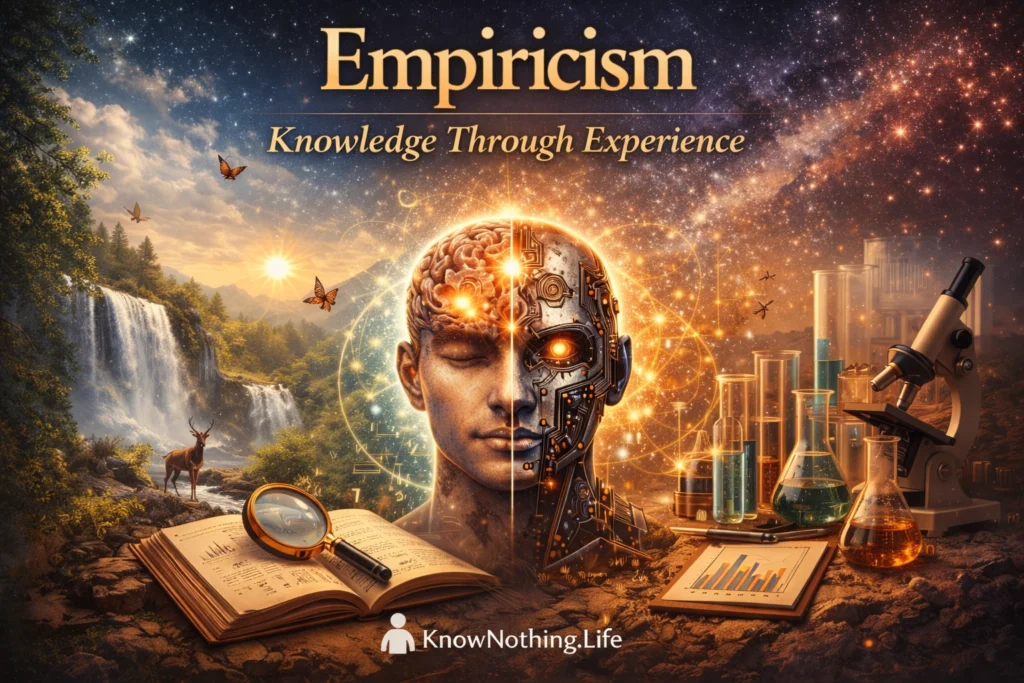
Empiricism is one of the most influential traditions in epistemology, asserting that knowledge originates primarily from sensory experience. In contrast to rationalism, which emphasizes reason and innate ideas, empiricism holds that the mind begins without content and is shaped through interaction with the world. This perspective has played a foundational role in the development of modern science, emphasizing observation, experimentation, and evidence as the basis for understanding reality.
The empiricist tradition is most closely associated with philosophers such as John Locke, George Berkeley, and David Hume. Each of these thinkers contributed to refining the idea that knowledge is grounded in experience, though they differed in how they understood the implications of this claim. Together, they formed a powerful counterpoint to rationalist theories of innate knowledge.
At its core, empiricism reflects a commitment to the observable. Rather than seeking certainty through abstract reasoning alone, empiricists argue that knowledge must be tested against experience. This approach not only shaped philosophical debates but also influenced scientific methodology, reinforcing the idea that reliable knowledge depends on empirical verification.
Locke and the Tabula Rasa
The modern empiricist tradition begins with John Locke, whose work An Essay Concerning Human Understanding provides a systematic account of how knowledge arises from experience. Locke famously rejected the notion of innate ideas, arguing instead that the mind at birth is a “tabula rasa,” or blank slate.
According to Locke, all ideas originate from two sources: sensation and reflection. Sensation provides information about the external world through the senses, while reflection involves the mind’s awareness of its own operations, such as thinking, doubting, and reasoning. Together, these processes generate the full range of human knowledge. Locke’s framework emphasizes the gradual accumulation of ideas, suggesting that knowledge is built from simple sensory inputs into more complex concepts.
Locke’s empiricism also includes a distinction between primary and secondary qualities. Primary qualities, such as shape and motion, are inherent in objects, while secondary qualities, such as color and taste, depend on the perceiver. This distinction highlights the role of perception in shaping knowledge, while also raising questions about the extent to which our experiences reflect objective reality.
Berkeley and Idealism
George Berkeley pushed empiricism in a more radical direction by questioning the existence of material substance altogether. In his work A Treatise Concerning the Principles of Human Knowledge, Berkeley argues that to be is to be perceived (esse est percipi). According to this view, objects do not exist independently of perception; rather, they consist entirely of ideas in the mind.
Berkeley’s idealism emerges from his commitment to empiricism. If all knowledge is derived from experience, and experience consists of perceptions, then there is no basis for positing an underlying material substance beyond those perceptions. This leads Berkeley to reject the distinction between appearance and reality, asserting that reality itself is constituted by what we perceive.
Despite its radical implications, Berkeley’s philosophy aims to preserve common sense by emphasizing the reliability of perception. He argues that the consistency of our experiences is guaranteed by the presence of God, who ensures that perceptions occur in a coherent and orderly manner. While many philosophers have found Berkeley’s conclusions difficult to accept, his work highlights the logical consequences of a strictly empiricist approach.
Hume and the Limits of Experience
David Hume represents the culmination of classical empiricism, offering both its most sophisticated articulation and its most profound critique. In An Enquiry Concerning Human Understanding, Hume distinguishes between impressions, which are vivid sensory experiences, and ideas, which are faint copies of those impressions.
Hume argues that all knowledge can be traced back to impressions, reinforcing the empiricist claim that experience is the foundation of understanding. However, he also exposes the limitations of this approach, particularly in relation to causation. Hume observes that we never directly perceive cause and effect; instead, we observe sequences of events and infer a connection based on habit.
This leads to one of Hume’s most famous insights: our belief in causation is not rationally justified but psychologically conditioned. As he writes, “All reasonings concerning matters of fact seem to be founded on the relation of cause and effect.” Yet this relation itself cannot be proven through reason or experience alone. Hume’s skepticism challenges the certainty of empirical knowledge, suggesting that even science rests on assumptions that cannot be fully justified.
Empiricism and Scientific Method
Empiricism has had a profound influence on the development of the scientific method. By emphasizing observation and experimentation, empiricist principles align closely with the practices of modern science. Knowledge, in this context, is not derived from abstract reasoning alone but is tested and refined through empirical evidence.
The scientific method reflects the empiricist commitment to verification and falsifiability. Hypotheses are formulated based on observations, tested through experiments, and revised in light of new data. This process ensures that knowledge remains grounded in experience and open to correction. The success of science in explaining and predicting natural phenomena has reinforced the credibility of empiricism as a theory of knowledge.
However, the relationship between empiricism and science is not without tension. Scientific theories often involve abstract concepts that are not directly observable, raising questions about how they fit within an empiricist framework. Despite these challenges, empiricism remains a guiding principle in scientific inquiry, emphasizing the importance of evidence in the pursuit of knowledge.
Critiques and Limitations of Empiricism
While empiricism offers a compelling account of how knowledge is acquired, it faces several significant challenges. One major criticism is that it struggles to account for a priori knowledge, such as mathematics and logic, which do not appear to depend on sensory experience. Rationalists argue that these forms of knowledge require innate ideas or structures that cannot be explained by empiricism alone.
Another challenge arises from the problem of induction, highlighted by David Hume. If all knowledge is based on experience, then our expectations about the future depend on past observations. Yet there is no logical justification for assuming that the future will resemble the past. This problem undermines the certainty of empirical knowledge, suggesting that it is always provisional.
Empiricism also faces difficulties in accounting for the role of interpretation in perception. Sensory experiences are not simply received passively but are shaped by cognitive processes, cultural influences, and prior knowledge. This raises questions about the extent to which experience alone can serve as a reliable foundation for knowledge.
Empiricism and Modern Philosophy
In contemporary philosophy, empiricism has evolved into more nuanced forms that incorporate insights from both philosophy and science. Logical positivism, for example, sought to ground all meaningful statements in empirical verification, though it ultimately faced significant challenges. More recent approaches recognize that knowledge arises from a combination of empirical data and conceptual frameworks.
Philosophers such as Willard Van Orman Quine have questioned the strict distinction between analytic and synthetic truths, arguing that knowledge forms a web of interconnected beliefs that is tested against experience as a whole. This perspective reflects a more holistic understanding of empiricism, one that acknowledges the complexity of knowledge formation.
Advances in cognitive science have further enriched empiricist theory by examining how the brain processes sensory information. These interdisciplinary approaches provide a deeper understanding of how experience contributes to knowledge, while also highlighting the limitations of purely empirical accounts.
Conclusion
Empiricism offers a powerful vision of knowledge as something grounded in experience. From John Locke’s tabula rasa to David Hume’s analysis of causation, the empiricist tradition has shaped our understanding of how we come to know the world. Its emphasis on observation, evidence, and experimentation remains central to both philosophy and science.
Yet empiricism also reveals the limits of knowledge, highlighting the challenges of justifying beliefs based solely on experience. As Hume’s skepticism demonstrates, even our most basic assumptions may rest on uncertain foundations. This tension between confidence and doubt continues to define the role of empiricism in epistemology.
As John Locke observed, “New opinions are always suspected, and usually opposed, without any other reason but because they are not already common.” This insight reflects the dynamic nature of knowledge, which evolves through experience and inquiry. Empiricism, with its focus on evidence and observation, remains an essential framework for understanding how knowledge is formed and refined.