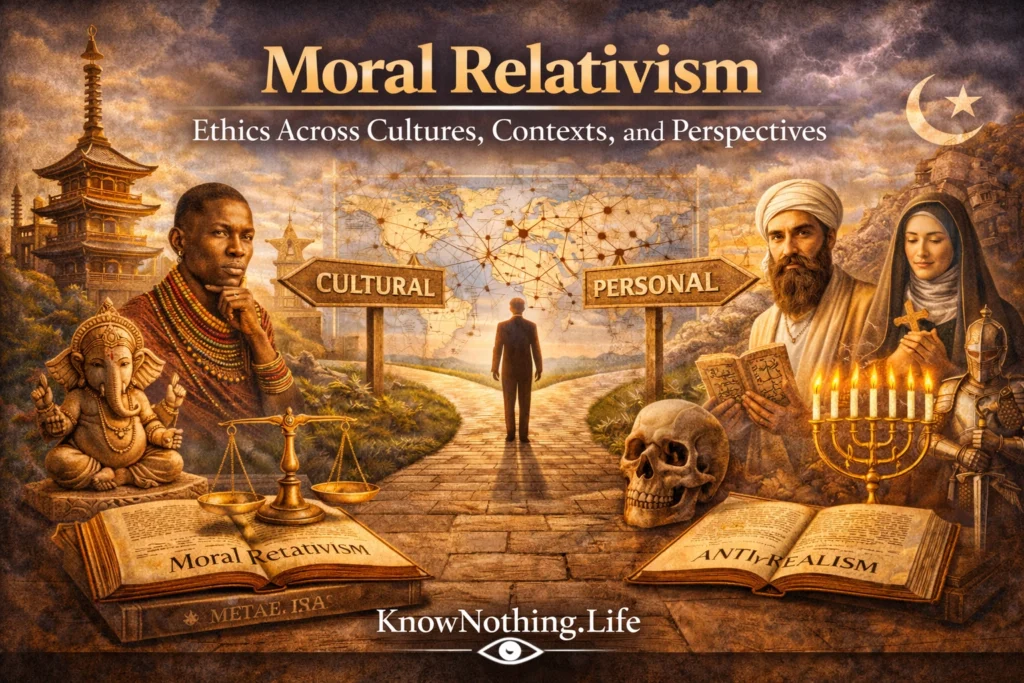
Moral relativism is the view that moral judgments are not universally true but are instead shaped by cultural, social, or individual perspectives. According to this position, there is no single, objective standard of right and wrong that applies to all people at all times. Instead, what is considered morally acceptable varies depending on context—across societies, historical periods, and even between individuals. This perspective challenges the idea of universal moral truths and invites a more pluralistic understanding of ethics.
At its core, moral relativism raises a fundamental question: are moral values discovered or created? While moral realists argue that ethical truths exist independently of human beliefs, relativists maintain that morality is constructed through social practices, traditions, and shared norms. This does not necessarily imply that “anything goes,” but it does suggest that moral judgments must be understood within their specific contexts rather than evaluated against a fixed, universal standard.
The appeal of moral relativism lies in its sensitivity to diversity and its recognition of the complexity of human societies. It encourages tolerance and openness, acknowledging that different cultures may have legitimate reasons for their moral practices. However, it also raises difficult questions about moral criticism, progress, and the possibility of resolving ethical disagreements. These tensions make moral relativism one of the most debated positions in contemporary metaethics.
Historical Roots and Philosophical Background
The origins of moral relativism can be traced to ancient philosophy, where early thinkers observed the diversity of moral customs across different societies. Herodotus famously recounted how different cultures practiced burial rites in ways that seemed strange or even shocking to outsiders. He concluded that “custom is king of all,” suggesting that moral norms are deeply rooted in cultural traditions rather than universal principles. This early insight laid the groundwork for later relativist thought.
In modern philosophy, David Hume contributed to the development of relativist ideas by emphasizing the role of sentiment in moral judgment. In A Treatise of Human Nature, Hume argued that moral distinctions arise from feelings rather than objective facts, stating that morality is “more properly felt than judged.” This perspective undermines the idea of universal moral truths by locating the source of ethics in human psychology and social interaction.
Anthropological research in the 19th and 20th centuries further reinforced relativist perspectives. Scholars such as Franz Boas and his students documented the vast diversity of cultural practices, challenging ethnocentric assumptions about morality. Their work emphasized the importance of understanding moral systems within their cultural contexts, rather than imposing external standards. This approach, often referred to as cultural relativism, has had a lasting impact on both anthropology and philosophy.
Forms of Moral Relativism
Moral relativism is not a single, unified theory but a family of related positions that differ in scope and emphasis. One of the most common forms is cultural relativism, which holds that moral standards are determined by cultural norms. According to this view, an action is right if it is approved by a given society and wrong if it is disapproved. This perspective highlights the role of social institutions, traditions, and collective values in shaping moral judgments.
Another form is individual relativism, or subjectivism, which locates moral authority within the individual rather than the culture. In this view, moral judgments are expressions of personal preferences or attitudes. What is right for one person may not be right for another, and there is no overarching standard to resolve such differences. This approach emphasizes personal autonomy but raises questions about the possibility of meaningful moral disagreement.
A more nuanced position is metaethical relativism, which asserts that the truth of moral claims is relative to a framework or standpoint. Gilbert Harman, in works such as The Nature of Morality, argued that moral judgments are dependent on implicit agreements within a society. According to Harman, there are no objective moral facts independent of these agreements, but this does not render moral discourse meaningless. Instead, it reflects the contextual nature of ethical reasoning.
Arguments in Favor of Moral Relativism
One of the strongest arguments for moral relativism is the observation of widespread moral disagreement. Across cultures and historical periods, people have held radically different views on issues such as marriage, justice, and human rights. Relativists argue that this diversity suggests the absence of a single, objective moral truth. If such a truth existed, we might expect greater convergence in moral beliefs.
Relativism also promotes tolerance and cultural understanding. By recognizing that moral values are shaped by context, it discourages the imposition of one culture’s standards on another. This is particularly important in a globalized world, where interactions between different societies are increasingly common. As Franz Boas emphasized, understanding cultural practices requires empathy and an appreciation of their internal logic.
Additionally, moral relativism aligns with insights from psychology and sociology, which show that moral beliefs are influenced by upbringing, social environment, and cognitive processes. This suggests that morality is not an objective feature of the world but a product of human experience. By acknowledging these influences, relativism offers a more flexible and context-sensitive approach to ethics.
Criticisms and Challenges
Despite its appeal, moral relativism faces significant criticisms. One of the most serious is that it undermines the possibility of moral criticism. If moral standards are entirely relative to cultures or individuals, then it becomes difficult to condemn practices such as slavery, discrimination, or oppression in other societies. Critics argue that without some form of objective standard, moral judgments lose their force and ethical progress becomes impossible.
Philosophers such as James Rachels have challenged cultural relativism by pointing out its problematic implications. In The Elements of Moral Philosophy, Rachels argues that if morality is determined solely by cultural norms, then no society can be said to be morally better or worse than another. This would mean that practices widely regarded as unjust could not be criticized if they are culturally accepted, a conclusion many find unacceptable.
Another challenge is the issue of moral disagreement within a single culture. Even within the same society, individuals often hold conflicting moral views. If morality is defined by cultural consensus, how do we account for such disagreements? This suggests that moral relativism may oversimplify the complexity of ethical life, failing to provide a satisfactory account of how moral judgments are formed and evaluated.
Moral Relativism in Contemporary Ethics
In contemporary philosophy, moral relativism continues to play a significant role, particularly in discussions of globalization, multiculturalism, and human rights. It has influenced debates about how to navigate cultural differences while respecting universal principles. Some philosophers advocate for a moderate form of relativism that acknowledges cultural diversity while maintaining certain baseline ethical standards.
In practical terms, relativism encourages dialogue and mutual understanding. It challenges individuals to examine their own assumptions and consider alternative perspectives. This can lead to more inclusive and respectful approaches to ethical issues, particularly in areas such as international relations and cross-cultural communication.
At the same time, many thinkers seek to balance relativism with a commitment to universal values. The tension between these approaches reflects the complexity of modern ethical life, where the need for global cooperation must be reconciled with respect for cultural diversity. This ongoing dialogue ensures that moral relativism remains a dynamic and evolving field of inquiry.
Conclusion
Moral relativism offers a compelling perspective on the nature of ethics, emphasizing the role of culture, context, and human experience in shaping moral judgments. Through the contributions of thinkers such as Herodotus, David Hume, Franz Boas, and Gilbert Harman, it has developed into a rich and influential tradition within metaethics.
While it faces important criticisms, particularly regarding moral criticism and progress, its emphasis on diversity and context provides valuable insights into the complexity of ethical life. It reminds us that morality is not a static set of rules but a dynamic and evolving aspect of human existence.
Ultimately, moral relativism challenges us to think critically about our own values and to engage with others in a spirit of openness and respect. Whether or not one fully embraces its conclusions, it plays a vital role in deepening our understanding of ethics and the human condition.