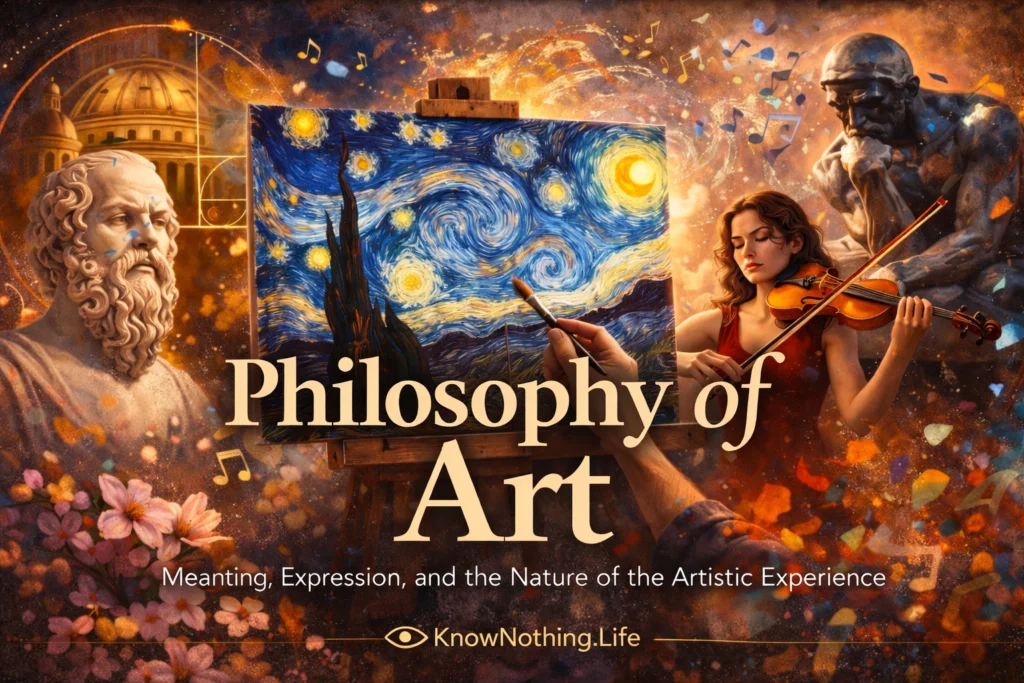
The philosophy of art seeks to understand what art is, what it does, and why it matters. While art itself appears in countless forms—painting, music, literature, film, and beyond—the philosophical questions surrounding it remain strikingly consistent. What distinguishes art from ordinary objects? Is art defined by beauty, expression, intention, or context? And how does art shape human understanding? These questions position the philosophy of art at the intersection of aesthetics, metaphysics, and cultural theory.
From ancient reflections to contemporary debates, philosophers have grappled with the elusive nature of art. Plato famously viewed art with suspicion, while Aristotle saw it as a powerful tool for emotional and intellectual engagement. Later thinkers such as Immanuel Kant and Arthur Danto expanded the discussion, exploring how art relates to perception, meaning, and interpretation.
The philosophy of art is not merely an abstract inquiry; it reflects our deepest concerns about creativity, communication, and human experience. Art has the ability to reveal truths that cannot be expressed through logic alone, offering insight into emotion, identity, and culture. To examine art philosophically is to explore how meaning is created and shared in ways that transcend ordinary language.
Classical Foundations of Art Theory
In ancient philosophy, art was often understood through the concept of imitation, or mimesis. Plato presents one of the earliest systematic critiques of art in works such as The Republic. For Plato, art is a copy of a copy—an imitation of the physical world, which itself is an imperfect reflection of the realm of Forms. As a result, art is removed from truth and has the potential to mislead or manipulate. He famously argued that poets should be excluded from the ideal state, suggesting that art’s emotional power could undermine rational judgment.
Despite his skepticism, Plato’s critique highlights the profound influence of art on human perception and belief. By questioning its value, he acknowledges its power. Art, in his view, is not trivial—it is dangerous precisely because it can shape how we understand reality. This ambivalence toward art has echoed throughout philosophical history, raising ongoing questions about its ethical and epistemological implications.
Aristotle offers a more favorable account in Poetics, where he reinterprets mimesis as a natural and valuable human activity. Rather than merely copying reality, art represents it in a structured and meaningful way. Aristotle introduces the concept of catharsis, arguing that tragedy allows audiences to experience and release emotions such as pity and fear. He writes that tragedy accomplishes “the purification of such emotions,” suggesting that art has a psychological and even therapeutic function. This perspective establishes art as a meaningful and constructive force, capable of deepening human understanding.
Art as Expression
The modern period saw a shift from imitation to expression as the defining feature of art. Rather than focusing on how art represents the external world, philosophers began to emphasize its role in conveying inner experience. Leo Tolstoy articulates this view in What Is Art?, where he argues that art is essentially the communication of emotion. According to Tolstoy, a work of art succeeds when it transmits the artist’s feelings to others, creating a shared emotional experience.
Tolstoy’s account places the audience at the center of artistic meaning. Art is not complete until it is experienced and understood by others. This relational perspective highlights the importance of empathy and connection in aesthetic experience. A painting, piece of music, or novel becomes meaningful not simply because it exists, but because it resonates with those who encounter it.
This emphasis on expression is further developed by thinkers such as Benedetto Croce and R. G. Collingwood, who argue that art is fundamentally an act of imaginative expression. For Collingwood, art is not the external object but the process of clarifying emotion through creative activity. He distinguishes true art from mere craft, suggesting that genuine artistic creation involves the discovery and articulation of feeling. This view shifts attention from the finished artwork to the inner experience of both artist and audience.
Formalism and the Structure of Art
In contrast to expressionist theories, formalist approaches focus on the intrinsic properties of artworks—their structure, composition, and aesthetic qualities. Formalists argue that what makes something art is not its emotional content or representational accuracy, but the way its elements are arranged. This perspective gained prominence in the early 20th century, particularly in the writings of critics such as Clive Bell.
Bell introduces the concept of “significant form,” suggesting that certain arrangements of lines, colors, and shapes evoke aesthetic emotion. According to this view, the value of art lies in its formal qualities rather than its subject matter or meaning. A painting does not need to depict anything recognizable to be considered art; its power comes from its ability to engage the viewer through visual relationships.
Formalism offers a way to analyze art objectively, focusing on observable features rather than subjective interpretation. However, it has been criticized for neglecting the cultural, historical, and emotional dimensions of art. While form undoubtedly plays a crucial role in aesthetic experience, it cannot fully account for the richness and diversity of artistic meaning.
Art, Interpretation, and the “Artworld”
The 20th century brought a radical rethinking of art, particularly with the rise of conceptual and avant-garde movements. Traditional definitions based on imitation, expression, or form struggled to account for works that defied conventional expectations. In response, philosophers such as Arthur Danto proposed new frameworks for understanding art.
Danto argues that what distinguishes art from non-art is not its physical appearance but its context within the “artworld.” In his essay “The Artworld,” he suggests that an object becomes art when it is interpreted within a network of theories, practices, and institutions. His famous example of identical objects—one in a gallery and one in a supermarket—illustrates that artistic status depends on meaning rather than form.
Similarly, George Dickie develops the institutional theory of art, which defines art in terms of its acceptance by the art community. According to Dickie, something is art if it is recognized as such by those operating within the artworld. These theories emphasize the role of interpretation and social context, suggesting that art is not a fixed category but a dynamic and evolving practice.
The Value and Purpose of Art
Beyond defining art, the philosophy of art also seeks to understand its value. Why do humans create and engage with art? What role does it play in society? These questions have inspired a wide range of answers, reflecting different philosophical perspectives.
For some thinkers, art has intrinsic value—it is worthwhile for its own sake, independent of practical utility. Immanuel Kant describes aesthetic experience as disinterested, meaning that it is not driven by desire or function. In this sense, art provides a unique kind of pleasure, one that is free from the constraints of everyday concerns.
Others emphasize the moral, political, or educational functions of art. Friedrich Nietzsche, for example, sees art as essential to human life, arguing that it allows us to confront and transform the harsh realities of existence. He writes, “We have art in order not to perish from the truth,” suggesting that art provides a necessary counterbalance to the demands of rationality.
Art can also serve as a form of critique, challenging social norms and encouraging reflection. From literature that exposes injustice to visual art that questions identity, artistic practices often engage with the broader cultural and political landscape. This capacity for critique underscores the enduring relevance of art in shaping human thought and experience.
Conclusion
The philosophy of art reveals that art is far more than a collection of objects or practices—it is a complex and multifaceted phenomenon that reflects the depth of human experience. From ancient theories of imitation to contemporary accounts of interpretation and context, philosophical approaches to art continue to evolve, responding to changes in culture and creativity.
What unites these perspectives is a recognition of art’s unique ability to convey meaning, evoke emotion, and inspire reflection. Whether understood as representation, expression, form, or institutional practice, art remains a central aspect of human life. It challenges us to see the world differently, to question assumptions, and to engage with ideas that extend beyond ordinary discourse.
In exploring the philosophy of art, we are ultimately exploring the nature of creativity itself—how humans create, communicate, and find meaning in the world. Art is not simply something we observe; it is something we participate in, shaping and being shaped by it in turn. Through this ongoing interaction, art continues to illuminate the possibilities of human thought and imagination.