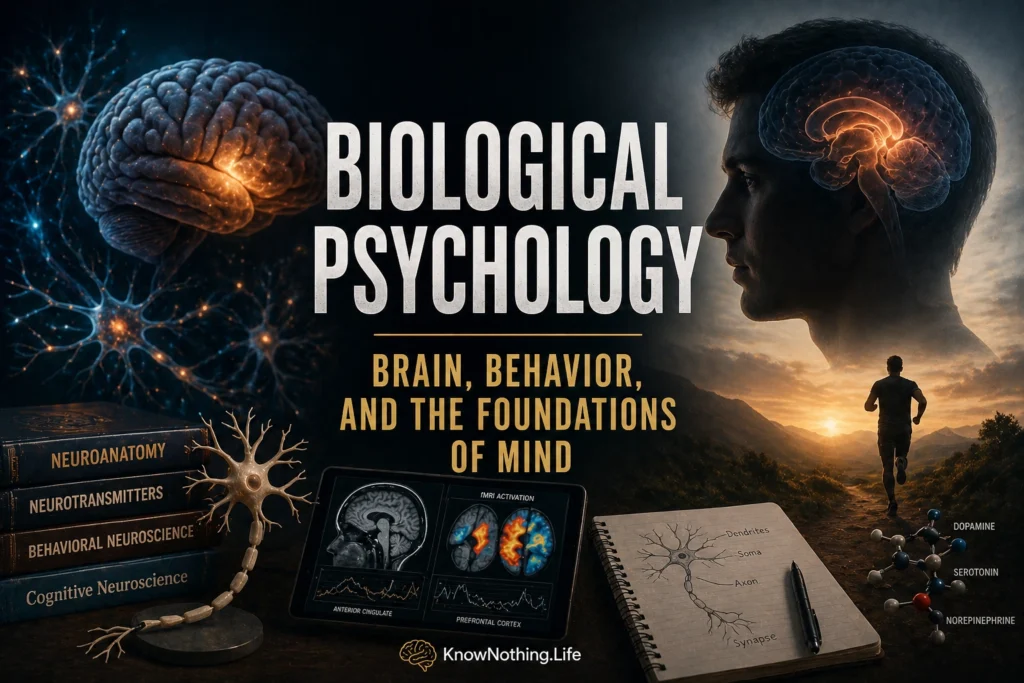
Biological psychology—often called biopsychology or behavioral neuroscience—is the study of how the brain and body give rise to behavior, cognition, and emotion. It seeks to explain psychological phenomena in terms of neural activity, genetic inheritance, and physiological processes, bridging the gap between the biological sciences and the study of the mind. In doing so, it addresses one of the oldest questions in philosophy and science: how physical matter can produce subjective experience.
The roots of biological psychology extend deep into intellectual history. Thinkers such as René Descartes proposed early models of mind–body interaction, suggesting that the brain plays a central role in mediating behavior. While Descartes maintained a dualistic view, separating mind and body, later developments in neuroscience have increasingly emphasized their unity. As neuroscientist Eric R. Kandel wrote in In Search of Memory, “All mental processes, even the most complex psychological processes, derive from operations of the brain.” This statement encapsulates the central premise of biological psychology: that understanding the brain is essential to understanding the mind.
Historical Foundations
The scientific study of the brain and behavior gained momentum in the 19th century, with advances in anatomy, physiology, and experimental methods. Early researchers such as Paul Broca and Carl Wernicke demonstrated that specific cognitive functions, such as language, are localized in particular regions of the brain. These findings challenged earlier views that mental functions were distributed uniformly, laying the groundwork for modern neuroscience.
Another key development was the work of Santiago Ramón y Cajal, who established the neuron doctrine—the idea that the nervous system is composed of discrete cells rather than a continuous network. His detailed drawings of neurons provided the first clear picture of the brain’s cellular structure, earning him recognition as one of the founders of modern neuroscience. Around the same time, Charles Darwin’s theory of evolution introduced a new framework for understanding behavior as an adaptive process shaped by natural selection.
These early contributions transformed the study of the mind from a philosophical inquiry into an empirical science. By linking mental functions to biological structures and evolutionary processes, biological psychology emerged as a field grounded in observation, experimentation, and measurement.
Neural Foundations of Behavior
At the core of biological psychology is the study of neurons and neural communication. Neurons are specialized cells that transmit information through electrical and chemical signals, forming complex networks that underlie all aspects of behavior and cognition. Each neuron consists of a cell body, dendrites that receive input, and an axon that sends signals to other cells.
Communication between neurons occurs at synapses, where neurotransmitters are released and bind to receptors on neighboring cells. Different neurotransmitters—such as dopamine, serotonin, and glutamate—play distinct roles in regulating mood, motivation, and cognition. Imbalances or disruptions in these systems are associated with various psychological conditions, highlighting the importance of neurochemical processes in mental health.
The brain itself is organized into specialized regions, each contributing to different functions. The prefrontal cortex is involved in decision-making and self-control, the amygdala in emotion and threat detection, and the hippocampus in memory formation. These regions do not operate in isolation but as part of interconnected networks, allowing for the integration of sensory, cognitive, and emotional information. As Donald Hebb proposed in The Organization of Behavior, “neurons that fire together wire together,” emphasizing the role of experience in shaping neural connections.
Genetics and Evolution
Biological psychology also examines the role of genetics in behavior. Genes provide the blueprint for the development and functioning of the nervous system, influencing traits such as temperament, intelligence, and susceptibility to mental disorders. Twin and adoption studies have demonstrated that many psychological traits have a significant genetic component, though they are always shaped by environmental factors.
The field of behavioral genetics explores how genes and environment interact to produce individual differences. Rather than determining behavior directly, genes influence the likelihood of certain outcomes, often in complex and indirect ways. This interaction is sometimes described through the concept of gene–environment interplay, which includes processes such as gene–environment correlation and epigenetic modification.
Evolutionary perspectives further enrich this understanding by examining how behaviors have been shaped by natural selection. Traits that enhance survival and reproduction are more likely to be passed on, leading to the development of adaptive behaviors and psychological mechanisms. Charles Darwin’s insight that emotional expressions are biologically rooted, as discussed in The Expression of the Emotions in Man and Animals, underscores the continuity between human and animal behavior.
Brain Plasticity and Learning
One of the most significant discoveries in biological psychology is the concept of neuroplasticity—the brain’s ability to change and adapt in response to experience. Contrary to earlier beliefs that the adult brain is fixed, research has shown that neural connections can be strengthened, weakened, or reorganized throughout life.
Learning and memory are central to this process. When individuals acquire new skills or knowledge, changes occur at the synaptic level, altering the strength of connections between neurons. Long-term potentiation (LTP), a process in which repeated stimulation enhances synaptic transmission, is one of the mechanisms underlying learning. These changes allow the brain to encode and store information, forming the basis of memory.
Neuroplasticity also plays a crucial role in recovery from injury and adaptation to new environments. For example, individuals who experience brain damage may regain lost functions through the reorganization of neural pathways. As Kandel observed, “Learning produces changes in the strength of synaptic connections,” highlighting the dynamic nature of the brain and its capacity for transformation.
Biological Bases of Mental Disorders
Biological psychology has significantly advanced the understanding of mental disorders by identifying their neural and genetic underpinnings. Conditions such as depression, schizophrenia, and anxiety disorders are associated with alterations in brain structure, neurotransmitter systems, and neural connectivity.
For example, depression has been linked to dysregulation in serotonin and other neurotransmitters, as well as changes in brain regions involved in mood regulation. Schizophrenia is associated with abnormalities in dopamine pathways and disruptions in neural connectivity, while anxiety disorders involve heightened activity in the amygdala and related circuits.
These insights have led to the development of pharmacological treatments that target specific biological mechanisms. Antidepressants, antipsychotics, and anxiolytics work by modifying neurotransmitter activity, providing relief from symptoms for many individuals. However, biological explanations alone are not sufficient, as psychological and social factors also play critical roles in the development and maintenance of mental disorders.
Methods and Technologies
The study of biological psychology relies on a range of methods and technologies that allow researchers to observe and manipulate brain activity. Neuroimaging techniques such as functional magnetic resonance imaging (fMRI) and positron emission tomography (PET) provide detailed images of brain structure and function, enabling the study of neural activity in real time.
Electrophysiological methods, including electroencephalography (EEG), measure electrical activity in the brain, offering insights into processes such as perception and attention. Advances in molecular biology and genetics have also made it possible to study the role of specific genes and proteins in behavior, further expanding the scope of the field.
Animal research has played a crucial role in biological psychology, allowing for controlled experiments that would not be possible in humans. While such research raises ethical considerations, it has provided valuable insights into the mechanisms of learning, memory, and emotion, contributing to the development of treatments for human disorders.
Conclusion
Biological psychology offers a powerful framework for understanding the relationship between the brain and behavior. By integrating insights from neuroscience, genetics, and evolutionary theory, it provides a comprehensive account of how mental processes arise from biological systems. Its contributions have transformed psychology into a more rigorous and empirically grounded science, while also deepening our understanding of the human condition.
At the same time, biological psychology does not reduce the mind to mere mechanisms. Instead, it reveals the complexity and adaptability of the brain, highlighting the interplay between biology and experience. As research continues to advance, the field will remain central to efforts to understand, treat, and enhance human behavior, bridging the gap between the physical and the psychological in the ongoing exploration of the mind.