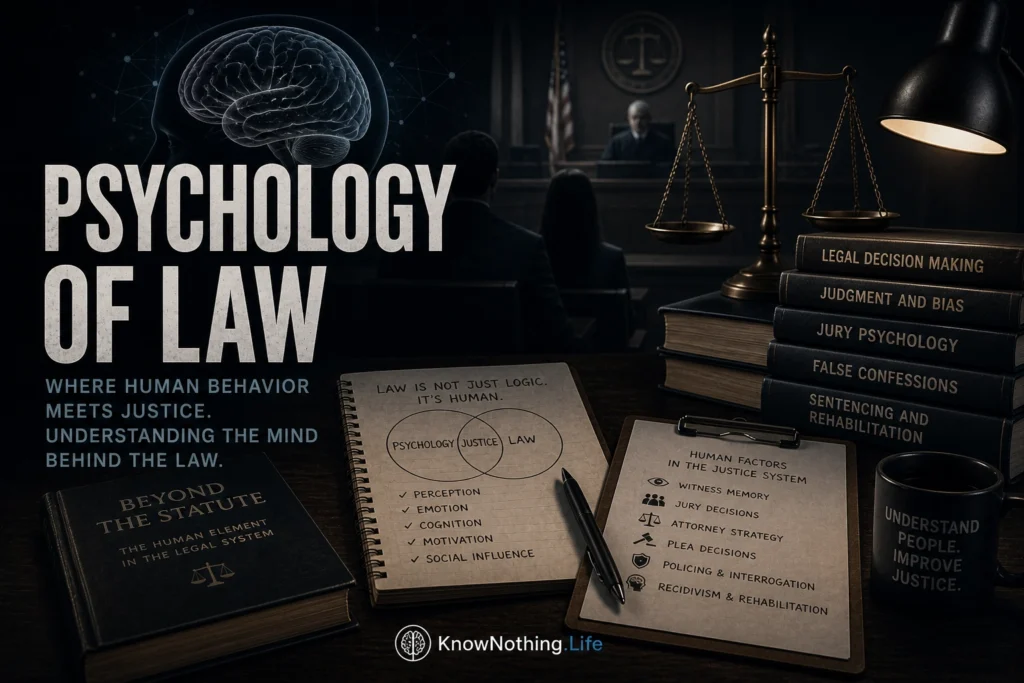
The psychology of law, often referred to as legal psychology or forensic psychology, examines how human behavior, cognition, and emotion intersect with legal systems. At its core, this field seeks to understand how individuals perceive, interpret, and respond to laws, as well as how legal institutions influence decision-making. While the law aspires to objectivity and rationality, psychological research reveals that human judgment is frequently shaped by biases, heuristics, and social influences. This tension between legal ideals and psychological realities lies at the heart of the discipline.
The emergence of the psychology of law as a formal field can be traced to early twentieth-century thinkers such as Hugo Münsterberg, whose controversial book On the Witness Stand (1908) argued that psychological science should play a central role in legal proceedings. Münsterberg challenged the legal establishment by asserting that courts often overestimate the reliability of human perception and memory. Although his ideas were initially met with resistance, they laid the groundwork for later integration of psychology into legal contexts. As he wrote, “The law has not kept step with modern psychology.”
Today, the psychology of law encompasses a wide range of topics, including eyewitness testimony, jury decision-making, criminal behavior, and the effectiveness of legal procedures. By applying empirical methods to legal questions, researchers aim to improve the fairness, accuracy, and efficiency of justice systems. This article explores the cognitive, social, and institutional dimensions of law through a psychological lens, highlighting key theories, research findings, and implications for reform.
Cognitive Processes in Legal Decision-Making
Legal systems rely heavily on human judgment, from police officers making arrests to jurors delivering verdicts. These decisions are often assumed to be rational and evidence-based, yet cognitive psychology demonstrates that they are frequently influenced by mental shortcuts known as heuristics. The work of Daniel Kahneman and Amos Tversky in Judgment under Uncertainty: Heuristics and Biases (1974) revealed that individuals rely on intuitive processes that can lead to systematic errors.
One such bias is the availability heuristic, where people estimate the likelihood of an event based on how easily examples come to mind. In legal contexts, this can influence how jurors assess the probability of guilt or innocence, especially when vivid or emotionally charged evidence is presented. Similarly, the representativeness heuristic may lead individuals to judge a defendant’s guilt based on how closely they match a stereotype of a criminal, rather than on objective evidence. Kahneman later summarized these tendencies in Thinking, Fast and Slow (2011), noting that “we are prone to overestimate how much we understand about the world.”
Another important cognitive factor is confirmation bias—the tendency to seek and interpret information in ways that confirm existing beliefs. Once investigators form an initial theory about a suspect, they may unconsciously prioritize evidence that supports that theory while overlooking contradictory information. This bias can affect not only law enforcement but also jurors, judges, and attorneys, shaping the interpretation of evidence throughout the legal process. Understanding these cognitive processes is essential for identifying sources of error and improving decision-making within the justice system.
Social Influence and Jury Behavior
Juries are central to many legal systems, serving as a collective body tasked with evaluating evidence and determining verdicts. While the ideal jury is impartial and rational, social psychology reveals that group dynamics can significantly influence decision-making. Research by Solomon Asch on conformity demonstrated that individuals often align their opinions with those of a majority, even when the majority is clearly incorrect. In a jury setting, this pressure can lead dissenting members to conform to the dominant viewpoint.
Group polarization is another phenomenon that affects jury deliberations. Studies have shown that discussions within a group can lead members to adopt more extreme positions than they initially held. This means that a jury leaning slightly toward conviction may become more convinced of guilt after deliberation, while a jury leaning toward acquittal may become more resolute in that direction. These dynamics highlight the importance of structured deliberation processes that encourage critical evaluation rather than conformity.
The influence of authority and persuasion also plays a role in courtroom settings. Attorneys use rhetorical strategies, emotional appeals, and narrative framing to shape how evidence is perceived. Jurors, in turn, may be influenced by factors such as the credibility of witnesses, the confidence of attorneys, and even the physical appearance of defendants. As Robert Cialdini explains in Influence: The Psychology of Persuasion (1984), human decision-making is deeply affected by social cues, including authority, consistency, and social proof. These insights underscore the need to consider not only the evidence presented in court but also the social context in which decisions are made.
Eyewitness Testimony and Memory
One of the most extensively studied areas within the psychology of law is eyewitness testimony. As discussed in the work of Elizabeth Loftus, memory is not a passive recording of events but an active, reconstructive process. In her book Eyewitness Testimony (1979), Loftus demonstrated that memories can be altered by suggestion, language, and post-event information, raising serious concerns about the reliability of eyewitness accounts.
The misinformation effect, first identified by Loftus and John Palmer, shows how easily memory can be distorted. Participants exposed to misleading questions often incorporate false details into their recollections, believing them to be accurate. This has significant implications for legal proceedings, where witnesses are frequently questioned multiple times and may be exposed to new information. As Loftus observed, “People’s memories can be changed by the wording of questions.”
Eyewitness identification procedures also present challenges. Research by Gary Wells has shown that traditional lineup methods can lead to misidentification, particularly when they encourage relative judgment. Reforms such as sequential lineups and double-blind administration have been proposed to reduce error. Despite these advancements, mistaken eyewitness testimony remains a leading cause of wrongful convictions, highlighting the need for continued integration of psychological research into legal practice.
Criminal Behavior and Responsibility
Understanding criminal behavior is another central concern of the psychology of law. Psychologists seek to identify the factors that contribute to unlawful actions, including biological, psychological, and social influences. The work of Sigmund Freud, although controversial, introduced the idea that unconscious drives and conflicts can shape behavior. Later theories, such as those proposed by Albert Bandura, emphasized the role of social learning in the development of aggression and criminal conduct.
Bandura’s Social Learning Theory suggests that individuals learn behaviors through observation and imitation, particularly when those behaviors are rewarded. This perspective helps explain how exposure to violence, whether in the home or in media, can influence criminal behavior. Bandura famously argued that “most human behavior is learned observationally through modeling.” Such insights have informed interventions aimed at reducing crime by addressing environmental and social factors.
The question of responsibility is closely tied to psychological understandings of behavior. Legal systems must determine whether individuals have the capacity to understand and control their actions, particularly in cases involving mental illness. The insanity defense, for example, relies on assessments of cognitive and emotional functioning. Psychologists play a crucial role in evaluating defendants and providing expert testimony, bridging the gap between scientific knowledge and legal standards.
Legal Procedures and Reform
The integration of psychology into law has led to significant reforms aimed at improving the accuracy and fairness of legal processes. One notable example is the increasing use of expert testimony to educate jurors about psychological phenomena such as memory distortion and bias. Courts have also begun to adopt evidence-based practices in areas such as eyewitness identification and interrogation techniques.
Interrogation methods have come under particular scrutiny, with research highlighting the risk of false confessions. Studies by Saul Kassin have shown that certain techniques, such as prolonged questioning and the presentation of false evidence, can lead innocent individuals to confess. Kassin noted that “the evidence indicates that people can be induced to confess to crimes they did not commit.” These findings have prompted calls for reforms, including the recording of interrogations and the use of less coercive methods.
The legal system continues to evolve as it incorporates psychological insights. However, challenges remain in translating research into practice. Differences in legal standards, resistance to change, and the complexity of human behavior all pose obstacles. Ongoing collaboration between psychologists, legal professionals, and policymakers is essential for ensuring that the justice system reflects the best available scientific knowledge.
Conclusion
The psychology of law reveals that legal systems are deeply intertwined with human cognition, emotion, and social interaction. Far from being purely rational, legal decision-making is shaped by biases, group dynamics, and the limitations of memory. Research by scholars such as Daniel Kahneman, Elizabeth Loftus, and Gary Wells has provided critical insights into these processes, challenging traditional assumptions about the reliability of human judgment.
The implications of this research are profound. By recognizing the psychological factors that influence legal outcomes, it becomes possible to design procedures that reduce error and promote fairness. From improving eyewitness identification to reforming interrogation practices, the integration of psychology into law offers a path toward a more just and effective system. As the field continues to develop, its central lesson remains clear: understanding the human mind is essential for understanding the law.