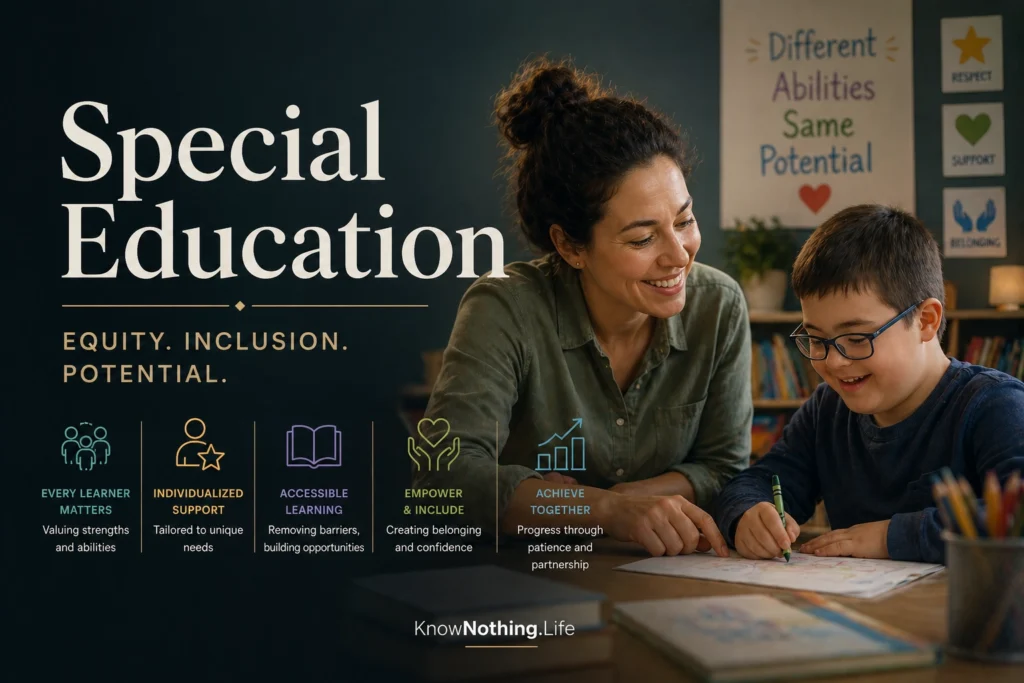
Special education is a field dedicated to supporting learners with diverse needs by providing tailored instruction, accommodations, and services that enable meaningful participation in education. It encompasses a wide range of conditions, including learning disabilities, developmental disorders, physical impairments, and emotional or behavioral challenges. The goal of special education is not merely to remediate deficits but to create equitable learning opportunities that allow all students to reach their potential. This commitment reflects a broader shift in education toward inclusion, recognizing that diversity in ability is a natural and valuable aspect of human variation.
The development of special education has been shaped by both scientific research and social advocacy. Historically, individuals with disabilities were often excluded from formal education, but this began to change in the 20th century with growing recognition of their rights and capacities. As educator Maria Montessori observed, “The child is both a hope and a promise for mankind,” emphasizing the importance of nurturing every learner’s potential. Today, special education is grounded in principles of equity, accessibility, and individualized support, reflecting a commitment to meeting students where they are.
Historical Foundations and Legal Frameworks
The evolution of special education is closely tied to broader social movements advocating for civil rights and inclusion. In many countries, legislation has played a crucial role in ensuring access to education for students with disabilities. In the United States, laws such as the Individuals with Disabilities Education Act (IDEA) established the right to a free and appropriate public education, requiring schools to provide individualized services tailored to each student’s needs.
These legal frameworks introduced key concepts such as the Individualized Education Program (IEP), which outlines specific goals, accommodations, and support services for each student. The principle of the least restrictive environment (LRE) further emphasizes that students with disabilities should be educated alongside their peers whenever possible. As scholar Mel Ainscow has argued, “Inclusion is not about placing students in classrooms, but about transforming systems to respond to diversity.” This perspective highlights that special education is not only about individual support but also about systemic change.
Theories and Approaches in Special Education
Special education draws on a variety of theoretical frameworks to understand and support diverse learners. Behaviorist approaches, influenced by B. F. Skinner, emphasize the use of reinforcement and structured interventions to shape behavior and build skills. These methods have been particularly effective in addressing behavioral challenges and teaching foundational skills.
Cognitive and constructivist theories, such as those developed by Jean Piaget and Lev Vygotsky, highlight the importance of developmental stages and social interaction in learning. Vygotsky’s concept of the zone of proximal development is especially relevant in special education, as it underscores the importance of providing appropriate support to help learners achieve beyond their current capabilities. These theoretical perspectives inform a range of instructional strategies, from structured teaching to collaborative learning.
Individualized Instruction and Differentiation
One of the defining features of special education is its emphasis on individualized instruction. Recognizing that students have unique strengths, challenges, and learning profiles, educators design tailored approaches to meet each learner’s needs. This often involves adapting content, modifying teaching methods, and providing specialized resources or technologies.
Differentiated instruction, advocated by Carol Ann Tomlinson, extends this principle to all learners, emphasizing flexibility in teaching. Tomlinson argues that “students learn best when teachers respond to their readiness, interests, and learning profiles,” a principle that is central to special education. Individualization not only improves academic outcomes but also supports self-confidence and engagement, enabling students to take an active role in their learning.
Inclusion and Inclusive Education
Inclusion has become a central goal of special education, reflecting the belief that students with disabilities should be educated alongside their peers in general education settings whenever possible. Inclusive education is not simply about physical placement; it involves creating environments that are accessible, supportive, and responsive to diverse needs. This requires collaboration among teachers, specialists, and families, as well as a commitment to adapting instruction and resources.
Research has shown that inclusive education can benefit both students with disabilities and their peers by promoting social interaction, empathy, and a sense of community. However, successful inclusion depends on adequate support, training, and resources. As education researcher Thomas Hehir has noted, “Inclusion works when schools are designed to meet the needs of all students,” emphasizing that systemic change is essential for effective implementation.
Assistive Technology and Accessibility
Advances in technology have significantly expanded the possibilities for supporting learners with disabilities. Assistive technologies, such as speech-to-text software, screen readers, and communication devices, enable students to access information and participate more fully in learning. These tools can compensate for specific challenges, allowing students to demonstrate their abilities in ways that might otherwise be difficult.
Universal Design for Learning (UDL), developed by David H. Rose and colleagues, provides a framework for creating accessible learning environments from the outset. UDL emphasizes providing multiple means of representation, engagement, and expression, ensuring that all students can access and participate in learning. This approach shifts the focus from adapting to individual needs to designing environments that accommodate diversity. As Rose has argued, “The curriculum, not the learner, is the primary source of barriers,” highlighting the importance of inclusive design.
Social and Emotional Dimensions
Special education also addresses the social and emotional needs of learners, recognizing that these factors are closely linked to academic success. Students with disabilities may face challenges related to self-esteem, social interaction, and emotional regulation, which can impact their learning experiences. Supporting these dimensions requires a holistic approach that integrates academic and emotional development.
Programs focused on social-emotional learning (SEL) have been shown to improve outcomes for students with diverse needs. Psychologist Daniel Goleman has emphasized the importance of emotional intelligence, noting that “emotional competencies are twice as important as cognitive abilities in determining success.” By fostering skills such as empathy, self-awareness, and resilience, educators can help students navigate challenges and build positive relationships.
Collaboration and Family Involvement
Collaboration is a cornerstone of effective special education, involving partnerships among educators, specialists, families, and communities. Teachers often work with speech therapists, occupational therapists, psychologists, and other professionals to provide comprehensive support. This interdisciplinary approach ensures that multiple perspectives are considered in addressing each student’s needs.
Family involvement is particularly important, as parents and caregivers play a critical role in supporting learning and advocating for their children. Effective communication and collaboration between schools and families can enhance outcomes and ensure consistency across environments. As researcher Joyce Epstein has noted, “When schools, families, and communities work together, students benefit,” highlighting the importance of shared responsibility in education.
Challenges and Future Directions
Despite significant progress, special education continues to face challenges, including disparities in access, funding limitations, and the need for ongoing professional development. Ensuring that all students receive high-quality support requires sustained commitment and innovation. Additionally, there is growing recognition of the need to address intersectionality, considering how factors such as race, socioeconomic status, and culture intersect with disability.
The future of special education is likely to be shaped by advances in neuroscience, psychology, and inclusive practices. Personalized learning, data-driven interventions, and expanded use of assistive technologies offer new opportunities for supporting diverse learners. At the same time, there is increasing emphasis on creating inclusive systems that benefit all students, rather than treating special education as a separate domain. This shift reflects a broader vision of education as a space where diversity is embraced and supported.
Conclusion
Special education represents a commitment to equity and inclusion, ensuring that all learners have the opportunity to succeed. By combining individualized support with inclusive practices, it addresses the diverse needs of students and promotes meaningful participation in education. Drawing on a range of theories and approaches, special education continues to evolve in response to new research and societal changes.
Ultimately, the goal of special education is not only to support students with disabilities but to transform educational systems to be more responsive to diversity. By embracing this vision, educators can create environments that empower all learners, fostering growth, independence, and a sense of belonging.