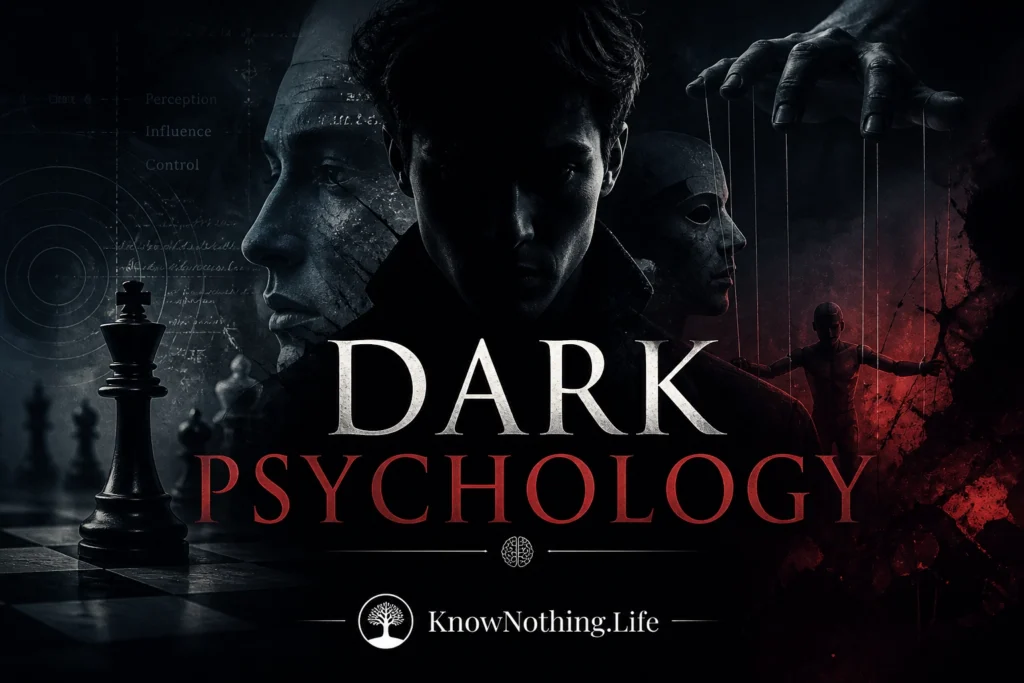
Dark psychology refers to the study of human behavior that seeks to manipulate, control, or exploit others for personal gain. While mainstream psychology often focuses on healing, growth, and understanding, dark psychology examines the mechanisms of deception, coercion, persuasion, and emotional dominance. It is not a formal academic discipline with a single accepted framework, but rather an umbrella term that draws from personality psychology, criminology, social psychology, behavioral science, and studies of persuasion. At its core lies a difficult truth: the same mental systems that make empathy, trust, and cooperation possible can also be turned toward control, deception, and abuse.
The fascination with the darker side of human behavior is ancient. Political philosophers, religious thinkers, playwrights, and psychologists have all tried to understand why some people exploit others and why manipulation can be so effective. Niccolò Machiavelli’s The Prince remains one of the most famous works associated with strategic power, especially his warning that a ruler must learn “how not to be good” when political survival requires it. In modern psychology, the subject has become more empirical through the study of personality traits, coercive control, antisocial behavior, propaganda, persuasion, and emotional abuse.
The Dark Triad
One of the most influential frameworks related to dark psychology is the Dark Triad, a term introduced by Delroy Paulhus and Kevin Williams in their 2002 paper “The Dark Triad of Personality.” The Dark Triad includes narcissism, Machiavellianism, and psychopathy. Each trait reflects a different pattern of self-centeredness, emotional detachment, and interpersonal exploitation. Narcissism is marked by grandiosity, entitlement, and hunger for admiration. Machiavellianism involves strategic manipulation, cynicism, and a willingness to use people as instruments. Psychopathy is associated with impulsivity, shallow emotion, fearlessness, and lack of remorse.
These traits are not identical, but they overlap in their disregard for others. A narcissistic person may manipulate to protect an inflated self-image. A Machiavellian person may manipulate patiently and strategically to gain advantage. A psychopathic person may manipulate recklessly, without guilt or emotional concern. Robert D. Hare, author of Without Conscience, describes psychopathic individuals as socially predatory people who may charm, deceive, and exploit while appearing normal on the surface. His famous observation that psychopaths can use words without emotional depth captures one of the most disturbing features of dark personality: the ability to imitate feeling without being guided by it.
The Dark Triad matters because it explains why some individuals can be socially effective in the short term while being destructive in the long term. Charm, confidence, fearlessness, and strategic coldness can help someone gain influence quickly. In workplaces, relationships, politics, and social groups, these traits may initially appear as charisma or strength. Over time, however, the pattern often becomes clearer: broken trust, unstable relationships, exploitation, blame-shifting, and moral damage.
Manipulation and Persuasion
Manipulation works by influencing another person’s thoughts, emotions, or choices while hiding the manipulator’s true intention. Persuasion is not always unethical; people persuade one another constantly through argument, teaching, advertising, leadership, and conversation. The difference lies in honesty, consent, and respect for autonomy. Ethical persuasion allows the other person to think clearly and choose freely. Manipulation pressures, deceives, confuses, or emotionally corners the target.
Robert Cialdini’s Influence: The Psychology of Persuasion is one of the most important works for understanding how influence operates. Cialdini identified principles such as reciprocity, scarcity, authority, social proof, liking, commitment, and consistency. These principles are not inherently dark, but they can be weaponized. A manipulator may create false scarcity to rush a decision, use fake authority to silence doubt, or exploit social proof by making a target believe “everyone else” agrees. The person being influenced may feel as though they are choosing freely, while their environment has been carefully arranged to narrow their options.
Dark psychology often relies on emotional leverage rather than direct force. Guilt, fear, shame, affection, flattery, confusion, and urgency can all become tools of control. A manipulator may flatter someone intensely, then withdraw approval to create insecurity. They may present themselves as a victim to avoid accountability. They may accuse others of the very behavior they are committing, a tactic commonly called projection. The aim is not simply to win an argument, but to shape the target’s emotional reality.
Gaslighting and Reality Control
Gaslighting is one of the most widely discussed forms of psychological manipulation. The term comes from the play Gas Light, later adapted into film, in which a husband manipulates his wife into doubting her own perceptions. In modern usage, gaslighting refers to a pattern of denial, distortion, contradiction, and blame that causes someone to question their memory, judgment, or sanity. It is especially damaging because it attacks the foundation of self-trust.
A gaslighter may deny things that clearly happened, insist that the victim is “too sensitive,” rewrite past events, or turn reasonable concerns into evidence of instability. Over time, the target may begin relying on the manipulator to define reality. This is why gaslighting is often connected with coercive control. It does not merely influence behavior; it weakens the person’s confidence in their own mind. Once self-trust is damaged, resistance becomes harder.
The psychoanalyst Erich Fromm explored related themes in Escape from Freedom, where he argued that people may surrender autonomy when freedom becomes frightening or overwhelming. His insight helps explain why manipulation can become psychologically binding. When someone has been repeatedly confused, punished, or destabilized, the promise of certainty from the manipulator can feel like relief. The person may cling to the very source of harm because it has become the center of their emotional world.
Cognitive Bias and Vulnerability
Dark psychology is effective because human beings are not purely rational. We rely on mental shortcuts, emotional reactions, and social cues. Daniel Kahneman’s Thinking, Fast and Slow describes two broad modes of thought: fast, intuitive thinking and slower, analytical reasoning. Manipulative tactics often target the fast system. They create urgency, fear, attraction, or pressure so that the target reacts before reflecting.
Confirmation bias is one common vulnerability. People tend to notice information that supports what they already believe and ignore information that challenges it. A manipulator can exploit this by feeding someone selective evidence, reinforcing suspicion, or framing events in a way that confirms the target’s fears. The availability heuristic also plays a role: dramatic, recent, or emotionally vivid information feels more important than it may actually be. This is why propaganda and fear-based messaging often use striking stories rather than balanced evidence.
The need for belonging is another major vulnerability. Human beings are deeply social creatures. Rejection, isolation, and shame can feel psychologically threatening. Manipulators exploit this by offering approval conditionally. They may reward obedience with affection and punish independence with withdrawal. This pattern resembles intermittent reinforcement, a concept associated with behaviorist psychology. B. F. Skinner’s work on reinforcement showed that inconsistent rewards can create persistent behavior. In relationships, unpredictable affection can make a person more attached, not less, because they keep chasing the return of approval.
Power, Control, and Social Systems
Dark psychology does not exist only in private relationships. It also appears in groups, institutions, and political systems. Propaganda, cult dynamics, authoritarian leadership, abusive workplaces, and exploitative marketing can all use psychological influence to shape belief and behavior. When manipulation becomes systemic, it can feel normal because everyone inside the system is pressured to accept its rules.
Edward Bernays, author of Propaganda, argued that the “conscious and intelligent manipulation” of public habits and opinions played a major role in modern society. Bernays saw public relations as a powerful tool for organizing mass behavior, but his work also reveals the ethical danger of influence at scale. When leaders, advertisers, or institutions understand how to direct attention and emotion, they can shape public reality without appearing coercive. The boundary between communication and manipulation becomes especially important when audiences lack transparency about who is influencing them and why.
Michel Foucault’s work on power is also relevant. In Discipline and Punish, Foucault examined how modern societies produce obedience not only through violence, but through surveillance, classification, and internalized discipline. His famous analysis of the Panopticon shows that people may regulate themselves when they believe they are being watched. Dark psychology at the social level often works this way: it does not always need direct threats. It can operate by shaping what people fear, desire, repeat, and believe is possible.
The Ethics of Dark Psychology
The study of dark psychology creates a moral problem. Learning about manipulation can help people defend themselves, recognize abuse, and resist coercion. At the same time, the same knowledge can be misused. A person can study influence to communicate better, or to exploit weakness more efficiently. The ethical question is not only what the tactic is, but what intention guides it and what effect it has on another person’s freedom.
Immanuel Kant’s moral philosophy offers a strong objection to manipulation. In Groundwork of the Metaphysics of Morals, Kant argues that human beings should be treated as ends in themselves, never merely as means. Manipulation violates this principle because it uses another person’s mind as an instrument. Even if the outcome benefits the manipulator, the target’s dignity is reduced because their ability to choose freely has been bypassed or distorted.
Friedrich Nietzsche complicates the picture. In Beyond Good and Evil, he challenges simple moral categories and examines the role of power in human values. Nietzsche does not excuse cruelty, but he forces readers to confront the fact that morality, influence, and power are often intertwined. Dark psychology exists in this uncomfortable space. It reveals that human behavior cannot always be understood through innocence and reason alone; ambition, resentment, fear, domination, and desire for control are also part of the human story.
Protection and Psychological Resistance
The best defense against dark psychology begins with awareness. A person who can identify manipulation is less likely to be controlled by it. Warning signs include repeated boundary violations, pressure to decide quickly, isolation from outside perspectives, constant blame reversal, emotional punishment, excessive flattery followed by withdrawal, and confusion after conversations. A healthy relationship usually increases clarity and stability. A manipulative one often produces anxiety, self-doubt, and dependency.
Boundaries are essential because manipulation often escalates gradually. The manipulator tests small limits before pushing larger ones. Clear boundaries interrupt this process. Saying no, asking for time to think, documenting important interactions, and seeking outside feedback can restore perspective. Trusted friends, therapists, mentors, or support groups can help counteract the isolation that manipulators often create.
Psychological resistance also depends on self-trust. People become more vulnerable when they are exhausted, lonely, ashamed, or desperate for approval. Strengthening emotional regulation, critical thinking, and self-respect makes manipulation less effective. Dark psychology feeds on confusion and dependency; clarity and independence weaken it. The goal is not to become suspicious of everyone, but to become harder to control.
Final Thoughts
Dark psychology is the study of the mind’s shadow side: manipulation, coercion, deception, and the pursuit of power without regard for another person’s autonomy. It draws from the work of thinkers such as Machiavelli, Cialdini, Kahneman, Hare, Bernays, Foucault, Kant, Nietzsche, and Fromm because each helps explain a different part of the problem. Some reveal the mechanics of influence. Others expose the moral danger of using people as tools.
The subject is uncomfortable because it shows that harmful influence is not always obvious. It can appear as charm, concern, leadership, romance, expertise, or social belonging. It can occur in private relationships or public institutions. It can be impulsive and cruel, or patient and strategic. What makes it dark is not intelligence itself, but the decision to use psychological insight against another person’s freedom.
Studying dark psychology should not make people cynical; it should make them discerning. Human beings are capable of manipulation, but they are also capable of honesty, empathy, courage, and moral restraint. To understand darkness is not to surrender to it. It is to see more clearly where power hides, how control operates, and why protecting human dignity begins with protecting the freedom of the mind.